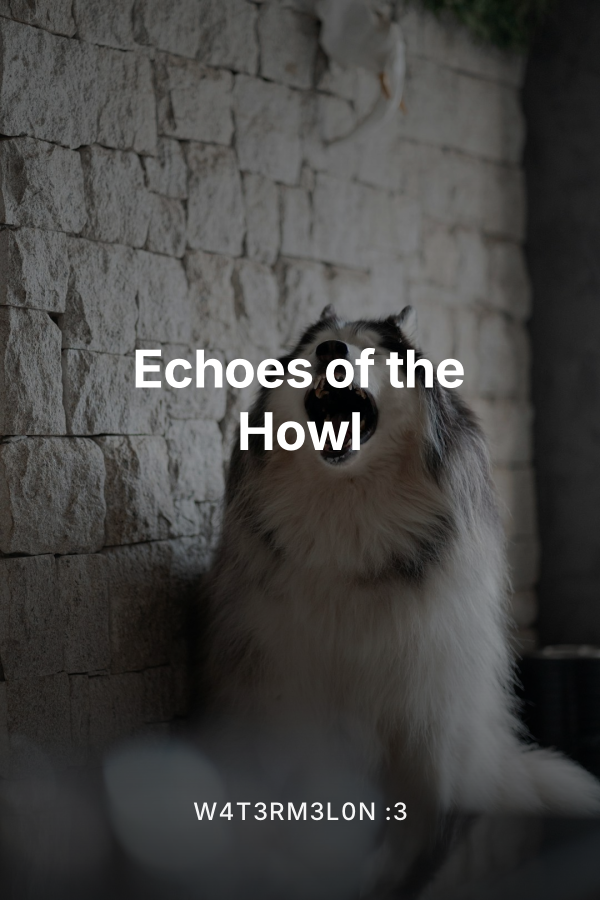
Raven and Arlo have survived by staying invisible. It is the only way to live in a world carved open by the howlers.
Raven watches everything. Quiet. Introverted. Always three steps back from anyone new. His gift is in the shadows. He moves without sound, slips through ruined streets, reads the smallest twitch in a stranger’s face. Emotion is a language he decodes in a heartbeat. Trust is something he has almost forgotten how to feel.
Arlo is the wall between Raven and the world. Strong. Fast to anger. Quicker to put himself in the line of fire. His temper is a weapon he barely controls, and under it sits one brutal fear. Losing Raven. The thought alone makes his hands shake.
They are both twenty. Too young for the kind of scars they carry. Old enough to know there is no one coming to save them.
The howlers used to be human. Now they hunt in packs, throats torn raw from inhuman screams. At night their cries bounce off broken towers and empty highways. No one knows if they are a virus, a weapon, or something older that woke up angry. The only thing that matters is this. If a howler gets too close, you do not just die. It tries to get inside your mind.
Raven and Arlo have learned the rules. Keep moving. Stay low. Avoid the government patrols that sweep the ruins. People vanish when soldiers arrive. Sometimes the howlers follow those same patrol routes. Like they are being herded.
The story opens on a raid that should be simple. One night. One ruined market. Supplies in. Supplies out. No heroics.
Raven slips into the shell of a supermarket, nerves electric. Arlo waits on the second floor with a rifle and a short fuse. Their routine is honed and tight. It keeps them alive.
Then the routine fractures.
Raven spots movement where there should be none. Not a howler. A person. Bleeding. Running. Behind the stranger comes a double threat. A swarm of howlers and a squad of black armored soldiers, moving with terrifying coordination. The patrol is not hunting howlers. It is driving them.
Raven could pull back. Arlo could walk away. Survival demands it. Instead Arlo’s fear spikes at the thought of Raven trapped between both forces. His anger explodes into action. They break cover to save the stranger.
That choice detonates their quiet life.
The stranger is a courier. He carries a cracked data drive and half-coherent warnings about something called Project Siren. A forbidden lab where the first howlers were made. A place that might still hold a cure. Or a control switch. Or something worse. The soldiers want that drive. So do the howlers.
When the courier dies of his wounds, the problem becomes theirs. The soldiers mark them as targets. The howlers begin to follow their scent. Everywhere they run, the world narrows to a single point. The lab.
Chapter One is a relentless chase through the dead city. Raven and Arlo scramble across collapsed rooftops, dive through flooded subways, weave between howler packs that move too deliberately to be random. Raven’s instincts pick up patterns. The monsters avoid certain streets. They react to distant signals that only they can hear.
Arlo’s anger keeps them alive in close calls. It also draws danger. A snapped shout here. A reckless charge there. Every flare-up risks exposing them to patrol drones and hungry throats. His terror of losing Raven drives him harder, and the harder he pushes, the closer he skids to the edge of control.
They reach the edge of the city with the drive and a trail of bodies behind them. The only way forward leads into territory no sane survivor enters. Government exclusion zones. Old research compounds. Places where even the howlers do not howl.
In Chapter Two the focus shifts to the journey. Roads crumble into wasteland. Silence thickens. The sky itself feels watched.
Raven’s trust issues become a liability. Every stranger looks like a potential betrayer. Every offer of help feels like a trap. When they stumble into a hidden survivor enclave, Raven studies every face, every flicker of fear, every forced smile. His emotion reading gift uncovers something rotten. The enclave is not just hiding from howlers. It is hiding a deal with the soldiers.
Arlo wants to smash through the lies. He does not see details the way Raven does. He sees patterns in threats. Weapons. Angles of attack. The more he senses the enclave’s duplicity, the closer he edges to an outburst that could ignite open conflict.
In the enclave they learn the first hard truth. The government never stopped working with the howlers. They are trying to control them. Harness them. At the heart of that effort is the lab from the courier’s drive. Survivors whisper about experiments that went too far, test subjects that still walk the night, and a scientist whose name keeps surfacing like a curse. Silas.
That night, hidden radios crackle to life. An illicit broadcast cuts through the static. A voice urges survivors to find proof of the government’s crimes. To expose the controlled infected being used as weapons. There is mention of a symbol. A broken circle engraved on old lab doors and soldier armor alike. Raven has seen that symbol in his nightmares.
Memories inside him buckle. Fragmented images flash. A white corridor. A locked room. Screams that never echo. Someone calling his name through a speaker.
The lab is no longer just a potential cure. It might be connected to Raven’s own past.
They escape the enclave after a tense standoff with soldiers and a tethered howler that seems almost obedient. During the clash, Raven catches the creature staring at him with a flicker of recognition. It does not attack. It shudders, claws at its own skull, then bolts.
The encounter leaves a mark. If howlers can be controlled, they can also be turned. Or corrupted. Or used. The moral lines blur. Killing them might mean killing people who are still trapped inside.
Chapter Two tightens the screws. Food runs low. Sleep vanishes. The drive begins to glitch. Files appear in broken fragments, hinting at neural interfaces and psychic resonance, at attempts to bridge human thought and howler instinct.
Along the way, Raven and Arlo grow more divided and more bonded at once. Raven hates secrets, yet keeps his resurfacing memories to himself. Arlo feels Raven slipping emotionally out of reach and reacts with volatile protectiveness. Their arguments crackle with fear rather than anger. Every fight ends with the same underlying dread. One of them will die first. The other will be left alone in a world that eats the lonely.
Chapter Three moves entirely inside the lab.
They locate it behind a camouflaged barricade, sunken into a ravine choked with rusted vehicles and silent drones. The broken circle symbol is carved above the entrance, just like in Raven’s flashes. The air tastes of rust and ozone. No birds call. No howlers scream.
Inside, the lab is a maze of dead lights and fossilized horror. Glass cages with claw marks on the inside. Straps worn smooth by desperate wrists. Soundproof walls and drains cut into the floor.
As they push deeper, the drive syncs with the remaining power grid. Systems wake. Security shutters grind upward. Emergency logs flicker onto cracked monitors.
Raven and Arlo discover that the first howlers were not victims of an accident. They were subjects of a trial. The project aimed to weaponize fear itself, to create soldiers whose terror response was rerouted into strength and predation. The side effect was catastrophic. The subjects lost themselves in the howl.
Buried in the logs is a chilling note. The howlers can do more than kill. With enough exposure, with the right neural resonance, they can invade. Slip into a mind. Hollow it out. Wear it like fresh skin.
The deeper they read, the more obvious it becomes that the lab still feeds information to someone. Systems are live. Files update. The project did not die. It moved.
Alarms slam to life. A containment breach triggers as power reroutes. Heavy doors open in the dark. Something that never should have been woken stirs.
The prime howler that emerges is not like the others. It is larger. Quieter. Its eyes track with awareness. It does not charge. It simply looks at them, then at the active consoles, and something in the air changes.
Arlo feels it first. A pressure in his skull. A distant, insistent whisper like a second heartbeat behind his thoughts. He shouts for Raven to run, but his legs do not obey. The whisper curls into words that are not quite sound.
Let me in.
Raven watches Arlo freeze, jaw clenched, eyes gone distant. His own terror spikes as he realizes the howler is not moving because it does not have to. It is already attacking. From the inside.
The climax unfolds as a dual battle. One in the lab. One inside Arlo’s mind.
On the outside, Raven sprints through corridors under flickering lights, searching for anything he can use. An active shock rig. A neural dampener. A way to break the link without killing Arlo. His stealth and quick observation skills become tools for frantic improvisation.
Inside Arlo’s head, the world warps. He staggers through a hallucinated version of the lab, corridors looping into impossible angles. The howler’s presence swells like dark water. It shows him Raven torn apart, Raven turning away in disgust, Raven walking willingly into the arms of another protector. It offers him power in exchange for surrender.
You can keep him safe if you let me in.
Every raw nerve in Arlo responds. His terror of losing Raven is twisted into bait. His anger surges, not at the monster, but at himself. For not being enough. For always failing. That fury is the crack the howler pushes into, trying to wear him from the inside.
The fight becomes a battle of memory against illusion. Arlo clings to the real past. Nights huddled in abandoned trains. Shared jokes whispered in the dark. The feel of Raven’s hand steady on his shoulder after a panic attack. Small, stubborn moments that the howler cannot fake.
Out in the physical lab, Raven hears Arlo muttering, then screaming, then going disturbingly quiet. He finds a functioning neural disruptor rig meant to sever psychic links. To use it, he has to attach it directly to Arlo while the prime howler stands a few feet away, not moving, its gaze fixed.
The scene shreds Raven’s trust issues to the core. To save Arlo he must walk into open space, fully visible, with no cover, relying entirely on the hope that Arlo can hold the monster back for a few more seconds. He has to trust Arlo’s strength more than his own fear.
He steps out.
Heart pounding. Hands shaking. He crosses the floor and locks the rig onto Arlo’s temples. The prime howler finally moves, surging forward. Raven slams the activation switch. White agony blasts through the room.
Inside Arlo’s mind, the lab-shape cracks. The howler shrieks, its stolen visions splintering. For a heartbeat it almost wins. It tears at his memories, claws at his fear. Then Arlo remembers one simple, human thing. The first time Raven smiled for real. Not fakery. Not politeness. A wary, flickering, genuine smile.
He chooses that memory and holds it like a knife.
He forces the intruder out.
The psychic link shatters. The prime howler reels, momentarily disoriented. Raven and Arlo, both half broken, take their one chance. They overload the remaining power grid and trigger a chain reaction that tears the lab apart.
They escape into fire and falling concrete, dragging crucial data and a few burned printouts. Behind them the lab collapses, but its secrets do not. The broadcast systems were already active. Before everything blew, files were sent to unknown receivers. Proof of the government’s control attempts. Proof of the psychic link. Proof that howlers are not mindless.
In the final pages, Raven and Arlo limp into the wasteland as dawn bleeds over the horizon. Radios across the ruins crackle. The resistance voice returns, this time speaking their names. Someone has seen what they did. Someone is waiting.
The last line of the book is not a promise of safety. It is a warning.
The howl is not finished with them.
Book One ends with Raven a little less afraid of trust and Arlo scarred by what tried to crawl inside his head. They have proof of a larger conspiracy and the first real understanding of what the howlers truly are. The series will push deeper into the government plot, the mystery of controlled infected, the truth about Silas and the lab’s relocation, and Raven’s own fragmented past, all while testing how far love and loyalty can survive in a world built on fear.