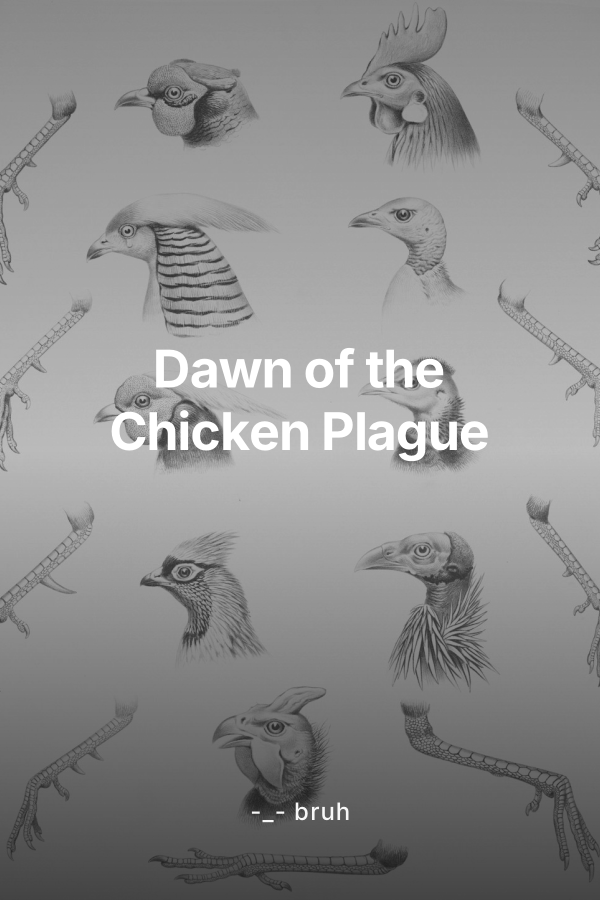
This book follows twelve-year-old David, a boy whose life has revolved around one irrational but very real truth: chickens are terrifying. His phobia began at seven, when a feathery blur, a pecking beak, and a storm of wings at Grandpa’s farm left him scratched, humiliated, and certain that anything related to chickens, even eggs, was enemy territory. His parents try to treat it like a phase, his older brother Lucas teases him, and his little sister Emma does not understand why a rooster in a picture book can send David out of the room. His best friend Rusty Ribbits, a wildlife-obsessed frog enthusiast, mostly just thinks it is weirdly fascinating. And Amelia, the smart, kind girl from his class he secretly likes, simply does not know the full story yet.
The story opens on an almost ordinary school day in their town. David’s morning routine is comfortable and safe: getting dressed, joining his family for breakfast, refusing the eggs on his plate while eating only pancakes and bacon, then heading to school with his mom. At school he meets Rusty and Amelia, trying to get through the day while dodging any chicken talk or cafeteria egg dishes. The tone is light, silly, and grounded in realistic family jokes and minor embarrassments, with David’s fear played both for humor and sympathy.
In the background, however, the world is already changing. A dangerous industrial chemical has contaminated a single chicken somewhere far from David’s town, mutating its biology. That infected chicken bites another. The strange pathogen propagates rapidly through poultry populations, rewriting nervous systems and behavior. Before long, chickens across the globe begin to act in coordinated, predatory ways that no one can explain. News clips, emergency broadcasts, and social media rumors talk about “chicken attacks,” strange glowing eyes, and flocks moving in eerie, synchronized patterns. Scientists argue about chemical cascades, neural rewiring, and accelerated evolutionary pressure, but by the time experts agree, the crisis is already at humanity’s doorstep.
The first act centers on the Town. At school, David, Rusty, and Amelia shift from joking about frogs versus chickens into genuine fear as alerts interrupt class and teachers scramble to keep students calm. When mutated chickens finally reach the outskirts of their town, small incidents quickly escalate. Reports describe birds with too many eyes, abnormal size, and erratic, coordinated flock behavior. Some move uncannily fast, others hit doors and windows in dense waves, testing every barrier. David’s worst nightmare is now the world’s shared problem, and the book frames this with a blend of absurdity and escalating tension, staying within a PG, middle grade tone while hinting at real danger.
A decisive turning point forces David’s family to evacuate. As chicken incursions intensify, streets become hazardous, and a combination of emergency broadcasts and the family’s own fear pushes them into action. The plan: pile into the car and leave town, heading toward Grandpa’s rural farm, which they hope will be safer and better defended against bird attacks. David’s mom and dad, Lucas with his teasing bravado, little Emma, David himself, Rusty, and Amelia all join the road trip, making it a chaotic, multi-generational survival caravan. The family dynamic shifts from casual sibling bickering to urgent coordination, yet humor persists as Rusty compares every chicken scenario to how much better frogs would handle it.
The second wave, the Road, transforms the book into a rolling survival adventure. Highways are partially blocked by abandoned vehicles, scattered supplies, and the remains of failed evacuation attempts. Mutant flocks, some with enlarged bodies and clusters of extra eyes, appear along power lines and rooftops, watching. In one signature set piece, the family’s car comes under direct assault on an open stretch of highway. Chickens swarm the windshield, pecking at glass and doors, their many eyes reflecting headlights and emergency flashing lights in unnatural patterns. The car spins into a terrifying roll, feathers and screams tumbling together as the world flips upside down. It finally lands battered but intact, leaving everyone bruised but alive, in keeping with the story’s boundary that no character dies, only close calls.
In the chaos following the crash, Emma is briefly grabbed by a mutant chicken. Her shriek cuts through the stunned silence. Lucas, whose usual role is the sarcastic older brother, explodes into action, pulling her free and driving the bird back. This moment reconfigures their relationship. Emma now sees Lucas as a true protector, clinging closer to him, while the whole family sobers into a new level of seriousness. They adopt clearer safety rules and a stronger team mindset, arguing less and relying more on one another’s strengths. The narrative uses this scene to deepen the importance of family, showing that crisis can reveal unexpected courage and tenderness.
Despite the danger, the journey is not relentless misery. Between attacks and near misses, the road offers quiet stretches of cracked asphalt, empty fields, and eerie calm. During these intervals the group shares snacks, jokes, and nervous stories. David and Amelia, still shy around one another, start to show mutual protectiveness. Rusty catalogs every strange chicken behavior with pseudo-scientific commentary, imagining how mutated amphibians would outcompete them. Moments like these maintain the book’s balance of humor and heart, setting up the emotional payoff of later scenes.
Reaching Grandpa’s farm marks the start of the middle act and the third major wave of the plot. Grandpa is tough, kind, and deeply experienced with rural life. He meets the exhausted group at his defended property, where improvised barricades, scarecrow-like decoys, and carefully arranged lights show he has been preparing. Over the years he has quietly carried guilt for David’s original chicken incident. Now, seeing his grandson trapped in a world shaped by that fear, he steps into a mentor role.
On the farm, the book explores the science-fiction horror of the mutated chickens in more detail. Grandpa has been watching their behavior, noting patterns in how they group, what they attack, and how they respond to noise and movement. Some have grotesque clusters of eyes. Others show unnatural size, with dense muscle growth. A few display strange emergent coordination, clumping together in living towers or moving in spirals that hint at altered neural processing. These details keep the threat imaginative and strange while staying within a middle grade comfort level.
Grandpa trains the kids in basic survival strategies: how to read the land, where chickens are likely to hide, which sounds attract or distract them, and how to move without drawing attention. He also carves out time for a private conversation with David, a pivotal fear versus bravery talk that crystallizes the book’s core theme. Grandpa shares his own childhood fear and explains that courage is not the absence of fear but choosing to act in spite of it. He may not use long philosophical speeches, but he gives David a clear, repeatable idea that will echo later: being brave is being scared and doing it anyway. He apologizes for not handling the old farm incident better and offers David quiet reassurance, reinforcing their bond.
David’s major turning point comes when Amelia, exploring part of the farm after hearing a strange cluck, wanders into danger. Drawn by the noise and curiosity, she edges into an old barn where mutant chickens lurk among broken equipment and shadowed rafters. The situation deteriorates quickly as the flock stirs, revealing multiple eyes gleaming in the dark. David sees her in trouble from a distance and freezes. His pulse spikes, his body refuses to move, and past memories of being attacked at seven surge back with suffocating force. For a heartbeat, he is the terrified little boy again.
Then Grandpa’s words surface in his mind. David repeats them internally, focusing on the idea of acting while scared. Step by step, he forces himself forward. The scene amplifies his internal conflict as much as the external one. He performs a risky jump or fall to reach Amelia, drawing chicken attention away from her. The rescue leaves him with a sprained ankle and a bruised body, but his successful intervention changes everything. Amelia sees the depth of his fear and his willingness to push through it, his family recognizes new courage in him, and David himself experiences the first solid proof that fear no longer has total control.
After Amelia helps him back to safety, she bandages his injured ankle. Their dynamic softens and complicates. They become shy and awkward, glancing away mid-sentence, blushing over small comments, yet they also watch out for each other more deliberately. She teases him gently about being her self-appointed bodyguard. Subtle touches and shared looks hint at something growing between them, without overshadowing the action-focused main plot. This budding relationship threads emotional stakes through the chaotic backdrop of the apocalypse.
That night, they move on again. An abandoned campsite becomes the setting for one of the book’s emotional high points. Around a small fire, the group roasts marshmallows, trying to reclaim a fragment of normal childhood. Under the dim glow and distant, haunting clucks from the dark tree line, David sits next to Amelia, his heart pounding harder than it did facing the chickens. With his fear of birds newly challenged, he must now face a different kind of fear: vulnerability in front of someone he cares about. He shakes and stutters through incomplete sentences until he finally blurts out his feelings. Amelia responds with warmth and gentle teasing, then admits she feels the same way. They share a quiet, safe moment, an eye-of-the-storm calm that validates all of David’s earlier struggles.
The peace does not last long. Rusty interrupts them, shouting from the shadows. This interruption is not another attack but a discovery. He has found a working map and a radio or intercepted a transmission, revealing the existence of a research lab actively working on a cure for the chicken pathogen. The message or map gives coordinates and suggests that survivors are needed both for study and for assistance. This discovery shifts the entire trajectory of the road trip. The group now has a concrete destination and a mission larger than their own survival.
The final act revolves around the Lab. Using Grandpa’s knowledge of the region and the new information, they navigate a hidden route that avoids the worst of the chaos. The lab turns out to be a strained but functioning research facility with damaged infrastructure, a perimeter occasionally breached by mutated chickens, and a small team of exhausted scientists. When David’s family arrives, they are processed as survivors, providing vital data about exposure patterns, attack behavior, and human responses. In the lab’s clean but fraying hallways, the book taps into more technical science fiction elements: containment protocols, power management, and experimental bio-signaling methods being used to decode the altered chicken nervous systems.
Just as hope becomes tangible, the most dangerous wave of the story hits. A huge swarm of mutated chickens, including giant and many-eyed variants, converges on the facility. The lab’s outer defenses strain and break. Scientists who have been working around the clock now face an enemy not just in petri dishes but clawing at reinforced doors and ventilation shafts. The group organizes a last stand defense, blending the adults’ technical knowledge with the kids’ creativity and field experience from the road and farm. Improvised tools, controlled power surges, and carefully placed sound lures contribute to a plan that stays tense but accessible for middle grade readers, mixing peril with inventive solutions and occasional humor.
At the heart of this climax is David’s most critical task. The lab’s primary cure system relies on a crucial power core that must be moved from one part of the facility to a central generator or control room under active assault. David, despite his lingering fear, is uniquely positioned to do it. He knows how these chickens move now, how they react, and he has already proven his ability to act under fear. With Amelia’s support and Grandpa’s mantra echoing in his head, he undertakes the mission. The corridors are under siege, glass cracking under pecks, alarms wailing. As he races to deliver the power core, a mutated chicken ambushes him in a side passage. For an instant, the earlier pattern repeats: paralysis, panic, the looming possibility of a bite.
This time, though, David is not alone. Before the chicken can bite him, Amelia appears and kicks the attacker away, integrating her own bravery into the resolution. Together, they finish the delivery, allowing the scientists to fully power the cure system. The machine activates, sending out a targeted bio-signal or dispersing a stabilizing agent that neutralizes the pathogen’s worst effects. In the aftermath, the attacking chickens lose their frenzied coordination and predatory focus, reverting toward more normal, if disoriented, bird behavior. The immediate danger subsides.
The lab’s interior sinks into exhausted relief. David, his family, Rusty, Amelia, and the scientists share a final, tight hug circle, laughing through tears and expressing simple, powerful gratitude for being alive and together. The tone is one of hopeful exhaustion and quiet triumph rather than loud celebration. They know the world has a long rebuild ahead, but they have turned the tide. For a closing note before the epilogue, the group decides to travel home, imagining a future where school, farms, and friendships can exist without daily attack alarms.
An epilogue jumps forward several years to show how the world, and the characters, have changed. The cure succeeded. Human communities have rebuilt. Chickens exist again, carefully monitored and studied. David is now older and no longer afraid of them. In a gentle, full-circle scene, he can walk among normal birds without flinching, perhaps even feeding them alongside his own children. He is married to Amelia, and they have a family of their own, their partnership forged in the bizarre furnace of the chicken apocalypse. Rusty remains his best friend, probably a budding scientist whose work still leans suspiciously toward frogs and now comparative mutation studies. Lucas has pursued his passion and become part of a famous rock band, while Emma runs a flower shop that symbolizes regrowth and beauty after chaos.
The book closes on small, human details rather than big explosions: a family picnic near a peaceful farm, kids teasing David about his long-gone fear, a poster advertising Lucas’s band plastered on a town wall, flowers spilling color from Emma’s shop window, Rusty showing the next generation a harmless frog and telling an embellished version of how “frogs would have handled the apocalypse differently.” The memory of terror remains, but so does the certainty that fear can be faced and transformed.
Across its five planned chapters and roughly ten thousand words, “Dawn of the Chicken Plague” blends silly, imaginative horror with grounded emotional stakes. The narrative arcs clearly through Town, Road, Farm, and Lab, each wave starting in a pocket of calm, rising into chaos, then settling into a new, slightly more mature equilibrium. Themes of overcoming fears, the importance of family, loyalty in friendship, and the strange, sometimes funny shapes courage can take are woven through encounters with many-eyed mutant birds, flipped cars, dark barns, and humming laboratory corridors. By the end, readers in the 10 to 13 age range will have journeyed with David from paralyzing phobia to earned confidence, discovering along the way that even the most ridiculous nightmare can be faced one trembling but determined step at a time.