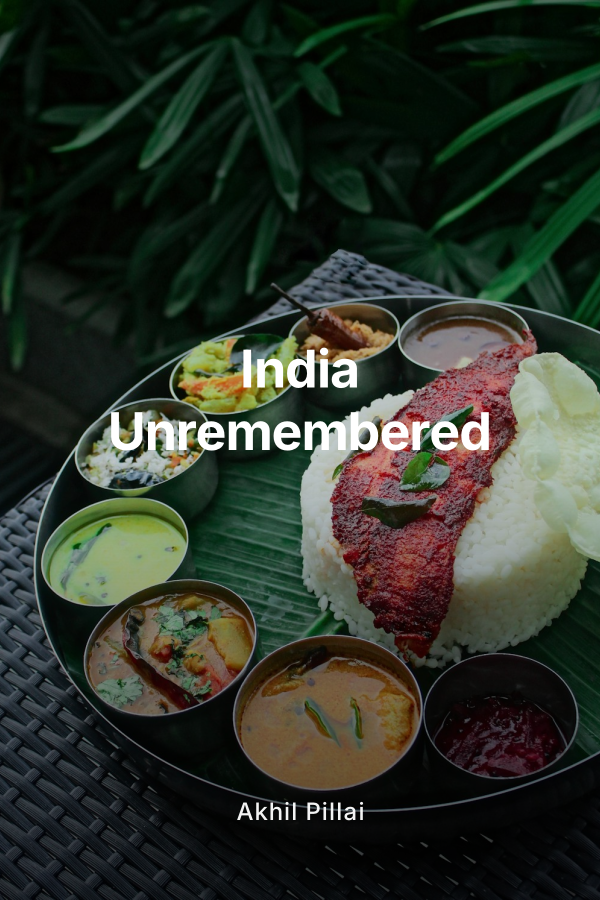
This book is conceived as a chef level reference and cultural food history of India, devoted to rediscovering dishes, techniques, and ingredient knowledge that are receding from contemporary culinary consciousness. It takes as its starting point the insight that India is not only a political or geographic entity but also a vast archive of kitchens, in which memory is preserved through taste, texture, and aroma. The preface frames the project as an attempt to honor recipes, lineages, and domestic practices that are in danger of disappearing in the rush of modernization and homogenized restaurant culture, positioning the work as both documentation and act of cultural care .
At the conceptual core lies India’s historical and sensory identity as the “Spice Capital of the World.” The book insists that spices are not decorative accessories to cuisine but active historical agents, shaping trade, empire, agriculture, and ritual. The introductory essay on spices reconstructs how diverse climates from the Malabar Coast to Kashmir created micro ecologies for black pepper, cardamom, turmeric, saffron, and other aromatics, and how these ingredients in turn reorganized global trade routes, from early Arab and Chinese networks to later European maritime enterprises . At the same time, the book argues that in Indian practice spices have always been more than commodities. They function as tools of nourishment, preservation, medicine, and celebration, forming a bridge between kitchen and healing, everyday meals and sacred observances.
The summary structure of the book rests on three interwoven pillars. First is a regional mapping of Indian cuisine, aligning with the decision to organize the work by region rather than by ingredient or course. This regional approach allows the text to foreground how geography, climate, caste, community, and historical contact produced distinctive repertoires of “forgotten” dishes. Each major chapter studies a specific region or cluster of regions, reconstructing local culinary systems through case studies of dishes that have receded from mainstream restaurant menus but remain alive in memories, home kitchens, and marginalized archives.
Second is the insistence on an equal balance between recipes and essays. For professional chefs and advanced cooks, the book does not treat recipes as isolated formulas. Instead, each recipe becomes an analytical lens through which to explore technique, historical evolution, and cultural symbolism. Essays surrounding the recipes probe questions such as the differences between home and hotel versions of a curry, the role of gendered labor in preserving certain desserts, or the impact of colonial trade on the souring agents and fats favored in a coastal region. Technical notes, mise en place breakdowns, and brief service considerations are embedded within this narrative frame, making the work a practical manual and an intellectual inquiry at once.
Third is a deep, systematized glossary of spices and foundational ingredients, already partially drafted in the current materials, which functions as an interpretive key to the rest of the book. The glossary does not simply define ingredients but situates them in living practice. Each entry outlines characteristic flavor, traditional uses, regional significance, and sometimes medicinal or ritual associations. For example, entries on alkanet root, amchoor, asafoetida, and black stone flower explain how these ingredients shape both the color and aromatic architecture of dishes, while also signaling authenticity within specific regional styles . Other entries such as curry leaves, kokum, jaggery, or vadagam point to overlaps between culinary and Ayurvedic knowledge, and to the subtle distinctions between similar souring or thickening agents across different parts of India .
Chapter 1 establishes the intellectual and emotional stakes of India Unremembered. It elaborates on the idea that recipes are repositories of memory, connecting contemporary cooks with ancestral practices. This chapter unpacks the notion of “forgetting” in culinary terms. Some dishes have disappeared from visibility because urban restaurant menus favor a narrow, standardized canon of “Indian” food tailored to commercial expectations. Others survive only within specific castes, scheduled communities, or rural households, with no written documentation. The chapter proposes a working typology of forgotten dishes, ranging from those almost entirely absent in modern public dining to those still known yet steadily losing technical fidelity and cultural context. Within this framework, “rediscovery” is not romantic nostalgia but a disciplined process involving elders’ testimonies, regional archives, and careful testing in contemporary professional kitchens.
Chapter 2 turns to spices as protagonists and method. Drawing on the extended essay on India as the Spice Capital, it articulates how spices operate at multiple scales: microscopic (as essential oils, pigments, and bioactive compounds), domestic (as seasoning, preservation, and everyday medicine), and civilizational (as drivers of trade, conquest, and cross cultural exchange) . The chapter analyzes key techniques that define the Indian manipulation of spices, such as tempering in hot fat, dry roasting, grinding to different textures, and layering at various stages of cooking. It also examines the regional grammars of spice usage: the coconut and curry leaf inflected temperings of the south, the garam masala frameworks of the north, the slow aromatic layering of the east, and the sour fragrant signatures of the western coastal belt. These grammars become interpretive tools for understanding why forgotten dishes in each region taste and behave the way they do.
The spice glossary, which appears as a major apparatus to this chapter, is treated not as a static dictionary but as a curated atlas of ingredients and their cultural biographies. Entries on staples like coriander seeds, cumin, fenugreek, mustard, and turmeric attend to their sensory role and their structural function in defining dish categories . Less familiar ingredients such as kalpasi, cubeb pepper, cassia buds, charoli, char magaz, or zedoary are positioned as gateway elements to rare regional preparations, signaling to chefs where further research and dish development might be most fruitful . In scholarly terms, this chapter argues that understanding spices as “living traditions” rather than fixed recipes allows the chef reader to adapt authentically, paying respect to regional logics while innovating responsibly.
Chapters 3 to 5 are organized regionally, in alignment with the user’s intention that the book be structured by region with an equal mix of recipes and essays . While the detailed contents of each region are developed in the full manuscript, the summary can outline the conceptual approach. Each regional chapter begins with a historical and cultural overview, mapping how climate, trade routes, religious practices, and political histories shaped local culinary ecosystems. It then introduces a curated selection of forgotten or endangered dishes, each accompanied by: a rigorously tested recipe designed for professional execution, a narrative essay situating the dish in its community context, and technical sidebars explaining mise en place, equipment, and service considerations for modern kitchens.
The regional chapters also attend closely to issues of authenticity, adaptation, and ethics. They confront the tension between presenting dishes “as they were” and acknowledging that all living cuisines evolve. Some recipes are reconstructed from oral memory and must be stabilized through contemporary testing. Others require sensitive adjustment for modern ingredient availability or equipment. The book encourages chefs to be explicit about these choices, framing them as interpretive decisions rather than transparent reproductions of a pure past. In that sense, India Unremembered is both archival and forward looking, seeking not to freeze Indian cuisine in a nostalgic ideal but to enrich its present and future by reconnecting it to underrepresented pasts.
Throughout the work, a consistent narrative voice guides the reader, one that combines professional authority with humility toward the elders, home cooks, and regional experts whose knowledge underpins the project. The preface and early chapters affirm that the author’s years of travel across India have revealed a multitude of extraordinary dishes that rarely appear in cookbooks or restaurant menus, and that this volume is a “humble attempt” to bring them back into circulation . Yet the tone remains analytical and reflective. Each chapter presents arguments about how cuisines are formed, forgotten, remembered, and transformed, aiming to influence not only how chefs cook but how they think about culinary heritage as an object of study.
In methodological terms, the book combines several perspectives commonly associated with food studies, anthropology, and professional culinary arts. It borrows from cultural history when reconstructing trade routes and ritual uses of spices, from ethnography when citing conversations with home cooks and vendors, and from kitchen science when explaining the functional roles of acids, fats, and aromatics in particular preparations. Although the text does not attribute specific ideas to named scholarly authors within the summary, it implicitly engages with concepts such as cuisine as cultural identity, food as intangible heritage, and the politics of authenticity and representation. These conceptual anchors can be explicitly referenced in footnotes or endnotes in the full manuscript, enabling future readers to trace genealogies of thought and give proper credit to foundational works.
For the professional reader, India Unremembered as summarized here promises a dual reward. On the one hand, it offers a rich repertoire of technically precise, historically grounded dishes that can diversify and deepen restaurant menus, catering programs, or culinary curricula. On the other, it cultivates a more reflective, ethically aware culinary practice, urging chefs to view dishes not only as profitable offerings but as vessels of memory embedded in specific communities and ecologies. By pairing an extensive spice and ingredient glossary with regionally organized narratives and recipes, the book becomes both a reference tool and a sustained argument about how to cook with, and think through, the living heritage of Indian food.