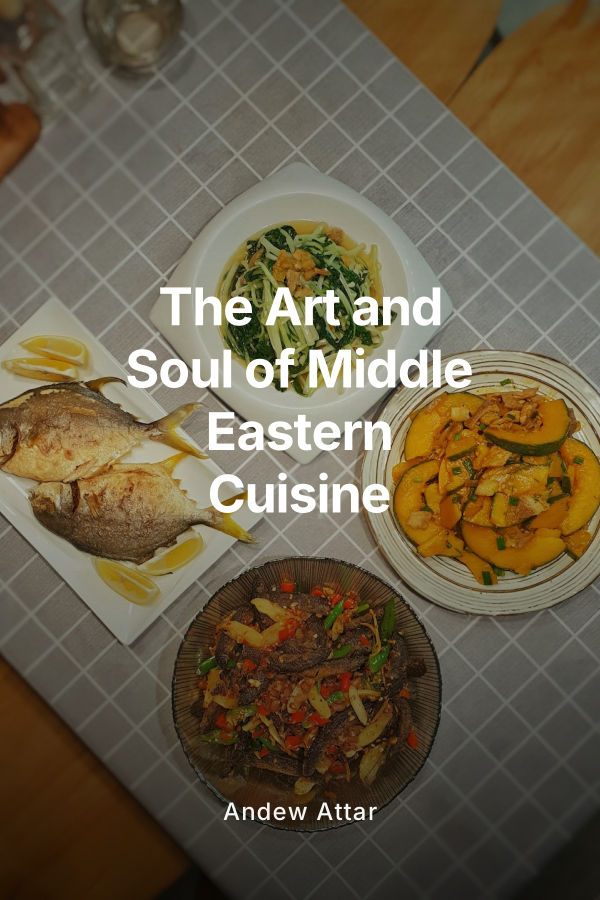
This book offers a rigorous and evocative exploration of Middle Eastern cuisine as both a codified professional practice and a living cultural inheritance. It is designed for professional cooks and serious enthusiasts who seek not only reliable recipes but also a deeper theoretical and historical understanding of the culinary systems that underpin them. Grounded in classical and contemporary dishes from across the region, the volume treats the kitchen as a site where history, agriculture, religion, trade, and family memory converge into a distinct gastronomic language.
Across five chapters, the work moves from regional and historical frameworks to ingredient systems, core techniques, and applied menu structures, culminating in a reflective synthesis on how chefs can carry this heritage into modern professional practice without sacrificing its integrity. The book thus positions Middle Eastern cooking not as a static repertoire of dishes but as an evolving method of thinking about food, hospitality, and identity.
Chapter 1, “Cradle of Civilization, Cradle of Cuisine,” establishes the historical and cultural foundations of Middle Eastern foodways. It examines how early agriculture in the Fertile Crescent, including the domestication of wheat, barley, figs, dates, and pistachios, created the material preconditions for leavened bread, beer, and enduring market cultures. It then traces how successive waves of influence from Persian courts, Arab trade networks, the Ottoman Empire, and wider Afro‑Eurasian exchanges layered new techniques and ingredients onto an older agrarian matrix, yielding a remarkably cohesive yet internally diverse culinary region. The chapter situates contemporary professional kitchens within this longue durée, arguing that a modern chef works, knowingly or not, inside a 12‑millennia continuum of practice.
Chapter 2, “Ingredients as a Grammar of Flavor,” analyzes the core pantry of Middle Eastern cooking as a structured system rather than a loose collection of items. Building from fundamental elements such as olive oil, legumes, lamb, yogurt, wheat products, and aromatic herbs, the chapter articulates how characteristic combinations of acid, fat, aroma, and texture create recognizable regional signatures. Through comparative discussion of spice blends, fermented products, and staple cereals, it shows how similar bases yield divergent expressions in, for example, Levantine, Gulf, North African, and Egyptian contexts. Specific reference dishes such as lamb and vegetable couscous, mujaddara, and molokhia exemplify how legumes, rice, grains, and greens are orchestrated into nutritionally dense and sensorially complex compositions that rely on a precise interplay between pantry structure and technique.
Chapter 3, “Techniques of Heat, Time, and Transformation,” turns from ingredients to method, treating cooking techniques as a professional taxonomy. It dissects key processes including long‑braising in tagines, inverted rice constructions such as maqluba, layered rice‑meat preparations, and the handling of offal and small birds, while also examining flatbreads, enriched doughs, and syrup‑soaked pastries as examples of cereal transformation. Lamb skewers, Moroccan lamb tagine, Libyan pasta stews, Egyptian pigeon dishes, and a full spectrum of breads from Moroccan loaves to saj illustrate how timing, temperature control, and sequencing of aromatics are used to control texture, concentrate flavor, and preserve ingredient integrity. By presenting these methods analytically rather than merely descriptively, the chapter equips professionals to generalize techniques across dishes and innovate without destabilizing core culinary logics.
Chapter 4, “Structure of the Table: From Breakfast Rituals to Feast Menus,” moves from individual dishes to the architecture of meals. It examines how daily and festive eating patterns are organized, starting with robust regional breakfast traditions that combine legumes, breads, cheeses, and sweets, and extending to multi‑course celebratory tables that might feature rice‑meat centerpieces, vegetable stews, salads, breads, and a diverse dessert canopy of creams, puddings, doughs, and nut‑based pastries. Using case studies such as Egyptian ful and falafel breakfasts, North African couscous feasts, and Gulf one‑pot meat and rice dishes, the chapter reconstructs the implicit rules of balance, generosity, and textural contrast that structure these meals. It then translates these vernacular logics into tools for contemporary menu design, including tastings, banquets, and à la carte formats tailored for professional kitchens.
Chapter 5, “Heritage in the Professional Kitchen,” concludes by reflecting on how chefs can steward Middle Eastern culinary heritage while operating under modern constraints of time, scale, nutrition, and globalized palates. Drawing on the breadth of classical recipes, from humble potato stews and lentil‑rice pilafs to intricate stuffed seafood, grilled meats, and elaborate sweets, the chapter formulates a set of guiding principles: fidelity to core flavor structures, respect for ingredient seasonality, transparency in adaptation, and a pedagogy that treats recipes as exemplars of systems rather than isolated formulas. It argues that professionalism in Middle Eastern cuisine rests on the ability to articulate why a dish is composed as it is, how its method emerged historically, and what is at stake culturally when it is altered.
Across these chapters, “The Art and Soul of Middle Eastern Cuisine” positions the region’s food not only as an object of consumption but as a rigorous field of study. It invites professional cooks and devoted enthusiasts to read recipes as cultural texts, to understand techniques as historically sedimented knowledge, and to approach their own practice as participation in a living, shared heritage that extends from the first cultivated grains to the contemporary restaurant pass.