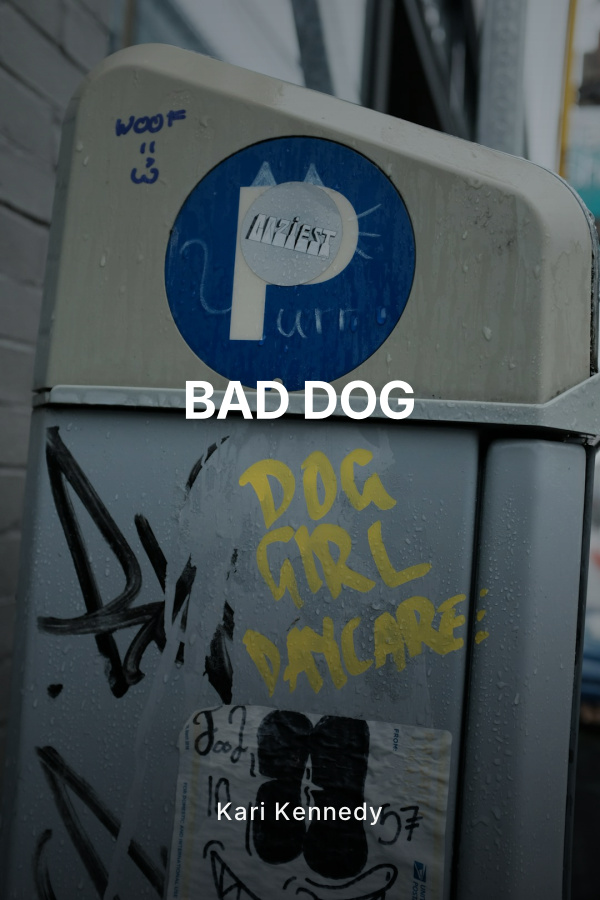
This book is a wildly playful, tongue in cheek “manual” about what happens when you take the idea of a “bad dog” far too seriously and not seriously at all at the same time. Built for kids-at-heart of any age, it treats canine mischief like a world changing force of nature, then gently reminds readers that behind every disaster chewing, sock stealing, garbage diving scoundrel is a heart of gold and a human who loves them anyway.
Across five chapters, the book follows a loose narrative wrapped inside a spoof handbook. A very earnest but constantly overwhelmed narrator tries to classify, diagnose, and “manage” bad dog behavior, only to be outwitted on every page by a gallery of ridiculous pups. Each chapter “teaches” the reader a new level of silliness, escalating from ordinary household chaos to full scale cartoon mayhem, with the narrator’s official tone slowly unraveling into affectionate surrender.
Chapter 1 introduces the core idea of “bad dog” as the most misunderstood label in the universe. Here the narrator defines different “breeds” of badness such as The Sofa Shredder, The Invisible Pooper, and The Selective Listener. Ordinary misdeeds are described with mock scientific seriousness, as if the dog’s choice to ignore “sit” is a complex physics problem and the trash can is a gravitational singularity no dog can escape. Readers meet a few recurring canine “case studies” whose antics will anchor the rest of the book, including a tiny but unstoppable troublemaker who keeps accidentally becoming the hero.
Chapter 2 zooms in on the everyday catastrophes that make humans wail “BAD DOG” while trying not to laugh. It explores silly scenarios like surprise mud art on white carpets, midnight zoomies during serious phone calls, and the mysterious law that freshly folded laundry must never remain folded. Each incident is told as if it were a top secret field report, with “lessons learned” that only get more outrageous, such as why you should never underestimate a dog’s ability to teleport directly to any forbidden snack within a ten mile radius.
Chapter 3 expands the silliness into social situations. The narrator explains the “Bad Dog Public Relations Crisis” that occurs in parks, cafes, and at the homes of people who own very breakable things. Readers learn about leash gymnastics, the art of pretending your dog has never licked a stranger’s face before, and the inevitable moment your pup chooses to loudly embarrass you in front of your crush, your boss, or your most easily shocked relative. The chapter gently pokes fun at human pride while celebrating the way dogs blast through awkwardness and make everyone a little more honest and a lot less serious.
Chapter 4 tilts fully into absurdity, treating dogs as undercover agents of chaos whose secret mission is to destroy boredom on Earth. Here we “discover” that every shredded shoe, every stolen sandwich, and every rogue belly flop into a kiddie pool is part of a grand silly conspiracy to keep humans playful. Ordinary training advice is parodied and flipped on its head, with “instructions” on how humans can become slightly better behaved around their dogs instead. Underneath the nonsense, a warm message surfaces about how our pets pull us away from screens, drag us outside, and teach us to laugh at ourselves.
Chapter 5 brings it all together by asking what “bad” really means when a so called naughty dog is also a steady companion through lonely afternoons, tough days, and scary nights. The narrator, now fully converted from stern expert to delighted co-conspirator, retires the idea of fixing bad dogs at all. Instead, the final chapter celebrates imperfect pups and imperfect humans as a perfectly matched pair. Mishaps turn into memories, ruined shoes into running jokes, and every shouted “BAD DOG” gradually softens into “my ridiculous, wonderful dog.”
By the end of the book, readers are invited to see mischief as a form of love shaped like muddy pawprints, to forgive themselves for not being perfectly patient pet parents, and to cherish the chaos that comes with living beside a creature who never learned how to be boring. The tone remains light, goofy, and accessible, but it also plants a quiet, heartfelt idea. A “bad dog” is usually just a good friend having the time of their life, waiting for you to join in.