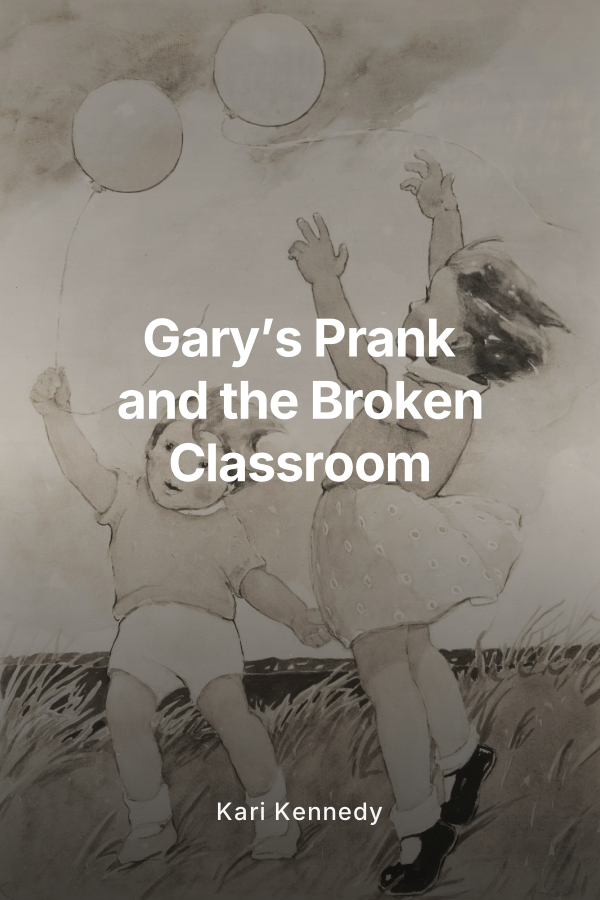
This book is a short, intense middle grade story about school going wrong. It follows Gary, a bored and angry student who thinks his teacher is the problem, and a stressed adult who thinks her students are the problem. Their fight explodes into a prank, a meltdown, and real injuries. Underneath the chaos, the story asks what happens when everyone in a school blames everyone else, and what it really costs when kids decide that “school is bad.”
Gary is a student in a class where people sleep, talk over the lesson, and misbehave every day because they are bored and do not feel the work matters. The teacher yells often, sometimes at the whole class for one person’s mistake, and seems to never listen. In Gary’s eyes she is a “bad teacher” who only shouts and hands out work. He does not see the side of her that drags home piles of grading, works late in an empty school, and worries about keeping her job and supporting her family.
The main story begins when the class, angry and restless, starts insulting the teacher while she tries to teach. Someone says out loud that they should pull a prank on her at lunch. Gary, who loves attention and already dislikes this teacher, volunteers himself through his actions. He sneaks a fake poop onto the teacher’s chair, expecting harmless laughter and a moment of power in a place where he usually feels powerless.
At first, the prank works the way Gary imagined. The class laughs, some students film on their phones, and even the kids who feel guilty cannot stop looking. When the teacher sits and realizes what is under her, the room explodes with noise. She sees Gary grinning and knows immediately who did it. Her reaction is much bigger than Gary expected. Already stretched to the limit by constant disrespect, pressure from the principal, and long nights of work, she snaps.
The teacher’s meltdown turns the prank from a joke into a real disaster. She starts yelling, throwing things, and running around her classroom. Desks are knocked over, and in the chaos some students are crushed or hit, ending up with broken bones and real fear. The class finally goes silent, but it is too late. The nurse’s office fills with hurt kids, and others wait outside, scared and confused. They whisper that “Gary did it” while also fearing the teacher, the principal, and what their parents will say.
From here, the story shifts from joke to consequence. The school reacts, trying to control the damage. Some staff members want to protect the school’s image and talk about handling things quietly. Others demand a full investigation. Letters, emails, and rumors spread. Students argue in hallways about who is to blame. Some say the teacher finally went too far. Others say Gary started everything and deserves whatever punishment is coming.
Gary’s parents are furious when the principal calls them in. They are angry at Gary, at the teacher, and at the whole school for letting things get this bad. At home and in the principal’s office, Gary finally feels the pressure that had been there all along but outside his view. His parents shout. The principal talks about school rules and safety. The teacher is caught between shame and fury, knowing she crossed a line but also feeling that no one understands how close to the edge she already was.
The most important part of the book is what happens inside Gary. At first, he wants to act tough and say it was “just a joke.” But when he hears about classmates with broken bones in the nurse’s office and sees their scared faces, guilt starts to pull at him. He talks with his friend, an honest type who both likes pranks and cares about people. This friend does not let Gary hide from what happened. The conversation forces Gary to ask himself if he is truly the victim of a bad school, or if he helped turn a bad situation into something much worse.
Meanwhile, we also glimpse the teacher outside of class. She stays late in the empty school, surrounded by stacks of papers and harsh emails. She looks at a photo of her family on her desk and feels the weight of her choices. She knows she hurt students and might lose the job that barely holds her life together. Her stress and fear help readers understand that while she did wrong, she is not simply a villain. She is a human being crushed by a system that leaves both kids and teachers feeling trapped.
The book’s emotional core lies in the shared fear that settles over the class after the accident. The hurt kids are scared to talk. Some freeze and say nothing. One or two might be brave enough to tell what they saw, torn between blaming the teacher, blaming Gary, or blaming both. The mood in class changes completely. Jokes are quieter. People stop sleeping at their desks, but not because they suddenly love learning. They are tense, watching adults and waiting for the next explosion.
Throughout, the story keeps asking what it means to say “schools are bad.” Are schools bad because of bored students, disrespect, and pranks that go too far? Are they bad because of burned out teachers and principals who put numbers above people? Are they bad because of systems that ignore why students are bored and why teachers are stressed? The book never turns into a lecture. Instead it lets readers feel each side through scenes in the classroom, in the nurse’s office, in the principal’s room, and in Gary’s home.
In the final parts of the book, Gary faces a choice. He can hide his role and let the teacher take all the blame, or he can admit what he did and accept that his “fun” had real consequences. Pressure comes from everywhere: from his parents, from the principal, from friends who want him to either stay loyal to the students or do the right thing. Most of all, the pressure comes from his own conscience.
Gary’s decision, and what the school does afterward, becomes the turning point. The book does not fix everything with a neat solution, because real schools and real people are more complicated than that. Instead, the ending focuses on growth. Gary starts to understand that his boredom and anger are real, but so is his responsibility for his actions. The teacher begins to see that yelling and humiliation were not just unhelpful but dangerous, and that she needs help and change as much as Gary does.
“Gary’s Prank and the Broken Classroom” is aimed at middle school readers who are tired of hearing adults talk about school without listening to how it feels from the inside. It is also for teachers and parents who suspect that the problems they see in classrooms are symptoms of something larger. With short, sharp scenes and emotionally honest moments, the book shows how one prank can uncover a whole broken system, and how guilt, fear, and a small bit of courage can begin to change the story.