In a suburban elementary school where the days are measured in bell rings, homework pages, and how full the lunch tables are, ten year old Maya sits at the fragile center of a quiet storm. Fifth grade was supposed to be about spelling tests and kickball games, not the sick twist in her stomach that appears every time she walks into the cafeteria and sees Liam, the smallest kid in their grade, bracing himself for another lunch of whispered jokes and shoved trays. The story that unfolds in this book traces one ordinary girl’s journey from uncomfortable silence to small but meaningful bravery, and shows how change in a school community often begins with one voice that finally decides to speak.
The novel opens with Maya carefully mapping out her safe routines at school. She knows which hallway to avoid when the older kids stampede through, which seat on the bus keeps her farthest from the loudest jokes, which spot at lunch lets her see everything while still feeling invisible. Her world is familiar and manageable, built around her best friend Zoe, weekend visits to her dad’s apartment after her parents’ recent separation, and a private love for drawing that she rarely shares.
Into this tense balance steps Liam, newly assigned to sit at Maya’s lunch table after a noisy reshuffle by the lunch monitors. He is quiet, shoulders slightly hunched as if he has practiced making himself smaller. At first, Maya notices only small details a wrinkled shirt, a hand that curls protectively around his milk carton, the way he double checks his homework more than anyone else. But on the second day he sits with them, three classmates from another table begin a cruel pattern that will come to define Maya’s crisis. They slide by like they are just passing through, flick a grape onto Liam’s tray, and laugh about his “pet ant meal.” The insult is small in words yet enormous in its effect. Liam stiffens, eyes fixed on the table as his ears turn red.
What makes the bullying more complicated is that it is not a single obvious attack. It comes in thin slices. A knocked over water bottle. A whisper about the second hand sweatshirt he wears. A chant under someone’s breath when the monitors are not looking. These are acts easy to overlook, and that is what most kids do. They glance, wince, and return to their chicken nuggets. Maya does the same, at first. She does not join in but she does not interfere, her silence forming a thin, fragile shield around her own safety.
Yet the quiet does not erase what she has seen. It follows her home, especially at night when the house is still and the voices from the cafeteria return in sharp fragments. Maya’s mother, tired from long shifts and still learning how to be the only parent in the house most nights, notices her daughter’s restlessness and asks if something is wrong at school. Maya hesitates. To speak of it would make it real. To stay silent lets it remain a blur she can almost pretend away. She chooses silence, answering that she is only nervous about an upcoming math quiz.
The story deepens as we see the layers of Maya’s life outside the lunchroom. Her weekends at her father’s new apartment, with its quieter rooms and unfamiliar couch, reflect a different kind of discomfort. Her parents are trying to be kind to each other, but there is a line they no longer cross. This unsettled home life makes Maya cling even more fiercely to the little bits of normal she still has. She is afraid that speaking up about anything will cause yet another thing to change.
At school, the bullying of Liam grows more frequent. It remains mostly verbal and petty in form, yet it casts a shadow over the entire lunch period. The bullies, led by a boy named Connor, never push hard enough to draw the attention of teachers for long. They learn how to time their remarks and gestures when backs are turned. A carton tipped just enough to spill, a nickname repeated until it sticks, a backpack shifted to the floor so Liam trips on his way out of the cafeteria. Each moment leaves no clear bruise and therefore no easy proof.
Maya’s internal struggle, however, becomes harder to ignore. After one particularly bad lunchtime, when Liam’s carefully packed lunch is scattered to the floor while a group laughs and claims it was an “accident,” she locks eyes with him for the first time. In that brief connection she sees not just embarrassment, but a tired fear. She looks away immediately, heart racing, ashamed that she has looked and equally ashamed that she did nothing more.
The novel spends careful time inside Maya’s thoughts, revealing how a child weighs fear and responsibility. She imagines what might happen if she speaks. Will Connor turn on her? Will she lose her place next to Zoe, who often looks uncomfortable at the bullying yet says nothing either? Will the teachers actually help, or will she be told simply to ignore it? The risk seems enormous, especially for a girl who has already watched her family change shape without her consent.
Her first act of bravery is small and almost invisible. On a Monday afternoon in the classroom, when they are assigned partners for a social studies project, the room buzzes with kids rushing to sit with their friends. Liam ends up alone at his desk, awkwardly shuffling his papers, as usual. Maya looks at Zoe, who is waving her over, their usual tradition secure and familiar. Something in her hesitates. Then, before she can talk herself out of it, Maya crosses the gap between the desks and asks their teacher if she and Liam can be partners. The room quiets for a second, surprised, and then the noise resumes. Maya’s face burns, but her decision stands.
Working with Liam gives Maya her first close look at who he is beyond the label of “the kid who gets teased.” She learns that he lives with his grandmother while his mother works nights in another town. He likes drawing maps and can name all the states without looking. He walks home instead of taking the bus because it is only a few blocks, and he prefers the quiet of the sidewalk to the chaos of the bus seats. As they create their project together, Maya begins to see how incomplete her picture of him had been, formed entirely by the way others treated him.
Their partnership does not magically make Liam bold or carefree. At lunch, he still hunches his shoulders when Connor approaches. But there is now a slight difference. Sometimes, when Connor makes a joke, Maya clears her throat or looks directly at him instead of at her tray. When a grape bounces onto Liam’s plate, she pushes it back toward the middle and says, in a low but steady voice, that it is not funny. The first time she does this, her heart pounds so loudly she is sure everyone can hear it. Connor raises his eyebrows but shrugs and walks away. It is not a grand victory, but it is something.
The heart of the book lies in the gradual way Maya’s courage grows. It is not one dramatic scene where she stands up and changes everything at once. Instead, there are small moments. A day when she chooses to sit a little closer to Liam, so the space between them does not look like rejection. An art assignment where she draws a picture that includes a lonely figure at a lunch table and, later, quietly leaves it on the guidance counselor’s desk. A talk with Zoe where she admits that the bullying makes her feel sick. Zoe listens, torn between her own fear of attention and her loyalty to Maya, and slowly begins to shift as well. Their friendship stretches, is tested, and deepens.
Eventually, the tension builds to a point where ignoring it is no longer possible. One rainy day, the cafeteria is louder than usual and the teachers seem tired. Connor and his friends are restless. They seize the moment to escalate their game, pretending to “accidentally” drop a full carton of juice onto Liam’s lap. The table roars with laughter as the orange liquid soaks his jeans. For a breathless second Maya freezes, the old fear clawing up her throat. Then, without quite realizing how, she stands up.
What she does in that moment is not dramatic in size, but enormous in meaning. She turns not on Connor directly, but toward the closest lunch monitor, voice shaking but clear as she calls the adult over and explains what happened. She does not embroider or exaggerate. She simply describes the pattern she has seen, the jokes that have become routine. Her words stumble yet arrive. The monitor, startled to have the situation laid out so plainly, responds. Connor is pulled aside, questioned, and eventually sent to speak with the assistant principal. The laughter dies down, leaving a thin silence.
For Liam, the immediate result is a mixture of relief and fresh embarrassment at being seen as a problem that needs attention. For Maya, the aftermath is complicated. On one hand, her knees tremble. On the other, a long held weight seems to shift from her shoulders. She expects Connor to retaliate, to whisper about her as the new target. He does, briefly. Yet it is half hearted, dragging only one or two others with him before the rest of the class loses interest. It turns out that his power was never as solid as it had seemed, depending heavily on everyone else’s silence.
The school’s response is imperfect but real. There is a brief reminder about kindness during morning announcements, followed by a visit from the counselor to their classroom to discuss how words can harm. Some students roll their eyes, but others glance quietly at Maya and Liam with new respect. A few kids who had once laughed along now simply look away when Connor tests his old jokes. The change is not absolute. It is, however, noticeable.
The ending of the book resists the temptation to claim that all bullying vanishes or that Connor becomes a close friend. Instead, it offers a measured, believable shift. Connor still mutters comments sometimes, though less often and with less audience. The lunchroom remains loud, with its usual chaos of spills and inside jokes. Liam still speaks softly and prefers the edges of groups. Yet he no longer eats alone. Maya and Zoe make sure of that, their three trays a small but steady island at table twelve.
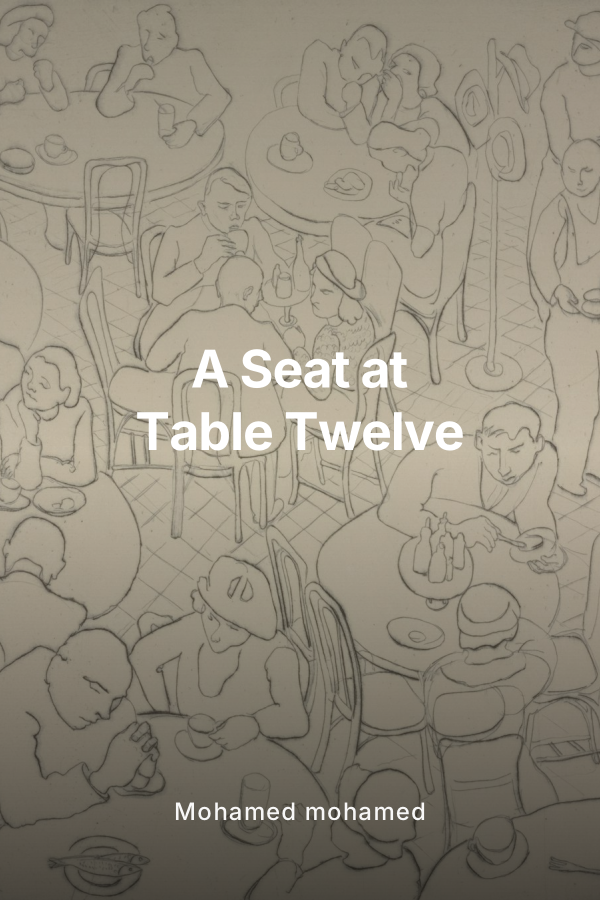
In the final chapter, we see Maya at the end of the school year, riding the bus home on a warm afternoon. The light through the windows catches the edges of her sketchbook as she draws what she now considers the most important picture she has made all year. It is a simple scene a cafeteria, viewed from slightly above, with one table where three figures sit a little closer together than the rest. There is nothing dramatic about it, no bright spotlight, no large text. Yet in this quiet illustration lies everything she has learned.
Maya understands now that courage is not a single grand moment reserved for heroes in stories. It is a collection of choices made when nobody is quite sure what will happen. She has seen that speaking up does not always end a problem outright, but it does shift the balance. It tells the person being hurt that they are not invisible. It shows the rest of the group that there is another possible way to be.
The book closes on a scene as ordinary as any other lunch period. Liam opens his brown paper bag. Zoe complains about the unfairness of pop quizzes. Connor, a few tables away, is absorbed in his own conversation, his influence smaller than before. The air buzzes with the usual noise of fifth graders ready for summer. Maya listens to the sounds around her and feels, for the first time in a long while, that she is exactly where she is supposed to be. Not because everything is perfect, but because she has learned that her voice belongs in the room.
This story, written in clear language suited to a fifth grade reading level yet rich with emotional truth, offers young readers a mirror for their own unspoken fears about school life. It gives them a main character whose worries and hesitations feel familiar, and whose growth feels possible rather than magical. The ending is realistic and gentle. No one is transformed overnight. Instead, the book suggests that real change often looks like a seat saved at a table, a quiet “that is not funny,” a partnership on a project, a small drawing left where it might be seen.
By the time the last page is turned, readers will have walked with Maya through the narrow halls of her school, sat beside her at a table where laughter can hurt, and watched her discover how even a single voice can begin to loosen the hold of cruelty. The novel does not promise that courage will remove all danger or discomfort. It promises something more honest and, in its own way, more hopeful. It shows that one ordinary child, keeping her eyes open and her heart willing to act, can make a real difference in the life of another.
In a world where many students learn too quickly to keep their heads down and avoid attention, “A Seat at Table Twelve” offers an invitation to look up, to notice, and to believe that even small acts of bravery matter. It reminds young readers and the adults who care for them that the middle of the lunchroom is not only a place where hurts are handed out, but also a place where kindness can quietly, steadily, take root.