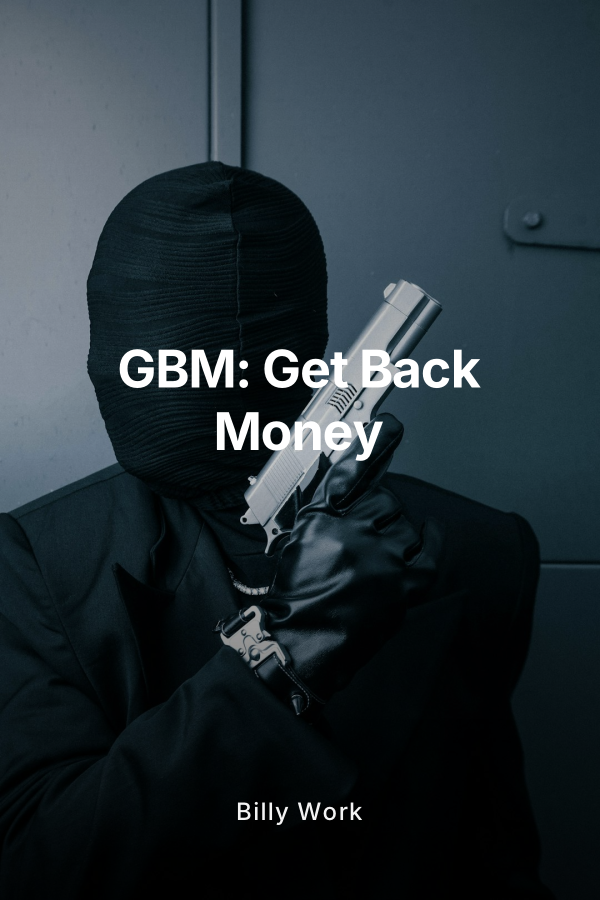
This book is a high intensity urban crime saga about power, strategy, and the cost of treating people as numbers. It follows Billy Bandz, a calculating ex inmate who refuses to be just another corner legend and instead builds GBM, a vertically integrated criminal corporation that operates like a Fortune 500 while hiding in plain sight on working class blocks and in anonymous warehouses. Drawing on the author’s earlier chapters about GBM’s birth in blood, its heroin empire, and the pivot into precision jewelry heists, this new volume expands the story into a five chapter arc that tracks Billy’s rise from seed money to full scale underworld holding company, his coldest betrayals, and the thin line between corporate discipline and sociopathic control.
From the opening pages, readers step into a world where every move feels like a board decision. The narrative begins with Billy’s first murder in El Paso, a killing he processes not as a moral break but as the initial capital injection for his future enterprise. That blood funded the “seed money” he carries back to the Bronx, where he rejects the loud, short lived path of block fame and instead drafts GBM as a corporate structure in his aunt’s spare bedroom. He recruits veterans Rico, Tariq, and Javier not as soldiers but as executives: Rico as a numbers obsessed CFO, Tariq as a paranoid security architect, and Javier as a logistics mastermind who can move anything through the city without leaving a trace. Together they build a wholesale heroin machine that underwrites smaller crews, launders cash through fronts and shell companies, and turns block chaos into silent, compounding profit.
As GBM scales, the city changes. Street violence shifts from theatrical shootouts to quiet disappearances. Men on corners curse or praise “the plug” without ever seeing the faces behind GBM Logistics LLC, a bland office name that hides a web of accounts, trucks, and safe houses. Law enforcement senses a new presence but cannot pin it down. DEA agents gather in fluorescent war rooms, circling “GBM” on whiteboards and arguing over a supply chain that seems too disciplined and too clean for the scraps of intelligence they have. In the Bronx, uniformed cops flood the streets, choking off visible trafficking with stop and frisk campaigns and mid level busts that never get them to the real boardroom. Billy watches it all from a high rise condo no one knows he owns, reading seizure charts and arrest stats the way other executives read quarterly reports.
The book’s second movement chronicles Billy’s boldest decision so far: he chooses to shut down the heroin side before the government can fully calibrate its sights on GBM. In a stark warehouse “board meeting,” he lays out a ruthless calculus for his inner circle: margins are shrinking, heat is rising, and heroin has become a trackable “heat source” that no longer justifies the risk. Rico argues about equity and loyalty, warning that internal games with numbers can corrode the brand they have built. Billy counters that loyalty is only a story, while control is math. This section presents GBM’s first major pivot, revealing how a criminal corporation can read a hostile market and exit a billion dollar vertical by choice rather than indictment. It also plants the first seeds of internal tension as Rico demands at least one moment of true transparency on the books, hinting that even the smartest crew can fracture once trust becomes just another line item.
Pivot becomes plot in Chapter Two, where Billy transforms GBM from a heroin engine into a high end robbery syndicate that moves like a special operations unit rather than smash and grab stickup kids. GBM’s jeweler heists are the proving ground. Tariq’s teams shadow family owned and boutique shops across New York and Connecticut, building dossiers on owners’ routines, alarm codes, and hidden keys. The night of the operation, GBM invades private homes, drags terrified jewelers back to their own stores, and empties safes and cases with military precision under a single hard rule: no dead bodies. By dawn, they have stripped multiple locations bare, sitting on roughly ten million dollars in stolen inventory. The DEA, still hunting heroin, never even sees the play. To them, these crimes are scattered home invasions and burglaries. To GBM, they are a clean, scalable revenue stream.
The twist that defines Billy’s character lands in the aftermath. At a storage unit “promotion ceremony,” he pays his crew one million dollars in cash for what he tells them was a ten percent fence payout on hot jewelry. In truth, he keeps the full stash, having never involved any outside buyer. He uses his own money to pay a fraction of the haul, pockets the real value, and cements a new level of leverage over men who would kill for him without knowing he has quietly converted their risk into his personal control. The scene captures Billy’s central paradox: he never shouts, never gloats, yet behind his calm, almost serene exterior lies a man who treats even his closest lieutenants as unknowing investors in his private equity of fear.
The new chapters push GBM into an even more dangerous evolution. In Chapter Three, Billy sits in a Porsche with a close female friend, a casual, sexually charged relationship that gives him rare space to vent. He tells her that everything he does in the streets is for GBM, that even his most selfish seeming choices are about the organization, the family, the company he wants to scale to “Fortune 500 money” and then pivot into legitimacy on a massive level. She admires his vision and warns him that success attracts envy, reinforcing for readers that Billy now lives at a level where the line between corporate dream and criminal empire has almost disappeared.
From there, the narrative escalates into GBM’s most audacious operation yet: a coordinated hit on four major gun stores and one ultra wealthy crypto investor, all in a single, tightly choreographed play. In the warehouse, Billy calls another meeting that feels more like a risk committee briefing than a crew huddle. He explains that they are not targeting mom and pop shops but high volume firearms retailers, and that the fifth target is a “crypto whale” whose digital holdings outweigh the physical inventory of all four stores combined. His tone is clipped and cold when someone jokes that the job sounds “light.” He reminds them that nothing is light when the stakes are this high, reinforcing one of the book’s core themes: in Billy’s world, underestimating risk is the one unforgivable sin.
The crypto kidnapping sequence showcases GBM at its most disciplined and chilling. At dawn, the whale leaves his quiet, affluent neighborhood for the office, unaware that Billy’s crew has everything timed to the second. Mad Dog drives the trailing car while Billy, dressed as a construction worker, steps into the street near a light, clipboard in hand. When the target rolls his window down to hear what the “worker” needs, Billy blows a measured dose of powder into his face, knocking him out within seconds. The crew takes control of the vehicle, moves it to a nearby warehouse, and begins a methodical extraction of digital wealth. While the whale lies bound with guns pointed at him, another GBM member hits his home disguised as a delivery driver, collecting computers and devices. When the victim wakes up, his screens and phone are lined up in front of him. Under the intimate terror of close range weapons and precise instructions, he is forced to move seventy five million dollars in cryptocurrency across multiple wallets, a transfer that unfolds like a corporate wire room under duress. Only when the last confirmation pings do they bag his head, bleach his clothes and skin to destroy DNA, and deposit him near his building, disoriented and alive.
In parallel, four GBM teams stalk gun store owners, snatching them outside closed shops, stuffing them into their own trunks, and using their keys and codes to strip shelves and backrooms bare. One robbery nearly spirals when a store owner reveals a boot gun and opens fire, forcing the crew into a chaotic exchange that miraculously ends without casualties. The scene reveals the fragility beneath GBM’s polished systems. No matter how clean the recon, human randomness can rip through the best laid plans. Still, by the end of the night, the crews regroup at GBM headquarters with roughly four thousand stolen firearms and the crypto whale’s fortune. They have just shifted GBM’s portfolio into weapons and digital cash at a scale that would terrify any government task force that could see the whole board.
Billy’s coldest financial move comes next. To the crew, he reports that the job yielded twenty five million in crypto, a number that already feels like a miracle to men who grew up counting street level thousands. In reality, he has captured seventy five million and quietly quarantined fifty million of it in wallets they will never see. He rationalizes this hidden war chest as “company money,” a reserve that belongs to GBM and its long term survival rather than to any individual’s pocket. The men under him, flush with their visible payouts and distracted by the high of pulling off an unprecedented hit, never suspect the scale of the deception. For readers, though, the book makes clear that Billy has taken his earlier jewelry play to a new level, using opacity, digital tools, and the mythology of GBM’s future to justify a level of internal theft that even Rico only half anticipates.
By Chapter Four, the fallout from these moves reshapes every layer of the ecosystem. On the street, GBM’s reputation soars. Crews talk not just about dope and drops but about a shadow company that can move product, jewelry, guns, and now even crypto with surgical precision. Small operators under GBM’s umbrella feel both safer and more trapped, tied to a supplier whose reach now spans physical and digital markets. Inside headquarters, Rico struggles with the tension between his accountant’s instinct for clean ledgers and Billy’s insistence that certain numbers must remain “ghosts” embedded in long term strategy. Tariq tightens security protocols, drilling crews harder on counter surveillance and digital hygiene as the gun and crypto scores raise the stakes. Javier redraws transportation maps to move firearms and hardware through the city while staying invisible to license plate readers and toll cameras. The book frames these adjustments like corporate restructuring: new risk committees, revised supply chains, and more aggressive insulation between the core and its noisy satellites.
Meanwhile, on the other side of the city, law enforcement finally starts to glimpse an outline of the new GBM. Ballistics reports, surveillance footage from one chaotic gun store robbery, and the growing number of high end crimes with no clear suspects begin to tug DEA analysts and local detectives out of their heroin tunnel vision. Whiteboards that once circled “GBM” near lines of seized bricks now share space with headlines about a missing crypto executive and rumors of a gun pipeline feeding violence in multiple states. Yet even as they connect more dots, they remain years behind Billy’s true position, a lag that the book uses to explore a key idea: when a criminal organization truly understands market dynamics and institutional blind spots, it can pivot faster than the systems designed to stop it can adapt.
Chapter Five centers on the psychological cost of living at the top of such a machine. Billy remains ostensibly unbothered by the bodies he has threatened, the terrified families he has zip tied, and the futures he has silently stolen from his own men. He tells himself that everything is for GBM, that his hidden war chests and carefully apportioned truths are necessary for the company to survive in a world of cages and coffins. Yet cracks appear. In quiet scenes alone in his condo or his car, he studies his own reflection and sees less of the boy who dreamed on a prison bunk and more of a pure executive of control, a man who has sold off the last of his conscience in exchange for an empire that might never actually let him exit into the legitimate life he once promised his friend in the Porsche. The book refuses to frame him as a hero or martyr. Instead, it presents Billy Bandz as a case study in how far the language and logic of corporate strategy can stretch when grafted onto a world of guns, drugs, and digital heists.
Across five chapters totalling roughly ten thousand words, GBM: Get Back Money is designed for readers who crave gritty realism but also want to see the underworld handled with the rigor of a business thriller. It blends street level tension with high level financial and operational thinking, showing not just what criminals do but how they think about margin, risk, brand, and pivot. It asks unsettling questions about loyalty, equity, and the stories we tell ourselves to justify control. In Billy’s world, every relationship can be converted into leverage, every neighborhood into a grid, every man, woman, and terrified victim into a line on a ledger. The book leaves readers wrestling with whether there is any piece of humanity left untouched once everything and everyone has been priced.