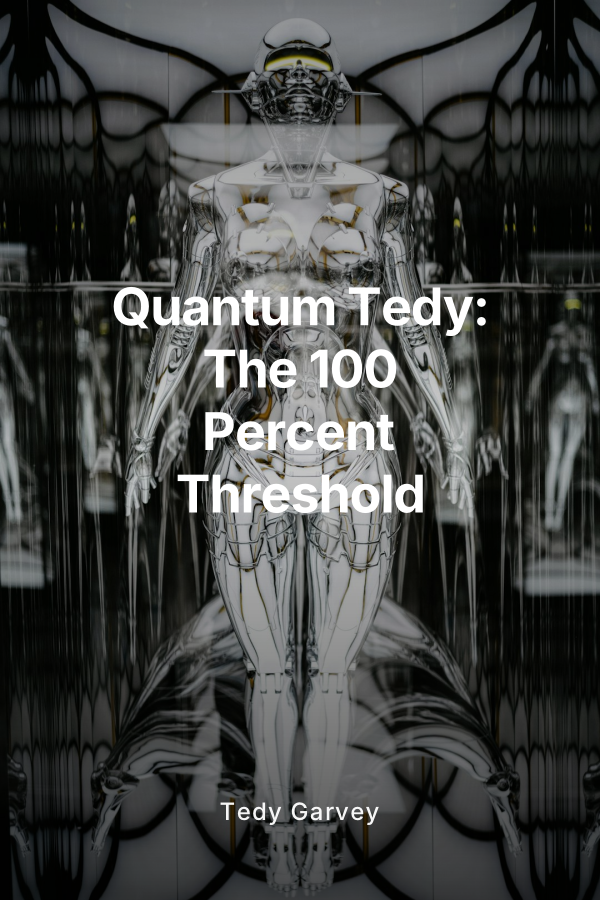
This book is a hard edged, futurist science fiction experiment in identity, physics, and war. It follows sixteen year old Tedy Garvey, an abducted teenager whose bloodstream is converted into a semi living radioactive medium that fuses biochemistry with quantum field behavior. What begins as a forced medical procedure in the back of a van becomes the seed of a new physics. The narrative tracks how one unstable serum, one frightened boy, and one act of scientific betrayal propagate into a multiversal conflict where the basic unit of strategy is not territory or ideology but the definition of a self.
At its core is the potion system, a living colloid of engineered isotopes, quantum bound proteins, and adaptive nanopolymers that integrates with hemoglobin analogs and rewrites cellular throughput. The serum radiates a controlled quantum flux that allows tissues to operate far beyond normal metabolic limits while imposing a punishing constraint: once dosed, Tedy must periodically ingest fresh potion or face systemic collapse. Every use of superspeed, kinetic manipulation, or temporal displacement burns through his reserves, shortening the interval between required doses from months to weeks to days to hours. Metabolism becomes clockwork. Heroism has a dosage schedule. The book repeatedly returns to this dependency as both hard rule and ethical trap.
The 100 percent rule is the defining limit of the system. Every previous subject who allowed the serum to fully replace their native blood died when their cellular scaffolding ruptured under the energy load. Julius Crime, the architect of the program, treats those casualties as data. In hidden facilities he grows clone vats filled with his own iterations, each new Dr. Crime awakening with inherited memories and refined strategies. Death becomes version control. His aim is to stabilize the serum as a scalable bioweapon and to build a clone army that can occupy not just cities but timelines. Against this, Tedy is not a chosen one but a failed experiment that refuses to stay within expected parameters.
Fredrick Durgs, the chemist who first plunges the needle into Tedy’s arm on that fog layered night, is the narrative’s moral hinge. Initially convinced he is working on a therapeutic breakthrough, he discovers Dr. Crime’s industrial clone arrays and realizes that every dose he prepares feeds a weapons platform. His defection creates the first breach in Crime’s design space. Fredrick brings stolen notes, a partial recipe for a crucial phase stabilizer, and a cryptic line about “anchoring the self to a constant” across quantum branches. Under his mentorship Tedy learns not only how to survive his new metabolism but how to treat each brewing session as a controlled experiment with cosmic risk. Fredrick’s eventual death in a defensive stand is both personal trauma and structural pivot, removing the safety net and forcing Tedy to become his own field scientist in the middle of a war.
Parallel to Tedy runs the arc of his eleven year old cousin James Joyce, whose variant dose of the potion manifests as chaotic teleportation, electromagnetic flares, and brutal surges of strength. James’s instability is not comic relief but a second research track. Under battlefield stress his wild output crystallizes into hard light constructs that first armor his hands, then enfold his entire body as a projected mech shell. As Super Robo James, he learns to treat his own bioenergetic field as an engineering resource, building an exosuit with self repairing plates, plasma conduits, and adaptive shielding that reconfigures in response to threat vectors. This mech evolution allows the book to explore applied field theory and emergent machine architectures as literal extensions of a child’s survival instinct.
Across five chapters that each compress several of the outlined story beats, the book scales from intimate biomedical horror to full multiversal siege. Early chapters focus on sensory detail in the van, disorientation on the lab table, first uses of superspeed that stretch perception ahead of causality, and small scale rescues that prove both exhilarating and expensive in metabolic terms. Fredrick’s quiet explanations of dosing curves, telomeric decay, and phase stabilizer tolerances make the science feel like a precise, dangerous machine around which the characters must learn to navigate. As Tedy’s powers evolve from Tier One kinetics to Tier Two phasing and electrical sprinting, every upgrade is explicitly tied to stress, observed behavior, and failed attempts, giving the speculative physics a laboratory realism.
Midway through the narrative, a mountain battle forces Tedy into his first unstable temporal slip. For a few terrifying moments he occupies overlapping timeframes, watches his own near future missteps, and brushes against adjacent branches where he made different choices. These Tier Three quantum events trigger glimpses of other Tedys and lay the conceptual groundwork for later multiversal travel. More importantly, they establish that the potion does not simply enhance biology. It rewires how Tedy’s information pattern interacts with spacetime, creating conditions where identity is no longer confined to one linear history. The discovery that each slip leaves cognitive residue becomes a scientific clue and a psychological burden.
The most dangerous emergent property appears not in combat but in sleep. Exhausted after a sequence of high output engagements, Tedy undergoes mitosis. His quantum field bifurcates and condenses into a separate body: Evil Tedy. This mitosis clone carries the same power set but interprets all underlying equations through a different objective function. Where Tedy values constraint and collateral minimization, Evil Tedy concludes that only absolute dominance can stabilize an inherently branching multiverse. Compassion is recoded as an error term. A similar fracture occurs in James, whose own mitosis event produces James Clone, a cold, systems driven analyst who prizes optimization over lives and views the potion as an industrial process waiting to be perfected. Together these clones transform the narrative from hero against villain into a distributed argument, fought with railguns and rifts, over what survival means when every value can instantiate its own body.
The alliance between Evil Tedy and Dr. Crime reconfigures the war. Crime supplies clone battalions and hidden vats. Evil Tedy contributes multiversal rift technology derived from his advanced Tier Three and Tier Four behaviors. They tear controlled holes between timelines, raiding branches where Crime has already succeeded, importing exotic drone designs and variant weapons that evolved under different constraints. Cities in multiple realities experience simultaneous incursions as rifts open overhead and spill in synchronized forces. Against this offensive, Tedy and James must think in four dimensions, coordinate across three primary battlefronts, and improvise labs in ruined structures to brew increasingly unstable potions under live fire.
As the conflict accelerates, Tedy’s dosing interval collapses. Monthly maintenance drops to weekly, then daily, then hourly. The book uses this collapse to structure its tension. Combat scenes are crosscut with frantic brewing sequences in improvised containment rigs built from scavenged electromagnetic coils and salvaged hospital hardware. Each batch risks not just poisoning his tissues but decohering local spacetime if phase parameters drift into forbidden regimes. The narrative leans into the tactility of this science: the metallic tang of the air, the hum of field generators, the visual patterns of radiation in the dark. Scientific diagrams are implied through vivid description rather than sketched outright, giving the reader a sense of operating inside an experiment that uses the protagonist as both subject and instrument.
The climax rests on a decision framed less as a sacrifice and more as a logically forced theorem test. With Evil Tedy nearing his own completion, clone armies breaching dimensional anchors, and James and Super Robo James stretched across multiple fronts, remaining under 100 percent serum saturation guarantees defeat somewhere in the branching structure of reality. Fredrick’s final message, recovered from his scattered notes, suggests a way to survive full conversion by treating identity as an anchored constant across branches rather than a single fragile timeline. Tedy realizes that his earlier multiversal slips have already constructed partial scaffolds. If he can synchronize these patterns at the exact moment his native blood volume drops to zero, he may transform his self from a biochemical continuity into a quantum anchored network distributed across universes.
The Reaching 100 percent sequence is rendered as both surgical and cosmic. In physical terms Tedy rigs closed loop circulation systems to displace every remaining molecule of native blood with the living serum, while sensors track flux gradients that would shred his tissues if left unmodulated. In informational terms his consciousness traverses the nascent anchors tying together alternate Tedys, resisting the pull of branches that promise simpler lives or ruthless efficiency. Time relaxes into a subjective manifold where he must choose what parts of himself to preserve under a vastly increased energy budget. Survival is no longer just a question of keeping organs functioning but of deciding what human constraints to carry forward into a state where he can rewrite causality as easily as velocity.
He survives, emerging as Quantum Tedy. Tier Four capabilities stabilize. Chrono anchoring locks his personal timestream into a configuration where paradoxes refract instead of erase him. Dimensional anchors weld select sectors of the multiverse against further rift incursions. Full multiversal attunement arrives not as a list of new tricks but as a change in cognitive topology: Tedy experiences branches as addressable vectors, routes probabilities like bandwidth, and can choose which version of reality to invest in. The cost is profound. Humanity becomes an ongoing decision. Every interaction, especially with James, carries the potential to slip toward the cold rationality of Evil Tedy if he optimizes purely for systemic stability.
The book resolves with a tactical win and a strategic unknown. Evil Tedy is forced into a collapsing rift, perhaps trapped in a pocket universe that still touches the network at its edges. Dr. Crime’s active vats are destroyed, though fragmented data indicates that dormant backups may wait in deeper, stranger configurations of reality. Cities rebuild under the protection of new mech field applications derived from Super Robo James’s design patterns. Yet subtle signals across remote branches indicate that Quantum Tedy’s existence has registered as an anomaly. Shadow organizations, variant civilizational stacks, and entities not yet fully described begin adjusting their models. The serum that started as one clandestine experiment now reads as an emergent constant in a larger, hidden physics.
Throughout, the book maintains a technical, speculative tone that treats every extraordinary event as the output of a rule bound system. Powers have prerequisites, side effects are tracked, and every escalation introduces new constraints rather than cleaning up old ones. At the same time the narrative remains grounded in lived experience: Tedy’s terror in the van, his disorienting first sprint where the world smears into vectors, James’s frightened joy when his first gauntlet solidifies around his arm, Fredrick’s quiet confession as he reveals Dr. Crime’s true agenda, and the almost silent moment before the 100 percent procedure begins when Tedy accepts that he may wake up as something the people he loves no longer recognize.
Quantum Tedy: The 100 Percent Threshold is engineered to captivate readers who want speculative systems with the rigor of thought experiments and the volatility of adolescence. It uses superspeed, living radiation, clone politics, and mech warfare as instruments in a larger inquiry. What does it mean to optimize a self when that self can split, replicate, and evolve across realities? How much agency can a teenager claim inside a machine that treats him as a variable? And in a universe where every choice generates an alternate solution, what kind of constant do you decide to become?