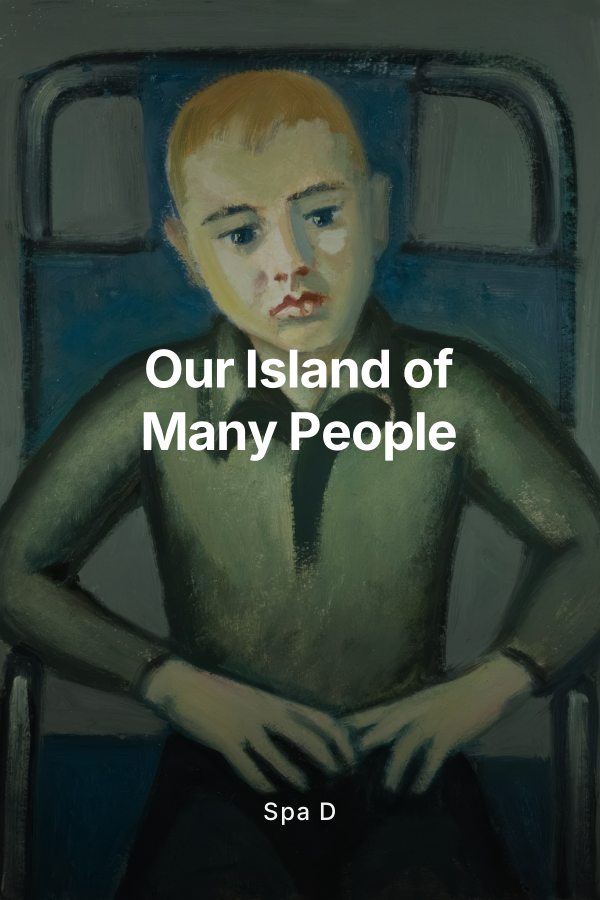
This book introduces young children to Jamaica as a living, breathing home filled with many different people, places, and ways of life. Grounded in simple words and clear pictures, it gently opens the door to ideas about “how many people,” “town versus country living,” and “different cultures and jobs,” using scenes and comparisons that primary school children can easily understand and enjoy .
At its heart, the book invites children to see Jamaica as “our island of many people” rather than as a list of numbers or facts. The emphasis is on what children can see and feel: a bustling town street, a quiet country lane, a classroom full of friends, a farmer in a field, a fisherman at sea, a vendor at the market, a teacher at school, families at church, and neighbours at a festival. Each image is chosen to be familiar enough for children to recognize, yet rich enough to stretch their sense of how big and varied their island really is.
The narrative unfolds in two broad steps that match the reading levels in primary school. The first chapter speaks to the youngest children using almost only pictures and very simple words. Here, the book offers a friendly walking tour across the island, parish by parish. The focus is on faces and places: children, adults, and elders in many different settings, with a special eye on how town and country might look and feel different. The pictures show crowded streets and tall buildings in some parishes and wide fields, beaches, or hillsides in others. The goal is not to teach statistics, but to plant the idea that “many people live here” and “people live differently in different places,” all within one shared home .
The second chapter gently introduces a little more structure for the upper primary grades, while still keeping everything extremely simple and visual. Here, very easy comparisons and tiny bits of number sense appear. Children see that some parishes have more people than others, that more people may live in towns than in the countryside, and that there are more children than elders in many places. These ideas are never presented as heavy data or complex charts. Instead, they appear as simple picture graphs, side by side drawings, or short sentences, such as “This parish has more people than that one,” always grounded in scenes of everyday life .
Throughout the book, the tone is warm, curious, and proud. It invites children to imagine questions about their own lives: “Where do I live? Is my home more like the busy town or the quiet country? What jobs do people in my family do?” By connecting national ideas to the familiar scale of a classroom or a neighbourhood, the book transforms abstract concepts into something touchable and close. Suggestions drawn from the planning notes, such as comparing national population to a classroom, or using rounded, friendly numbers, help keep everything comfortably within the grasp of young minds while still planting the seeds of real understanding about population and place .
The finished work is designed as a resource that teachers can open at any page and use immediately. Each spread stands on its own with a clear image and a few guiding words or phrases. Educators can build simple conversations around town and country scenes, point and count people in each parish on the map, or invite children to describe the different jobs and clothes they see. At the same time, the book can be read silently by children who are just beginning to pick out individual words, giving them both the comfort of pictures and the confidence of reading short, clear sentences.
By the final pages, children come away with three quiet but powerful understandings. First, that Jamaica is home to many people, more than fit into their own town, but still small enough to feel like “ours.” Second, that people’s lives look different across parishes: some live in tall-town houses, others in country yards with trees and fields, yet all belong to one country. Third, that simple comparisons and numbers can help them talk about these differences without taking away the human stories inside them. The book closes as it began, with the image of children, adults, and elders together, reminding young readers that every number they will ever learn about Jamaica begins and ends with real people they might one day meet.
In a world where statistics often float far above children’s heads, “Our Island of Many People” offers an early, gentle bridge. It links the bright, busy scenes of everyday Jamaican life with the first steps into ideas like “how many,” “more than,” and “less than,” always in language and pictures tailored to the youngest learners. In doing so, it helps children see their island not as an abstract shape on a map, but as a living community of people, places, and stories in which they already have an important place.