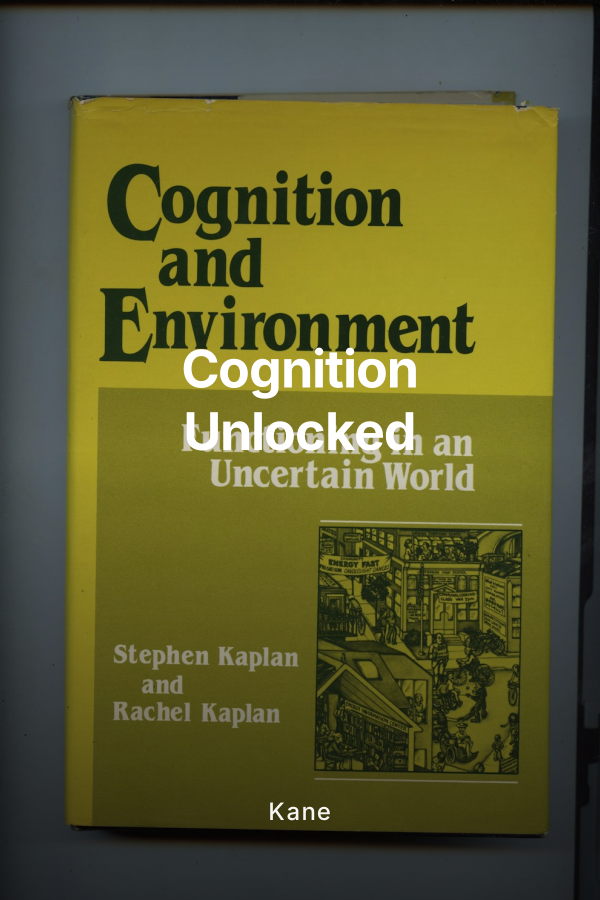
This book shows how cognition is the real engine that drives learning, behavior, and performance in everyday life. Instead of treating school struggles, workplace disengagement, or family conflicts as separate problems, it explains how many of these issues share the same hidden root in how the brain takes in, processes, stores, and uses information. By translating scientific ideas about attention, memory, executive functions, and cognitive overload into simple visual models and practical tools, it equips parents, educators, NGO leaders, and managers with a shared language and a shared roadmap for change.
Structured as a five chapter journey, the book starts by reframing cognition as a system that anyone can learn to observe, support, and strengthen. It uses vivid, everyday scenarios such as a student who “does not get it,” a child who “refuses” homework, or an employee who is always unmotivated to reveal the cognitive mechanisms behind the behavior. Instead of blame or labels, readers see concrete cognitive skills at work: working memory limits, slow processing speed, fragile executive functions, or chronic cognitive overload. Each scenario is unpacked with data informed explanations and then mapped to targeted strategies that can be applied immediately in homes, classrooms, community programs, and organizations.
The second chapter introduces a visual framework for cognition that serves as the backbone of the entire book. Cognition is presented as an “engine” with interacting subsystems: input (attention and perception), working space (working memory and processing), control panel (executive functions such as planning, inhibition, and flexibility), and fuel (motivation, emotion, and energy). Readers are guided to sketch this engine, label it, and then use it as an analysis tool for real situations. Data driven explanations clarify how each subsystem contributes to learning outcomes, productivity, and mental health, making it clear why a weakness in just one component can derail the whole system.
The third chapter focuses on the bridge between cognition and mental health. It explains, in accessible language, how overloaded or unsupported cognitive systems generate frustration, stress, and anxiety, and how these in turn further weaken cognitive performance. The chapter offers a set of visual “load maps” that help readers identify when a learner or employee is in a healthy challenge zone versus a risk zone of overload and burnout. It connects improved cognitive support to greater confidence, resilience, and well being, showing how small shifts in expectations, instructions, and environment can significantly reduce cognitive strain. Practical tools such as checklists, timers, reward systems, and structured breaks are reframed not as shortcuts but as cognitive scaffolds that protect mental health while building independence.
Chapter four turns to practice, offering a portfolio of concrete, enjoyable methods for strengthening cognition across age groups and contexts. Activities such as games, puzzles, creative projects, movement based learning, and multi sensory teaching are categorized according to which cognitive skills they train and how. Readers see how play, curiosity, and social interaction can be organized into low cost, high impact interventions that fit into existing school routines, family habits, NGO programs, or corporate training. For each method, the book explains what cognitive processes are being targeted, why they matter, and how to adapt the activity for different ability levels. The chapter emphasizes how technology can be used strategically to enhance engagement and feedback without creating digital overload.
The final chapter integrates all elements into a systems view of social impact. It shows how a shared understanding of cognition can align parents, teachers, managers, and community leaders around common goals: more equitable learning, higher quality education, better work environments, and healthier communities. Drawing on global development priorities such as inclusive, high quality learning and decent work, it demonstrates how cognitively informed practices can support broader social and educational objectives when scaled through platforms and programs. The book concludes by arguing that supporting cognition is not only a personal or organizational choice but a strategic lever for human potential at every level of society. When families, schools, NGOs, and businesses learn to see and strengthen the cognitive engine in each person, they create conditions where more people can learn effectively, contribute meaningfully, and thrive.