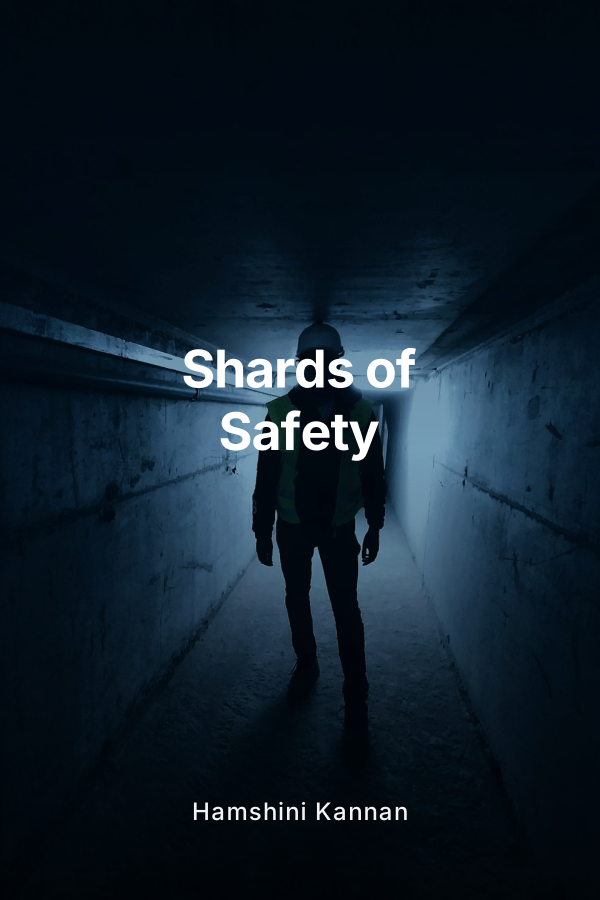
Hana’s life runs on quiet, careful routines. As a young professional in a bustling city, she is used to long workdays, late commutes, and the small, private comforts of living alone. She moves through the adult world with wary independence, carrying old wounds she refuses to name, determined to prove that she can take care of herself. When she meets Jaewon, a reserved yet disarmingly gentle man whose life barely brushes against hers at first, she has no intention of letting anyone close enough to unsettle the fragile order she has built.
The story unfolds entirely through Hana’s eyes, locking the reader into her thoughts, fears, and slow, reluctant hopes. Her single point of view creates an intimate lens that never quite lets us step outside her uncertainty. Facts arrive filtered through her perceptions, emotions, and trauma, so the truth always seems to hover just beyond full clarity. This claustrophobic focus allows every small detail in her day to matter, and every shift in Jaewon’s behavior to feel loaded, significant, and potentially dangerous.
The first chapter establishes Hana’s world before the terror begins. We see her habits, the boundaries she draws with colleagues, and her guarded way of navigating social situations. Jaewon appears here as a quiet presence, an almost accidental constant who shares spaces with her more often than seems coincidental. He is polite, observant, and inexplicably kind in the small, unremarkable ways people rarely notice. The early connection between them is fragile. It is not a sweeping romance but a hesitant, almost reluctant recognition of another lonely person moving through the same city.
Then the incidents begin.
At first, the disruptions in Hana’s life seem almost dismissible. Something moved in her apartment. A small gift appears where it should not be. An anonymous note that could be a tasteless joke. She tries to rationalize each event, weighing her own tendency toward anxiety against the facts in front of her. The story leans into psychological tension more than spectacle at first. Every object out of place forces her to question her own memory. Every message she receives demands that she decide whether she is being cautious or paranoid.
The stalking escalates deliberately and dramatically. The incidents grow bolder, and the gifts shift from oddly personal to unmistakably invasive. The notes become sharper, more possessive, more threatening. The sense of violation deepens with each new line crossed, and Hana’s world contracts as she becomes afraid of her own home, her commute, and every unfamiliar face. The narrative uses this tightening circle of fear to trace how stalking invades not just physical space but also identity, self-trust, and the ability to feel safe even in daylight.
As the pressure mounts, Hana’s relationships strain. Some people dismiss her fears as overreactions. Others try to help but do not fully understand the extent of the threat. Authorities hover in the periphery, unreliable and frustratingly slow. Jaewon, meanwhile, walks a careful line between concern and restraint. From Hana’s perspective, his presence is comforting yet confusing. We see her start to lean on him in small, unspoken ways, even while she fights not to depend on anyone at all.
The turning point of the book arrives with a violent incident that shatters every illusion of safety. The stalker’s obsession boils over into direct attack, leaving Hana hospitalized and physically broken. This moment is not depicted as a sudden twist but as the grim, inevitable culmination of a pattern that has been ignored or underestimated for too long. In the aftermath, the stalker’s identity comes into focus, and the truth slices through Hana’s already fragile trust.
The man who has been tormenting her is Jaewon’s brother.
This revelation corrodes the fragile bond Hana has begun to form with Jaewon. From her perspective, everything about him becomes suspect: his timing, his concern, his silence about his family. Even though he is not the one who hurt her, his blood ties to her attacker feel like another violation. The single point of view intensifies this rupture. We are trapped inside her confusion and anger as she tries to reconcile the kindness she has seen in Jaewon with the cruelty carried out by someone who shares his face, his name, his past.
Jaewon is forced into an impossible position. Through Hana’s eyes, we witness his guilt, his shame, and his desperate need to take responsibility for something he did not personally do. He apologizes on behalf of his brother, not as a performative gesture but as a raw acknowledgment that the person she fears most is entwined with his own history. This apology does not fix anything. Instead, it opens a long, uncertain path where both of them must decide whether healing is even possible when the deepest wound is tied to family.
The latter portion of the book charts this slow, uneven healing. It is not a rush toward forgiveness or romance but a painstaking reconstruction of trust in the shadow of trauma. Hana’s scars are not only physical. She struggles with hypervigilance, intrusive memories, disrupted sleep, and a constant sense that something bad is waiting just outside the frame. The narrative respects her fear rather than minimizing it, showing how survival is not a single moment but a long, repetitive effort to feel safe again.
Jaewon’s presence in her recovery is quiet yet persistent. He offers practical support where she allows it, but the real work happens in the small, halting conversations they share. He does not defend his brother or ask for understanding. Instead, he tries to understand Hana’s pain, even when it implicates him by association. The story explores what it means to carry inherited guilt and how loving someone can demand a willingness to confront the ugliest parts of your own history.
Together, they navigate tangible steps toward safety. There may be legal actions, restraining orders, or court proceedings that run parallel to their emotional journey, but the heart of the narrative is not procedural. It is personal. The question is not only whether the stalker is stopped, but whether Hana can reclaim her sense of self without being defined by what happened to her. The city around them remains the same, but every familiar street and building holds a different weight now, colored by what she has survived.
The romance between Hana and Jaewon is marked by restraint and honesty. It is a love story that does not romanticize trauma or frame healing as something a partner can simply provide. Instead, their connection grows only when Hana actively chooses it, on her terms, and only when Jaewon proves willing to accept the limits she sets. Their relationship becomes a space where boundaries are not obstacles but acts of trust, and where vulnerability is treated as strength rather than weakness.
Throughout the book, the theme of “scarred but healing together” emerges in layered ways. Hana’s scars are visible and invisible, reminders of harm but also of survival. Jaewon’s scars are internal, carved by the realization that someone he loved committed unforgivable acts. The story acknowledges that some damage cannot be undone, yet it insists that life after violence can still hold tenderness, laughter, and moments of unexpected peace.
The final chapter offers a hard won form of hope. It does not erase what happened or promise that fear will never return. Instead, it shows Hana in a life that no longer orbits entirely around her trauma. She has coping tools, support, and the courage to claim joy even when it feels fragile. Jaewon stands beside her, not as a savior but as a partner who has learned to listen, to apologize without conditions, and to exist in her world without demanding that she move faster than she is ready to.
Together, they create a new definition of safety. It is not the absence of risk or the guarantee of control. It is the knowledge that when fear resurfaces, they will face it with honesty and shared strength. The shadow of the past still exists, but it no longer dictates every choice. Their healing remains an ongoing process, yet the book closes on the quiet, powerful certainty that love can grow in the cracks left by terror, and that two people marked by violence can still build something gentle between them.
“Shards of Safety” blends psychological suspense, emotionally grounded romance, and intimate character study into a single narrative voice anchored in Hana’s perspective. It invites readers into the disorienting reality of being stalked, the complicated grief of loving someone connected to your worst nightmare, and the difficult, courageous work of choosing to trust again. Through escalating danger, devastating revelation, and patient recovery, it tells a story not only about survival, but about the fragile, resilient hope of healing together.