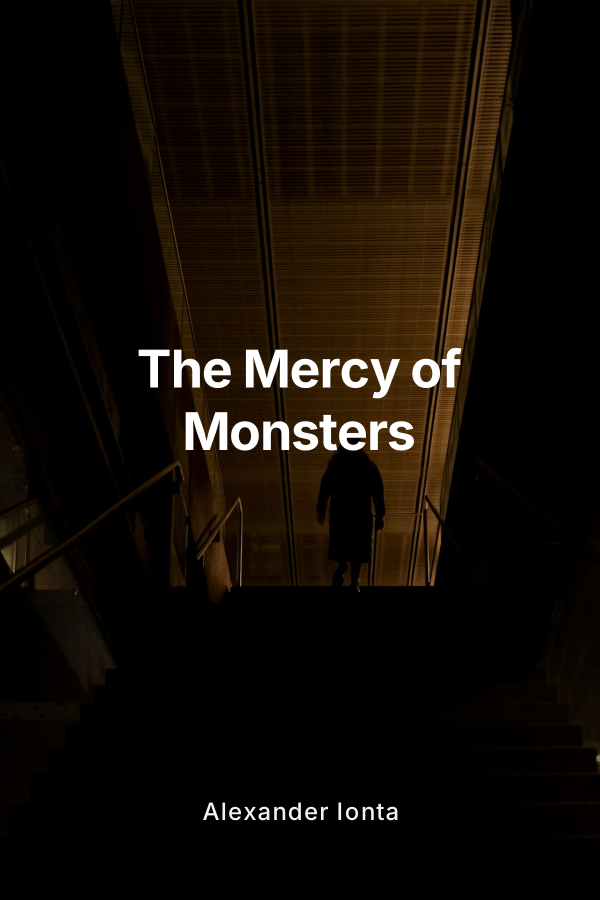
This book follows Julian, a gifted but obscure writer who stumbles into the orbit of Willem, a charismatic philanthropist and secret predator whose public image is built on lies. What begins as a simple ghostwriting job for Willem’s self‑mythologizing memoir slowly mutates into a corrupt intimacy where survival, desire, and ambition fuse into something almost holy in Julian’s mind. The memoir becomes both their shared scripture and their shared weapon, a text that can save or destroy lives depending on whose hands are turning the pages.
Julian starts by doing what he tells himself every ghostwriter does: bending the truth. He polishes Willem’s past, smooths out scandals, turns victims into “misunderstandings,” and learns how to phrase cruelty as resilience. The work is framed as necessary PR spin for a man who funds museums, charities, and cultural institutions. Very quickly, though, Julian realizes he is not just rearranging facts. He is constructing an alibi that stretches across continents, bank accounts, and bodies. Each artful sentence tightens a noose around the possibility of justice.
As Julian is drawn deeper into Willem’s private world, their relationship takes on a strange and heady intimacy. Late night drafting sessions, confessional interviews, and moments of apparent vulnerability draw Julian toward Willem with equal parts disgust and fascination. The turning point comes one evening when Willem finally opens up to him with disarming sincerity. In that moment Julian understands the full extent of Willem’s crimes, and he also recognizes a terrifying truth: he now holds enough information to obliterate this man completely. Knowledge becomes leverage, and leverage feels a lot like love.
From there Julian’s compromises escalate. What began as softening details in a manuscript becomes active collaboration in hiding evidence. He helps recast patterns of abuse as unfortunate rumors, then assists in the quiet destruction of documents and testimonies that do not fit the heroic narrative they are building together. Each time, Julian tells himself he is simply doing his job, or protecting himself, or buying time. Each time, he is lying a little more explicitly, not just on the page but in his own head.
The moral center of the story collapses completely with a death that refuses to stay simple. Yonaton, one of the few remaining people who sees Willem clearly and refuses to be rewritten, reaches a breaking point. He invites Willem to a museum under the pretense of a final confrontation, aching for some form of reckoning or release. Julian, learning of the meeting, rushes there and stumbles into a chaotic, violent struggle that ends with Yonaton’s death in what can barely be called a mercy killing. It is messy, desperate, and far from the neat executions of justice or villainy that thrillers usually promise.
In the aftermath, Julian moves with a precision that horrifies even him. He understands that the story told about this death will define what it means. Yonaton’s final words, heavy with sorrow and apology, could expose Willem and rupture the entire edifice they have built. So Julian edits reality itself. He recasts Yonaton’s last moments as a burst of vitriol toward Willem, one final hateful tirade that justifies Willem’s narrative of persecution and bolsters the myth of his wounded innocence. The truth of the struggle is buried; a new, more useful truth takes its place. The memoir has spilled into real life, and Julian is now revising people instead of pages.
The public fallout is swift. Willem is not imprisoned but exiled, hounded from polite society and forced into a kind of luxurious isolation. In a move that both secures and poisons their bond, Willem quietly buys the publishing house that supports Julian’s career, ensuring that Julian can go on writing as long as he stays in orbit. This financial lifeline is also a leash. Julian’s success is literally funded by the man he has helped to shield, and every book he produces is haunted by the story he can never fully tell.
The novel’s final movement unfolds in Willem’s high‑end condo, a space of glass, steel, and curated art where the outside world feels very far away. Here, Willem and Julian inhabit a routine that resembles domesticity: shared drinks, muted conversations, momentary tenderness that almost feels genuine. The world sees Willem as disgraced and diminished, but inside these walls he still looms over Julian’s life in ways that are both oppressive and strangely intimate.
In the closing scene, they embrace. It is a moment that could easily be read as reconciliation. Willem believes it to be a rare instance of unguarded affection, a sign that some part of his life remains unbroken. Julian holds him with practiced gentleness, even as his mind runs far ahead. Because this time, Julian is not content to merely protect or survive. He is making arrangements. The drugs are prepared. The questions are ready. The recorder is close at hand. This embrace is not an end but a beginning to a new act of exploitation in which Julian is the one in control.
Yet Julian’s control is never as absolute as he wants to believe. What he hopes to extract from Willem is not only a final catalogue of crimes or hidden funds, but also the raw, unfiltered confessions that could anchor a second, secret book. He is no longer simply a ghostwriter for Willem’s self‑serving narrative. He is positioning himself as the sole custodian of Willem’s real story, a story that can be weaponized later against governments, institutions, and networks that quietly benefited from the violence they now pretend to condemn. The betrayal is intimate, almost erotic, but also ruthlessly strategic.
Throughout the book, readers are invited into an uneasy complicity with Julian. The narrative voice hovers between confession and seduction, drawing the audience to admire his intelligence and psychological insight even as his choices become increasingly unforgivable. Moments of doubt and flashes of self‑disgust surface after the murder, but they never crystallize into genuine repentance. Instead, Julian learns to metabolize guilt into a clearer, colder sense of purpose. His nightmares, when they appear, are not about the dead but about losing control of the story.
The core tension of The Mercy of Monsters lies in its refusal to offer a clean hierarchy of evil. Willem is a predator, yes, but he is also a man capable of vulnerability and even moments of misguided tenderness. Julian begins as the apparent victim, the poorer, weaker one, the artist with no real power. By the end, he has become something far more unsettling than a simple accomplice. He is the person who understands that in a world built on performance and narrative, the author of the story can be more dangerous than its villain.
Each of the five chapters of the full book deepens this exploration of truth, authorship, and complicity. The early chapters focus on the craft of ghostwriting and the seduction of influence: how a life story gets curated, which memories are foregrounded, and how a public image is sculpted in boardrooms and back offices. Mid‑book, the emphasis shifts to the machinery of coverups, from legal maneuvering to the subtle rewriting of media narratives and internal reports. The Yonaton museum sequence serves as the book’s brutal hinge, tearing away any remaining illusions of harmless spin and confronting readers with the real cost of “protecting” a reputation.
Later chapters move into exile and inversion. Willem’s power contracts geographically, yet his hold on Julian intensifies. Julian’s external prestige as a writer grows, even as his inner world narrows to the single task of managing this man, his secrets, and the dangerous comfort of their bond. The final chapter, culminating in the condo embrace and planned drugging, lays the groundwork for a potential sequel where Julian’s private archive of Willem’s confessions becomes the spark for new threats, new predators, and perhaps a still more monstrous type of love.
The intended audience for The Mercy of Monsters is readers who are drawn to morally complex psychological thrillers that blend intimate relationships with systemic critique. Instead of a simple cat and mouse dynamic, the book offers a toxic, evolving dependency where cat and mouse trade roles from scene to scene. Romantic tension and erotic undercurrents are present but never simple or purely pleasurable; they function as tools of control, self‑delusion, and mutual survival.
In its full length, the book will explore:
- The ethics of storytelling: how memoir, journalism, and PR can all become instruments of both truth and harm, and how those who craft narratives for others are almost never neutral.
- The psychology of complicity: what it means to keep choosing the self‑serving option long after ignorance is no longer an excuse, and how self‑perception can twist to justify nearly anything.
- The politics of reputation: how wealth, philanthropy, and cultural capital are used to insulate abusers, and how even “whistleblowing” can become a form of power play rather than justice.
- The intimacy of betrayal: why the deepest acts of harm often occur between people who know and even love each other, and why those betrayals can feel, in the moment, like acts of care.
By the last page, readers will not be asked to forgive Julian. Instead, they will be forced to decide what frightens them more: men like Willem, whose brutality is at least recognizable as monstrous, or men like Julian, whose monstrosity is built out of talent, sensitivity, and a very understandable hunger to matter in a world that values stories more than lives. The Mercy of Monsters does not promise redemption. It offers something more unsettling and perhaps more honest: a close, unblinking look at how certain people learn to call their worst betrayals a form of mercy, and how easily the rest of us might be tempted to believe them.