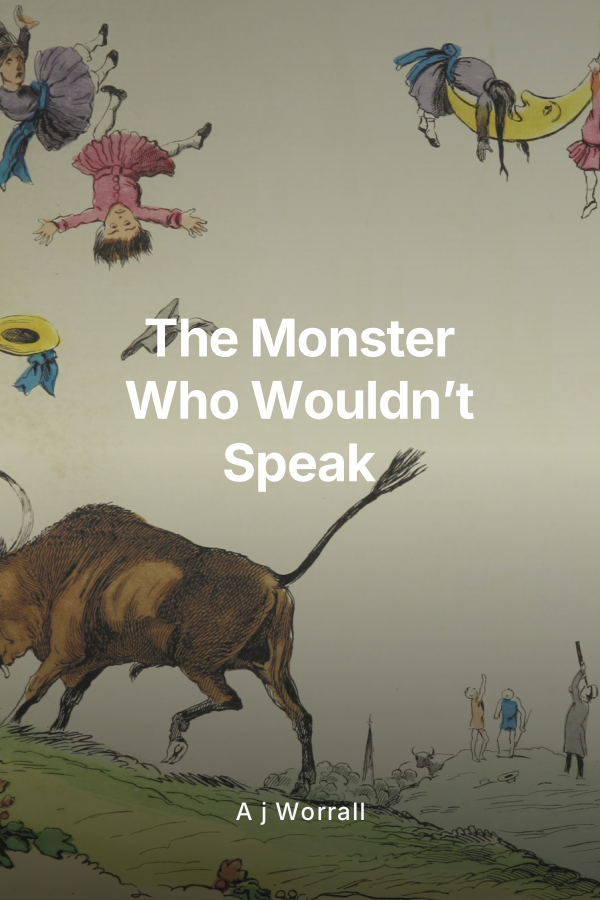
This book unfolds as a gentle, luminous tale about silence, bravery, and the tender work of truly listening, shaped around the simple but resonant premise of an explorer who discovers a monster that does not speak and decides to help it find its voice.
Across two chapters of reflective, emotionally rich storytelling, the narrative follows the explorer from confident problem solver to humbled companion, and the monster from a being defined by its quiet to a character whose inner world slowly shines through.
Chapter 1 traces the meeting of the explorer and the monster, a creature misunderstood not because of what it does, but because of what it does not do speak. The explorer arrives with the bright certainty of someone who believes every puzzle has a clear solution and every silence is a problem to be fixed. Early scenes show the explorer trying method after method to encourage the monster to talk. These efforts are imaginative and kind, but they are shaped by the explorer’s own assumptions about what courage must look like.
The monster’s silence is not simple shyness, nor is it a theatrical refusal. It is layered a blend of past hurts that it cannot quite name, a natural comfort in quiet, and a fear that any sound it makes will be wrong, too loud, too strange, or too disappointing. The story never reduces this to a single neat explanation. Instead it lets children sense that big feelings often sit behind small behaviors, and that a quiet child or creature might be holding far more than they can express.
At first, communication comes in other forms a hesitant nod, a drawing scratched into the dirt, the way the monster leans closer when it feels safe and edges away when it does not. The explorer misses these signals at the beginning, too focused on waiting for words. This imbalance gently mirrors how adults or more confident children sometimes overlook the quieter forms of expression around them.
As one attempted “solution” after another fails, the explorer’s confidence wavers. That unraveling becomes one of the book’s central emotional arcs. The explorer must face an uncomfortable truth the desire to help can itself become a kind of pressure. In moments of private doubt, the explorer wonders if perhaps the monster is not the only one who is afraid. This reflection opens a second, subtler theme the realization that listening is its own kind of bravery and that admitting “I do not know what to do” can be more courageous than charging ahead.
Chapter 2 deepens this transformation. The explorer slowly learns to share silence instead of trying to fill it. Walks through the forest become less like missions and more like companionship. The monster begins to respond not because of a spectacular trick, but because the explorer’s attention turns from fixing to understanding. The “solution” the explorer finally finds is not a magical cure or a loud breakthrough, but a shift in perspective.
Rather than insisting the monster must speak to be whole, the explorer creates a space where the monster is accepted exactly as it is, whether or not it ever speaks aloud. The final turning point might involve a moment of quiet danger or difficulty that requires the monster to act. In that instant, the monster expresses itself in a way that is unmistakably its own a small word, a soft sound, a protective roar, or even a nonverbal act of courage. The story treats this less as a triumphant performance and more as an honest expression that emerges from trust.
By the close, the explorer has learned that some voices are soft, some are colorful, some are hidden in drawings or gestures, and that all of them matter. The monster, once defined by what it would not do, is finally seen for everything it is already doing. Children are left with the sense that:
- It is okay to be quiet.
- You do not need to be loud to be brave.
- True friendship listens more than it instructs.
- Confidence grows best where gentleness and patience are given room.
Throughout, the prose remains thoughtful and lyrical, inviting young readers and the adults who read with them into a shared space of reflection. Scenes are painted with sensory detail that helps children imagine the monster’s world a forest glade where breath clouds in the morning air, a cave where drawings bloom across the walls, a starlit clearing where the explorer and the monster sit side by side, saying nothing and yet sharing everything.
The emotional focus is never on “fixing” the monster, but on transforming the explorer’s understanding of what it means to help. This makes the book especially meaningful for shy or anxious children, for kids who feel different, and for adults who want to support them without forcing them into someone else’s idea of bravery.
The Monster Who Wouldn’t Speak ultimately becomes a story about two journeys folded into one. On the surface, it is the tale of an explorer searching for a way to draw out a monster’s hidden voice. Underneath, it is the story of a childlike heart learning to cherish silence, recognize quieter strengths, and honor the many ways a soul can say “I am here” without needing many words at all.