In the irradiated shadows of the Mojave, eighteen year old Jessie begins as little more than property. The naked, shambling ghoul she calls “father” keeps her in rags and filth, half feral, half invisible, surviving on scraps and terror in a shack far from the Strip’s neon. She learns young how to turn her mind off, how to endure, how to let humiliation slide across her skin without ever quite sinking in. The only light she knows comes from rumors: the distant glow of New Vegas, where caps flow, music plays, and no one knows her name.
When one beating too many cracks something inside her, Jessie runs. Barefoot, filthy, and numb, she staggers toward the Strip with nothing but a will to see another sunrise. New Vegas in 2079 is a carnival of vice, rebuilt and corrupted past anything the pre war city ever dreamed. Strip clubs promise every flavor of flesh, brothels stack bodies four stories high, cashinos glitter under pornograph billboards, nude gun lounges, and XXX holos blaring at all hours. Jessie is swallowed almost immediately.
The Nuka Pussy Cashino takes her in, not as a victim but as product. In a tight bunny outfit that barely qualifies as clothing, her “huge tits” and curvy ass become part of the décor as she serves drinks, chips, and greasy food to gamblers and degenerates. For Jessie, it is almost a relief. No one knows her past. Nobody calls her “daughter.” She is an object again, but this time with caps in her pocket and hot water in the staff showers. Humiliation no longer stings; it is simply the price of staying alive.
At first, Jessie moves through the Cashino in a fog. She learns the angles of a crowded floor, the way to slide between drunk arms without spilling a drink, the unspoken rules that keep a bunny from getting dragged to the VIP rooms. Paid sex is her hard line. Every other girl eventually crosses it. Jessie does not. The pressure mounts in whispers from management, casual shrugs from co workers, and the ever present eyes of high rollers, but she keeps her body for herself even if her image belongs to the house.
Her numb routine cracks one night at Cowboys Delight, a male strip club where she and her friend Sarah blow off steam watching dancers in cowboy hats and little else. Across the smoke and strobe lights, Jessie spots soldiers. Not simple guards but armored figures with strange emblems, mixing the symbols of two feared powers. Sarah explains what they are: remnants of Enclave hardliners and Brotherhood of Steel knights, rumored to have formed something new together.
Curiosity flares. In those soldiers, Jessie sees something she has never had: purpose, discipline, and a code. The next day she visits a recruiter’s office out of half formed desperation and raw instinct. The female recruiter gives her a choice. Enclave. Brotherhood. Or a third emblem pinned carefully between the others: the United States Cavalry Corps: Steel Division.
This Steel Division is a joint operation that weds Enclave intelligence, ruthlessness, and long range marksmanship with Brotherhood physical training, ground pounding discipline, and ironclad hierarchy. They have taken the iconography of nineteenth century cavalry and welded it to power armor, laser sights, and wasteland pragmatism. Their mission is simple and absolute: preserve the human race by exterminating everything that falls outside their definition of “pure.” Ghouls. Raiders. Super mutants. Nightkin. A newer horror they call Comanche ghouls, tribalized feral packs patterned after the brutal legends of the Old West. Anyone who shelters them dies too.
Jessie looks at the three paths laid out: stay a bunny, drift between vices, or ride with men and women who kill the kind of thing her father has become. She chooses the saddle.
Her induction is not a soft transition but a controlled ordeal. Stripped down in a decontamination bay, blasted with searing hot water and freezing jets, pounded by gusts of air until her skin feels flayed, she is treated not as a woman but as a contaminated asset to be burned clean. There is no pleasure in it, only pain, exhaustion, and a strange sense of being smelted into something else. A clinical medical intake follows: height, weight, scars, muscle, posture, every inch catalogued with cold efficiency. She leaves with itchy decon powder in her pores, a shaved down outer shell of her old life, and a bundle of drab uniform pieces that are the first clothes she has ever truly owned.
From there, the book plunges into a horror soaked war western as Jessie is absorbed into a squad that will become her new family: Cooper Howard, Kellogg, the three Shelby brothers with their brutal charisma and battlefield humor, and White Jackson, all under the iron rule of Captain Lucas Briggs. The “shark attack” phase of training breaks them down with screaming drill instructors, sleep deprivation, and ideological bombardment. Jessie listens as Elder Maxson and General Truss lay out a doctrine of total war against anything non human, their rhetoric echoing both Enclave extremism and Brotherhood fanaticism.
Training is relentless and tactile. Under a boiling sun, they run until people vomit, grapple in brutal jiu jitsu and wrestling drills that leave them bruised and bloodied, trade punches in boxing rings where mercy is a foreign word, and shoot until their shoulders are purpled from recoil. Jessie’s natural gift with pistols surprises the cadre and her squad alike. She starts as a skinny ex cashino girl who cannot win a clinch, but she refuses to quit and grows into a fast, accurate shooter who can drop steel plates while gasping for air.
One particularly vicious training day forces each recruit to ambush another at random. Knowing that any corner might bring a fist, elbow, or chokehold rewires Jessie’s instincts. The man who jumps her does more than pummel her; he brands her left shoulder with three stars, a scar that marks the moment she truly belongs to the Cavalry. Later, ice baths sear their nerves, and the Enclave, Brotherhood, and Cavalry tattoos branded into biceps and chest permanently fuse their bodies to the cause. Jessie feels pride rather than fear. She has been owned before. This time she has chosen her owners.
Out of this furnace, the Steel Division mounts up. In green cavalry uniforms echoing the 1800s and contemporary wasteland gear layered over them, sabers at their sides, rifles slung, sidearms holstered, they ride real horses across irradiated Nevada sand. Their first deployment pits them against Minotaurs, twisted abominations that are more insect and nightmare than man. The combat is dark and gory, with close quarters saber work and rifles thunder that blends western charge and horror siege. Jessie learns to see monsters not as unknown terrors but as targets that bleed, scream, and die.
Their next campaign stretches into New Mexico where Comanche ghouls haunt the mesas and ravines. These ghouls raid with old Comanche fury in irradiated form: scalping, burning, torturing, sometimes committing atrocities that the Steel Division’s propaganda only hinted at. Jessie rides through razed settlements littered with desecrated corpses. The imagery brands into her mind as deeply as the scars on her skin. Whatever doubts she might have carried about killing ghouls crumble before the carnage she witnesses. Her father becomes less a singular tormentor and more proof of an entire category that needs to be erased.
A year of patrols, night raids, and relentless hunts carves hard edges into the squad. Yet emotionally Jessie remains strangely stable. She tells jokes around campfires, trades crude banter, swims in base pools when they rotate back to Vegas, and dives into the Strip’s bars, casinos, brothels, and strip clubs without drowning in them. Killing has not broken her; if anything, it has given her context. The horrors she grew up with are no longer private shame but part of a larger war she feels justified in fighting.
Their second long deployment pushes them from Texas through swampy Arkansas into Missouri. Along the way they take down raider gangs, stalk more Comanche packs, and finally confront entrenched super mutants in a fortified stronghold. The book lingers not only on the battles but on everything between: horse care at dusk, sand crusted gear, the stink of rotting marsh, arguments around stew pots, the quiet ritual of cleaning rifles under an indifferent moon. Landscapes shift from desert to swamp to broken plains, each region birthing new nightmares and new campfire stories.
The climax of this campaign is the assault on a super mutant fort, a pitched fight that fuses all their training into one bloodstained symphony of coordinated fire and saber charge. It is brutal and costly, but they take the fort, plant their banners, and ride back to base as proven killers.
Promotion follows. Jessie and her squadmates are elevated to base commanding lieutenants, each given authority to shape the outpost’s culture and rules. Jessie, forged in naked degradation and strip floor objectification, surprises everyone with one of her first decrees: no porn or casual sex on base. Any such indulgence becomes a rare reward, tightly controlled. For soldiers starved of distraction, her decision is both resented and quietly respected. She knows what unrestrained flesh markets do to the vulnerable. She refuses to build a military that runs on the same fuel that once trapped her.
At the same time, command uses her image strategically. Jessie poses for military style pinup photo shoots in caps, jackets, and cavalry gear, echoing mid twentieth century propaganda posters. These images are not for private indulgence but for recruitment, morale, and the myth making of the Steel Division. In them, Jessie learns a new way to own her body: as a symbol she can leverage rather than a commodity others control.
Running beneath the entire narrative is Jessie’s evolving relationship with control, violence, and identity. From the very first time she steps under hot shower water in the Cashino staff quarters, watching years of dirt swirl down the drain as she trims her body hair for herself instead of someone else, to the moment she sits in uniform, boots on, pistol cleaned, giving orders about what may or may not enter her base, the book tracks a single, unbroken line of time. There are no skipped years or blurred ellipses. Every step from the ghoul’s shack to the Cavalry’s command tent is laid out in sequence, letting readers feel how each bruise, each laugh, each kill, and each quiet meal by a campfire shapes her.
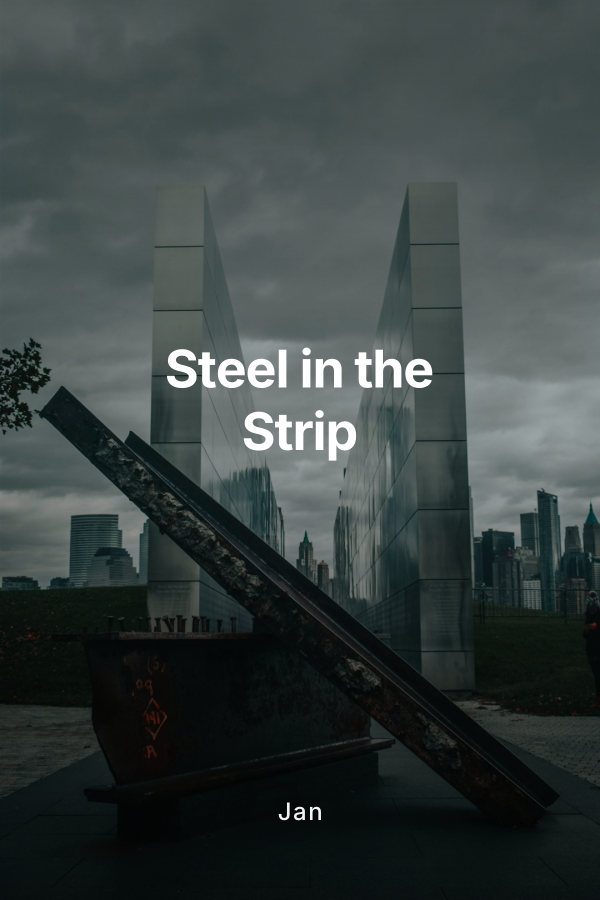
“Steel in the Strip” is a horror thriller western set in a Fallout style wasteland, told in a raw first person voice that never shies away from the disturbing, the violent, or the morally compromised. It follows Jessie as she transforms from abused runaway in porn splashed New Vegas to a hardened cavalry officer devoted to a cause that mixes heroism with genocide. Through explicit physical experience and unsparing psychological detail, the story asks where the line lies between reclaiming one’s body and becoming an instrument of someone else’s ideology, and whether a girl who learned to survive by feeling nothing can ever truly choose what kind of monster she becomes.