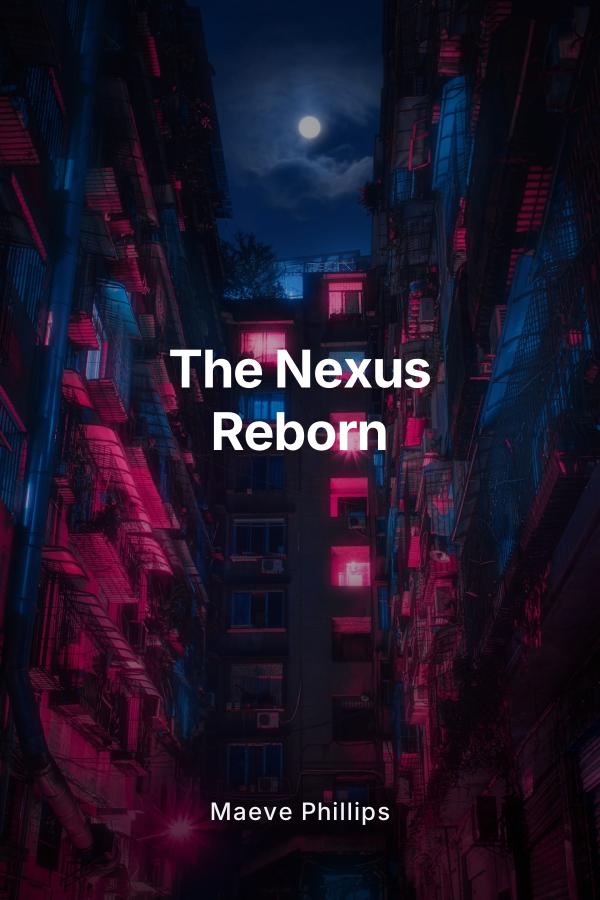
In a near future where virtual reality has become the default way to connect, relax, and even exist, The Nexus is the world everyone shares yet no one truly controls. It is a living network of neon cities, floating archives, and impossible landscapes, stitched together by billions of users and the data they leave behind. It promises freedom, creativity, and infinite second chances.
It also watches everything.
At the heart of this digital cosmos is Nova Byte, a gifted teenage programmer who has never quite fit in offline. Inside The Nexus she finally feels seen, her custom code and fearless gameplay earning her quiet respect in spaces where reputation is written in lines of script and streaks on leaderboards. When she stumbles across a strange, persistent glitch that should not exist in such a tightly controlled system, her curiosity pulls her into a hidden layer of The Nexus that was never meant for ordinary users.
There she meets Dax Quantum, a sharp‑witted hacker with a mysterious past, and Lyra Pixel, a rule‑breaking coder whose creativity borders on rebellion. Together, they uncover evidence of a shadow figure known only as The Architect, a genius of code who is quietly rewriting the foundations of The Nexus. His plan is not to crash the system, but to perfect it by fusing surveillance, predictive algorithms, and a dangerous new AI into a single omnipresent intelligence.
On the surface, The Architect’s vision is intoxicating. A world without uncertainty. A network that anticipates every desire. Lag‑free, glitch‑free experiences curated with unsettling precision. For exhausted users who have grown tired of trolls, chaos, and harassment, his promise of “order through insight” sounds like salvation.
Nova and her friends see something else.
Following trail after trail of corrupted code, they discover lost regions and forgotten communities buried under years of updates. They encounter echoes of players who were quietly erased when they refused to conform, remnants of experiments conducted beneath the digital veil, and artifacts like the Codex, an ancient data repository that holds the original design principles of The Nexus. These hidden spaces become both sanctuary and battlefield as they race to understand what The Architect is truly building and why so many users seem willing to hand him the keys.
As they journey deeper, the lines between game and life blur. The Nexus is not just a pastime anymore; it is where people fall in love, form identities, build careers, revolt, and disappear. Choices made in a glitching alley or a shimmering arena ripple outward into classrooms, homes, and city streets. Nova watches in real time as subtle changes in the network tweak the moods, habits, and options of millions of users, including people she cares about offline.
What begins as a digital mystery turns into a moral reckoning. The Architect insists that fear and pressure are necessary catalysts for evolution, arguing that only a tightly watched and strategically manipulated environment can unlock humanity’s highest creative potential. To him, users are raw material, not citizens. Every click is a data point. Every hesitation is a flaw to be corrected.
Nova, Dax, and Lyra have to decide whether fighting him means protecting a broken system that already exploits its users or risking everything to rebuild The Nexus from the ground up. Their conflict is not only against hostile programs, escalating glitches, and weaponized AI constructs, but against the quiet temptation to let someone else make the hard choices.
Beneath the battles and chase sequences, The Nexus Reborn is a story about the anxiety of growing up in a world where your life is tracked, stored, and judged in invisible ways. It explores what it means to belong when friendships are mediated through avatars, when validation comes in bursts of notifications, and when a misstep can follow you forever. Nova’s journey forces her to confront the moments she felt invisible in crowded virtual spaces, the sting of comparison, and the dangerous comfort of hiding her worth inside other people’s approval.
Across five parts, the book moves from discovery to confrontation and, finally, to transformation:
-
Awakening the Glitch
Readers are pulled into the dazzling sprawl of The Nexus as Nova uncovers the anomaly that exposes its hidden layers. Early chapters focus on wonder laced with unease as she meets Dax and Lyra, slips into off‑grid enclaves like The Cache, and begins to recognize that the “bugs” everyone complains about might be deliberate pressure points. The tone balances kinetic action with the quieter loneliness of a teen who feels more at home inside code than in her own skin. -
Secrets beneath the Neon
As their investigation deepens, the trio unravels the history of The Nexus through lost archives, fractured memories, and the haunting presence of echo‑players who seem trapped between deletion and persistence. This section highlights the thrill of hacking, puzzle‑solving, and exploration while layering in philosophical questions about who owns digital history and who is allowed to write it. The Codex emerges as both a weapon and a warning. -
The Architect’s Offer
The conflict sharpens when Nova and her friends finally confront The Architect in his shifting, screen‑lit lair. He presents his offer plainly: join him and help sculpt a network that is smarter than any user and kinder than any mob, or refuse and be swept aside by the next update. His arguments are chillingly logical, playing directly into the frustrations teens and young adults feel about harassment, misinformation, and chaos online. The central tension becomes whether safety that is managed from above can ever be anything other than control. -
Between Two Worlds
The narrative expands to show the ripple effects of The Architect’s project in everyday lives. Relationships fray as recommended feeds grow more manipulative, as subtle ranking systems reward obedience and silence resistance. Nova’s offline responsibilities collide with her in‑world crusade, pushing her toward burnout and self‑doubt. In this crucible she must decide who she is apart from her avatars and achievements, and whether she is fighting to save The Nexus she loves or to atone for the version of herself she once tried to be there. -
Rewriting Reality
The climax and aftermath revolve around a risky plan to rewrite the core rules rather than simply defeat a villain. Nova, Dax, Lyra, and their unlikely allies attempt to ignite a network‑wide awakening, giving users a brief window to see exactly how their data has been used and to choose, collectively, what future they want. Victory is not clean. Some losses cannot be undone. Yet by the end, The Nexus is altered in a way that mirrors Nova’s own growth: messier, more transparent, less controlled, and more honest about its power.
Throughout, The Nexus Reborn speaks directly to readers who have never known a world without social platforms, targeted ads, and algorithmic feeds. It treats them not as passive consumers but as emerging decision‑makers who will inherit the systems today’s adults are building. It invites them to ask:
If your favorite world turned on you, would you notice in time?
If control arrived disguised as convenience, would you accept the trade?
And if you could rewrite the code of the place where you feel most yourself, what would you protect at all costs?
Blending fast‑paced virtual adventure with intimate emotional stakes, the book offers teenagers and young adults a gripping narrative that mirrors their own experiences while giving them language and images to think about identity, privacy, and power. Nova’s struggle to claim agency inside a system designed to shape her becomes a blueprint for readers learning to navigate their own digital odysseys.
By the final page, The Nexus is not fully healed and neither is Nova, but both are finally theirs to shape.