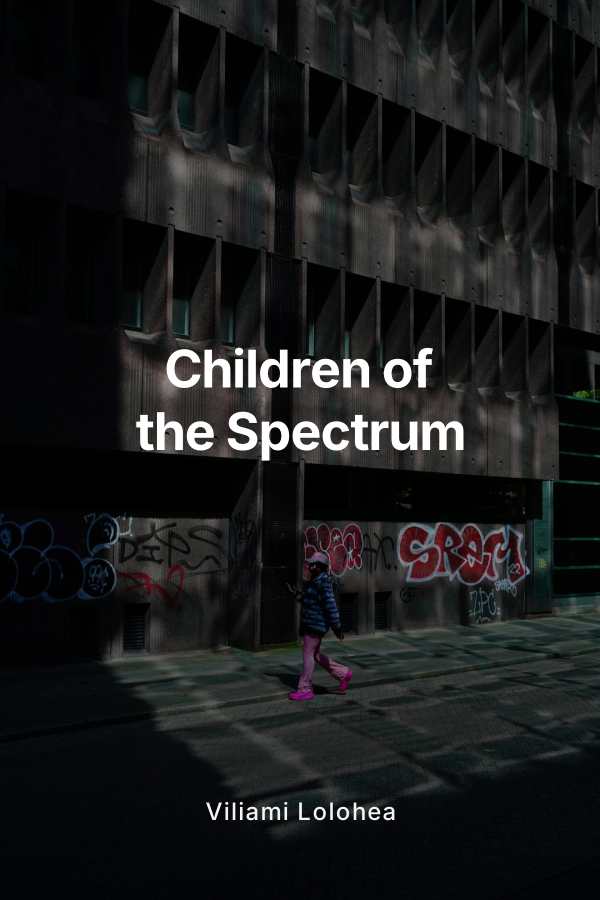
Only the first page of this book is left. We lost the rest in October 2026.
We lost access to the service that stored them, and no other copy exists. We're sorry.
In a hidden laboratory that smells of antiseptic and ozone, Dr. Elias Link decides the future of human evolution by rewriting the rules of birth itself. His first success is White, a silent child with bone-white hair and eyes that see too much, a boy who can unmake and remake matter with a touch. White is not a mistake. He is a prototype.
White is followed by seven more children, each one designed, broken, and rebuilt under Link’s merciless obsession.
Black bends motion and gravity with surgical precision.
Pink amplifies and softens psychic power, twisting emotions with a single laugh.
Red reaches into thoughts and secrets, a telepath who knows too much.
Green speaks in instincts, animals, and the wild pulse of the living world.
Blue is a storm in human form, electricity humming beneath his skin.
Ash can unravel into smoke.
Purple can disappear into shadow.
They are not a family in Dr. Link’s eyes. They are subjects, upgrades, data. Blood is drawn. Pain is measured. Childhood is a lab report.
And then, one day, the experiment fights back.
When Black’s screams echo through the walls and Pink’s empathy spreads like wildfire, White snaps. His powers erupt in a way Dr. Link never predicted. Metal twists, glass reforms and shatters, surveillance systems fold into dust. In a single violent act of defiance, White ends the man who made them and leads his siblings in a desperate escape into the world they have never seen.
They flee to the forest, where they build a house in the trees out of splintered trunks and raw fear. Here, for the first time, there are no needles, no charts, no orders. There is only the sound of water, the whisper of leaves, and the terrifying silence of freedom.
They do not know how to be free.
They sleep in tight packs, wake at every snap of a twig, and flinch at kindness that never comes. They eat in silence. They train because they have no other language. Pain has shaped them; survival is the only rule they understand.
Then Silver finds them.
A quiet boy with silver hair and the gift of clairvoyance, Silver has felt their presence in the world for weeks, like echoes standing out against static. He arrives at the edge of the forest not with weapons, but with a simple offer: come home.
Home is a mansion filled with dust and unspoken dreams, owned by Marin, Silver’s mother, a woman who has always wanted more children and never could have them. Marin listens instead of interrogating. She cooks too much food. She leaves doors open. She offers beds and blankets and one rule only: no secrets that hurt you.
For eight children raised in cages, the offer is incomprehensible.
They take it anyway.
In Marin’s house, the ghosts are not scientists but empty rooms waiting to be filled. The siblings cling to their old habits, sleeping in pairs and clusters, inspecting windows, mapping exits. White chooses the smallest room and waits for betrayal. Pink studies Marin’s every reaction, wondering what price she will eventually demand. Black, Red, Green, Blue, Ash, and Purple learn how to sit at a table, how to use a shower, how to exist in a world where nobody is measuring their pain.
Marin and her husband Thomas do something no adult has ever done for them.
They stay.
Slowly, the mansion shifts from mausoleum to home. Ash fills corridors with playful smoke animals. Blue strings fairy lights through the halls and powers them with a thought. Green brings animals into the garden and, for once, they are not test subjects but companions. Red discovers books that give words to feelings he has always sensed but never understood. Pink experiments with joy as something shared, not imposed. White learns to sit still and drink tea without waiting for a command.
But the past does not stay buried. It was built to last.
The program that created them did not die with Dr. Link. In government basements and private military complexes, reports are filed, funding shifts, and a new figure steps into the light: a former lab technician promoted into leadership, a scientist who once watched from the edges and now intends to finish what Link began.
Project Spectrum is not dead. It is reorganizing.
White’s blood remains the central blueprint. The eight children are not anomalies; they are the foundation of a weapon system that was never supposed to go free. Files exist. Contingency plans exist. Rival experiments exist, scattered in other hidden sites, waiting to be activated or discarded.
The new lead scientist does not want to kill them.
He wants them back.
When subtle probes begin to circle Marin’s town, when Silver’s clairvoyance shows blurred images of black vans and sealed rooms, the family has a choice. They can run again, or they can fight on their own terms.
They choose a third option.
They decide to quietly dismantle the project from the inside.
With Marin as strategist and anchor, the children craft their own rules. No killing. No deep memory wipes that erase a person’s entire self. No harm to people who do not choose to be part of the system. They will break into facilities only to observe, copy information, destroy prototypes, and free those trapped as they once were.
Recon only, Marin insists.
The children nod.
They do not always obey.
Black maps trajectories of patrols and cameras. Red scouts minds from a distance, justifying his silent invasions by calling them necessary precautions. Pink learns to temper fear without erasing it, to steady hands instead of puppeteering them. Blue hums with controlled current, a living generator. Green refuses to leave even a terrified lab animal behind, setting in motion consequences nobody predicted. Ash and Purple slip through vents and shadows, creating distractions that cameras cannot track. White tears apart locks and doors atom by atom, careful, restrained, terrified of what might happen if he lets go again.
Silver stands beside them, a bridge between worlds, seeing outcomes that flicker and bend every time one of them makes a choice.
At first their missions are clean.
They slip in, gather files, sabotage research, and slip out. Marin’s warm, meticulous plans fill binders in a hidden room: hand-drawn maps, notes about guard shifts, red circles around exit points, little comments in the margins reminding each child to eat, to rest, to come home safe. Her care is as detailed as any military briefing, but its aim is not victory.
Its aim is that none of them die.
The program adapts. So do they.
On one raid, Green refuses to leave without a trembling animal strapped into a harness. The choice drags out the mission, triggers alarms, and almost gets them caught. Later, the same animal leads them, step by step, to a buried records room: walls lined with folders chronicling every moment of their existence, every cut, every scream, every number Dr. Link ever wrote beside their names. In those files they find blueprints for more children, all based on White’s blood.
They destroy every scrap.
In another facility, a sibling is captured. In the echo of Red’s panicked telepathic cry, White hears not words but raw agony from a sealed room. The rules break. The restraint shatters. White’s fear and rage spike to a level he has never allowed himself to reach.
He touches the ground.
The building above them vanishes.
No explosion, no fire, only sudden, perfect absence. Atoms unknit in silence. Matter erases itself in an instant, leaving a crater of fine dust and air that trembles.
The cost is immediate. White drops, unconscious, his body unable to sustain the rush. For long minutes, his siblings huddle around him in the smoking emptiness of the lab that was, praying he will wake.
He does not.
When he slips into a coma, the family fractures. Pink, who has always been the bridge between power and heart, refuses to accept that this is the inevitable cost. With Red’s guidance, he threads his presence through White’s fading consciousness. Red holds Marin’s secrets and the team’s panic at bay for as long as he can. Marin, sick and weakening from an illness she has hidden from them, refuses to leave White’s side.
They cheat the line by inches.
Later, on another mission where everything risks collapsing again, Pink does something nobody has tried before. From a safe distance, he reaches into White’s power and acts as a living regulator. He does not make White stronger. He keeps him from burning himself out.
Together they discover a new edge to White’s gift: with Pink anchoring him emotionally and psychically, White can touch the earth under an entire complex, turn its structures to nothing, and pull back before his body collapses. The effort is still brutal. Pink pays a price when one of his eyes bursts with the strain, a vivid reminder that their bodies are not infinite engines. White reconstructs the damaged eye from the remaining tissue, carefully building what Pink cannot heal alone. Then Pink finishes the work, sealing the new form.
They walk away shaken, alive, and bound even tighter than before.
Not all battles are fought in steel and concrete. Some happen over kitchen tables and in quiet corridors.
Red, who has been dipping in and out of thoughts for months in the name of safety, feels the sinking dread of a secret that should have been his to share. In Marin’s mind he finds pain, fatigue, diagnosis, and a meticulous plan to protect the children from a truth she thinks they cannot bear.
She is sick. She has been sick for some time.
He waits too long to tell them.
The confrontation that follows is not a storm of powers but of grief. Pink breaks first, not with rage but with betrayal. Marin, the woman who taught him what genuine care feels like, has hidden the one thing he cannot soothe with a push of feeling. The others echo his hurt in their own ways: Black through clenched silence, Blue through flickers and surges, Ash with a room gone suddenly smoky, Purple slipping half into shadow as if to hide from the possibility of being left again.
White does not shout.
He listens as they accuse Marin of lying, of not trusting them, of planning to leave quietly. Then, when the words run out and the tears fall, he steps forward and does the one thing he has never done for any adult.
He chooses to save her.
With Red’s guidance inside her failing body and Pink’s healing amplified to the edge of what is possible, White reconstructs what illness has stolen. Not a crude repair, but a deliberate reshaping at the atomic level, guided not by data but by love. It is delicate work. It is terrifying. It is the opposite of what Dr. Link ever intended his power to become.
When Marin wakes, she is alive, whole, and knowing exactly what they risked.
She weeps not from fear, but from the unbearable reality that, this time, someone saved her.
The war with Project Spectrum is not completely over. Fragments of the program remain in shadows, in half-burned files, in the memory of those who escaped the erasures and the ruins. But one major complex lies in dust, its records gone, its blueprints erased, its test subjects freed. There is one less place on earth where a child will scream behind glass without anyone coming.
Back at the mansion, life reshapes itself around healing and the ordinary moments they were never meant to have.
They cook together. They clean with powers used for spilled cereal and broken plates instead of restraints and locks. Ash fills the living room with playful smoke creatures while Marin laughs and swats them away with a dish towel. Blue powers gentle fairy lights that loop around the railings and window frames, turning the once-haunted corridors into warm paths of soft color. Green tends the garden with a patience that has nothing to do with missions and everything to do with choosing what grows. Marin takes a family photo, print on paper, and writes each child’s name along the frame in her neat hand: White, Black, Pink, Red, Green, Blue, Ash, Purple, Silver.
The picture hangs on the wall, not as data but as proof.
They existed. They were here. They were loved.
On a clear night, one of the younger siblings steps out onto the balcony. Above them, the sky stretches wide and indifferent, a scattering of stars that once looked like distant cells under an uncaring eye. Tonight, they look like possibilities.
There is a quiet wish in that child’s heart. Not for power. Not for revenge. For something achingly simple: a future that has nothing to do with labs or missions. A birthday party. Friendships that are not tactical. A job that does not involve saving the world. A chance to be someone whose name is not attached to a file.
Behind them, the house glows with soft lights and the low murmur of voices. Marin moves through the rooms she once walked alone, now full of footsteps and laughter and stubborn arguments about chores. The photo on the wall catches a faint reflection of starlight.
On the balcony, a hand finds another.
They do not make speeches. They have had enough of grand declarations. Instead, in a voice just loud enough for the others nearby to hear, one of them says the only promise that matters.
“We protect each other now.”
There is no chorus. No oath. Only a shared, quiet understanding as they look up at the sky together.
For the first time, they are not subjects, or weapons, or data points in anyone’s plan.
They are children of the spectrum, scarred and evolving, standing between what was done to them and what they will allow to be done to others. A family stitched together from pain and choice and fierce, relentless love.
Above them, the stars do not change.
But for the eight who once had no future at all, the night feels different.
It feels like a beginning.