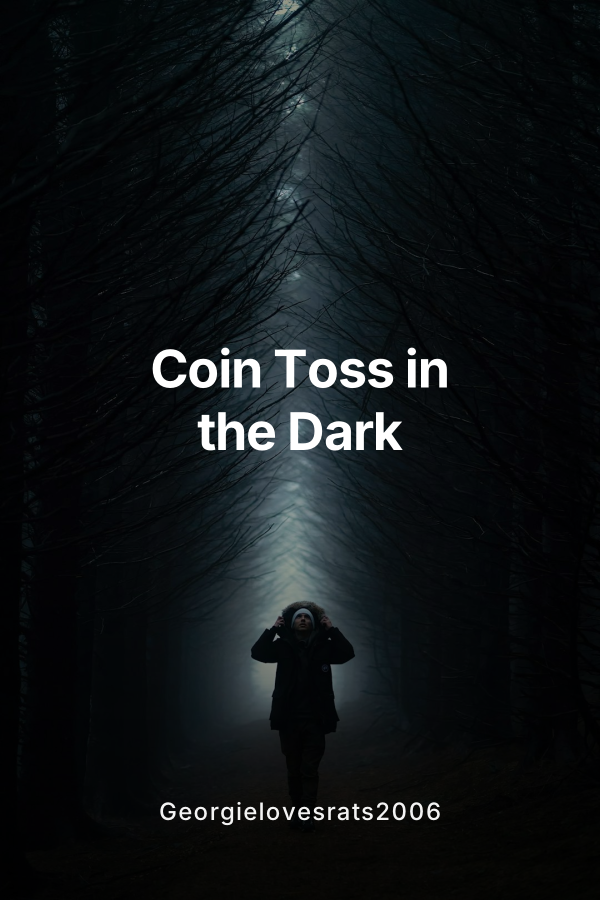
Only the first page of this book is left. We lost the rest in October 2026.
We lost access to the service that stored them, and no other copy exists. We're sorry.
In a quiet college town, a simple overnight lock in is supposed to be a break from exams and pressure. Lisa, a driven and fiercely protective mentor, agrees to supervise her small group of students for a night of movies, games, and laughter in one of the campus halls. Chlo, Amy, Daniel, Kendra, Jake, Jacob, Robert, and Janey trust Lisa. The building is locked, the lights are warm, and the world outside feels distant.
Then the lights go out.
There is no warning, no drawn out buildup. One moment the room is full of jokes and half finished snacks. The next, it is swallowed by a blackout that erases everything. By the time Lisa and her students open their eyes again, the lock in is over and the real nightmare has begun.
They wake in an unfamiliar basement, spread out on a cold floor, wrists and ankles bound so tightly that every tiny movement bites into skin. Their wheelchairs, mobility aids, and any sense of control are gone. Chlo, who lives with cerebral palsy and relies on her legs only with help and support, has been stripped of both her sticks and her chair. She lies slower and more vulnerable than anyone else, forced to drag herself across the floor with her arms if she wants to move at all.
Every one of them is restrained. Every one of them is helpless. And they are not alone.
Their captors treat the entire scene as a twisted form of entertainment. What begins as a horrifying introduction quickly becomes a ritual of humiliation. A coin is produced, glittering faintly in the dim light. One by one, the students are lined up in the captors’ taunting focus, and the rules of the game are explained with casual cruelty.
Heads means a cloth gag, stuffed or pressed into the mouth, wrapped hard across lips and jaw. Tails means tape, sealed tight and unforgiving, skin pulled and silenced under adhesive. The coin flips, rises, spins, and falls, over and over, while Lisa and her students fight to move, shout, or even breathe more freely. Each flip decides how their next muffled cry will sound.
The captors treat their reactions as a show. They comment on how ridiculous the students look with cheeks bulging around cloth, lips buried beneath tape, chins wet with drool and sweat. They copy their muffled cries, exaggerate their desperate “mmphs,” and laugh at the strained kick of a leg or the futile twist of bound hands. Sometimes they place their own hands behind their backs and wobble theatrically, parroting the way the captives struggle on the floor. They clap, point, and judge each effort to move or vocalize as if it were a talent contest held in hell.
Lisa refuses to accept this as her new reality. Furious and terrified in equal measure, she thrashes and tests every knot. She drags herself across the floor on her side, smearing sweat and dust, until she can rub at the ropes, twist her wrists, and fight for any angle that might give her a fraction of slack. She chokes and strains behind her gag until it shifts just enough for her to force it free. Gasping through a dry throat, she does the only thing she can think to do: crawl toward one of her students.
She heads for Chlo.
Lisa knows that Chlo moves slower than the others and is already in more pain from the rigid position. Without her sticks or chair, Chlo’s options are almost nonexistent. Lisa’s instinct, honed by every hour she has spent mentoring these students, is to protect the one with the least chance to protect herself. With ragged breaths and trembling arms, she drags her body across the basement floor toward the girl whose legs will not carry her. Every inch she gains feels like a victory. Every new sting from the ropes is a price she willingly pays.
Lisa reaches Chlo and starts to work at her bonds, fingers fumbling and raw. For a brief, shining moment, the dynamic shifts. The ropes stretch. The possibility of escape feels real enough to touch. Chlo’s eyes widen with a mix of pain and fragile hope. This could be the moment they break free.
The captors make sure it is not.
They storm back into the basement, catching Lisa mid attempt. Amused rather than alarmed, they drag her away from Chlo and punish her for daring to disrupt their “fun.” Her original gag is ripped away, only to be restored in a crueler form. Something is forced into her mouth, filling it until her tongue is pinned and every sound turns into a deeper, more suffocated hum. The cloth is then bound back over her lips, pressed tighter across her face until fabric grinds into the corners of her mouth and her cheeks bulge. Her mmphing, once sharp and furious, becomes low, choked, and almost entirely swallowed.
Her restraints are doubled. Ropes are tightened until her hands tingle. Ankles are drawn harder together, leaving almost no play in the knots. Her body, which moments before had inched across the floor in defiance, becomes effectively locked in place. The others watch, their own gags forcing every protest into choked, panicked noises. They see how resistance is answered. They see what happens when someone tries to be brave.
Still, they do not stop trying.
What follows is a night of relentless tension and suffocated hope. Each student struggles in their own way. Some work silently and methodically at the ropes that cut into their wrists. Others focus on the gag, straining their jaw, pushing with their tongue, trying to slip cloth or tape past their teeth. A few try to use the floor itself, grinding the knots against rough spots, straining ligaments in the process. At times they nearly faint from effort. At times they are forced into long stillness, lungs burning as they pant helplessly through their chosen gag.
The captors return in waves. Sometimes they come only to observe, leaning against the walls as if this is nothing more than a late night show. Sometimes they inject new cruelty into the routine. They flip the coin again, “rewarding” too much noise with thicker stuffing or an extra strip of tape. They boast about how ridiculous their captives sound, grading each person’s muffled pleas, mocking the pulsing veins at their temples, the trembling of muscles that have surpassed exhaustion.
They find special entertainment in Chlo’s situation. They point out the way she drags herself by her arms, legs trailing uselessly behind. They laugh at how long it takes her to move even a small distance, oblivious to the agony that every inch costs her. To the captors, she is an easy target. To Lisa, she is one more reason to keep fighting in whatever limited way remains open to her.
Deprived of clear speech, the group learns to talk in subtler ways. They use eye contact, small nods, and carefully timed mmphs to signal each other. A sharp double grunt becomes “look.” A drawn out hum becomes “wait.” A hard jerk of the head means “no.” They watch each other’s gaze to track where a captor has walked, where a rope looks looser, where a dropped object lies just out of reach. Even gagged and bound, they start to build a crude, shared language of resistance.
The captors underestimate them. To these tormentors, the locked basement is secure, the ropes are absolute, and the gags are final. They do not imagine that desperate, exhausted students can communicate complex plans through muffled noises and tiny movements. In their arrogance, they begin to slip. They come too close when they mock. They handle ropes lazily after long hours, assuming fear and fatigue have broken any serious will to fight. In their eagerness to put on a better “show,” they reveal patterns, habits, and weaknesses.
At the center of it all is that simple coin. Heads and tails determine who receives cloth stuffed deep inside the mouth or who earns a fresh wrap of tape that flattens their lips completely. The game, initially a single moment of horror, becomes a recurring ritual, cutting the night into segments of dread and aftermath. With each flip, the captors decide how audible or silent their prisoners will be, unconsciously shaping which attempts at communication can succeed and which will literally be smothered.
Coin Toss in the Dark follows Lisa and her students through this suffocating ordeal, never flinching from the psychological impact of ongoing, enforced helplessness. The story does not rely on graphic gore or explicit violence. Instead it draws its power from the details of restraint, the nuance of muffled sound, and the way fear warps time when every movement hurts and every breath must fight past gag and panic.
This is not a heroic fantasy where chains fall away at the first clever idea. Attempts to escape fail again and again. Hands swell against unforgiving bindings. Lips burn under layers of tape. Throats ache from useless shouting. The captors’ appetite for humiliation turns the captives into props in their own suffering, forcing them to wrestle with shame as much as with rope.
Yet even here, in a basement that feels like the end of the world, small acts of courage persist. Lisa’s reckless crawl toward Chlo becomes more than a failed breakout. It sets the tone for what they will try next. Chlo’s determination to move, even when her body resists, proves that vulnerability is not the same thing as surrender. Other students begin to test their own limits, some quietly, some with reckless defiance that earns them harsher treatment but also shifts the captors’ focus at key moments.
The book’s five chapter structure tracks the transformation of this nightmare from shock into strategy. It examines how panic cools into a calculation of risk, how shame mutates into anger, and how a group of terrified young people, stripped of nearly everything that once made them feel strong, can still carve out something resembling agency from almost nothing. It also explores how cruelty often masks fragility in those who wield it. The captors’ relentless need to mock, stage, and dramatize the suffering in front of them hints at fears and emptiness they themselves refuse to confront.
Coin Toss in the Dark is a psychological thriller built around non sexual but deeply involuntary restraint, intense gagging, and the sound of voices that have been reduced to raw, desperate “mmphing.” It aims at mature readers who can handle prolonged tension, emotional distress, and the slow, methodical stripping away of control without relying on graphic physical mutilation. The true horror lies in feeling every failed attempt, sharing every choked breath, and realizing exactly how thin the line is between ordinary life and a night where a flip of a coin decides how you are allowed to scream.
At its core, the story asks one difficult question. When your hands are bound beyond reason, your mouth is sealed, and your captors treat your fear as entertainment, what does resistance even look like? In Lisa’s world, the answer is simple and brutal. Resistance is every inch you crawl for someone weaker than you. It is every muffled sound shaped into a warning. It is every clumsy, painful stretch toward a knot that may never come loose.
It is the refusal to let a coin toss define how your story ends.