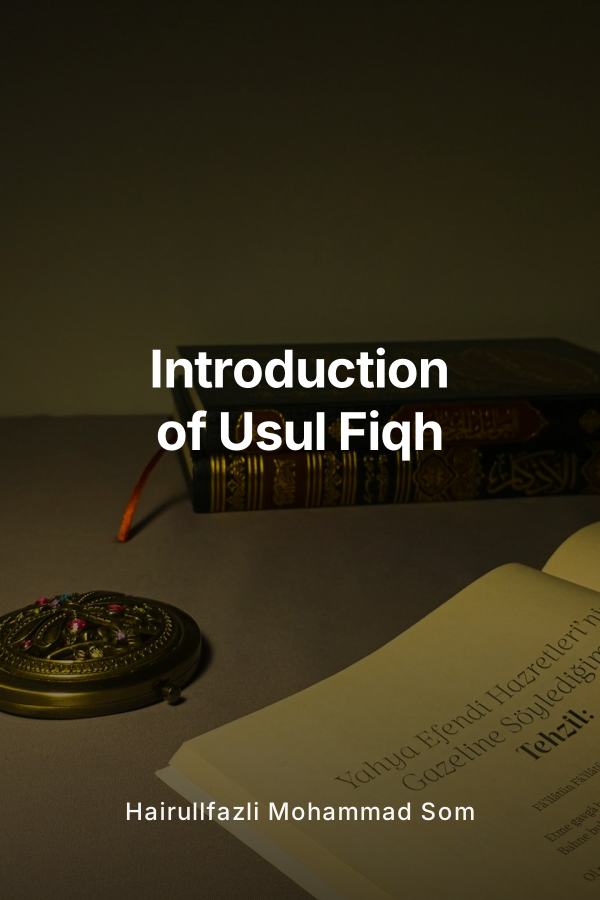
This book is designed as an academic yet accessible revision guide for degree students studying Usul Fiqh, or the Principles of Islamic Jurisprudence. Developed from a structured topic outline supplied by the user, the book presents a five chapter foundation that introduces the discipline, explains its purpose, and guides readers through the central legal concepts that shape Islamic legal reasoning. The work is intended to function as a clear and professional study resource for students who require legal English that remains easy to understand for non native English speakers. Its original specification calls for a professional academic presentation, a legal tone, brief and essential dalil in every section, and integration of Arabic terms with English explanation throughout
The book opens by establishing the meaning, importance, scope, and essential elements of Usul Fiqh. It explains that Usul Fiqh is not merely a list of legal rulings, but the disciplined method by which those rulings are understood, derived, classified, and applied. This introductory chapter gives students a firm conceptual entry point into the subject. It clarifies the distinction between Usul Fiqh and Fiqh, showing that while Fiqh concerns the detailed rulings governing acts, Usul Fiqh concerns the principles and methodology through which those rulings are recognized from authoritative sources. The chapter is structured to help readers appreciate why the study of legal theory is indispensable for any serious engagement with Islamic law. It also demonstrates how legal methodology preserves consistency, protects interpretation from arbitrariness, and provides the intellectual framework for legal judgment.
The first chapter further explains why knowledge of Usul Fiqh is important for students of Shariah and law. It presents Usul Fiqh as a bridge between revelation and application, between sacred texts and lived legal reality. In this account, students learn that the discipline is essential because it teaches how legal evidence is approached, how commands and prohibitions are understood, how general and specific texts are reconciled, and how jurists distinguish certainty from probability in legal interpretation. The scope of the subject is then outlined in a student friendly way, covering the law giver, the legal ruling, the subject of law, the human agent of law, and the sources from which law is derived. The essential elements introduced here prepare the student for later chapters by mapping the architecture of Islamic jurisprudence in a coherent sequence. Brief Qur'anic and Prophetic evidences are included in each section to anchor theory in revelation, as requested in the source brief
The second chapter turns to the general objectives of the Shariah, or Maqasid al Shariah. This chapter explains that the legal system of Islam is not a collection of disconnected commands, but an ordered and purposeful system directed toward benefit, justice, mercy, and the protection of core human interests. The book presents Maqasid as a central interpretive lens that allows students to understand not only what the law says, but why it says it. Readers are introduced to the major protections classically associated with the Shariah, such as religion, life, intellect, lineage, and property, along with the broader ethical spirit that animates legal reasoning. The discussion avoids unnecessary complexity while remaining academically serious, making it especially suited to revision and examination preparation.
In this second chapter, the reader is shown how Maqasid helps reconcile textual fidelity with practical wisdom. The chapter explains how legal rulings are connected to human welfare and how jurists consider consequences, hardship, necessity, and public interest within proper legal limits. It also clarifies that Maqasid does not replace textual evidence, but operates in harmony with revelation and legal principles. By presenting this balance carefully, the book protects students from two extremes: rigid literalism without wisdom, and unrestricted rationalism without scriptural discipline. Short dalil in Arabic with English translation support the chapter's major points, reinforcing that the objectives of Shariah are rooted in revelation and not merely philosophical speculation. As a revision guide, the chapter highlights the conceptual value of Maqasid for answering problem questions, comparing rulings, and understanding legal policy.
The third chapter addresses Hukm Taklifi, the prescriptive rulings of Islamic law. This chapter is built around the key categories identified in the user provided outline: obligation, recommendation, prohibition, disapproval, and option Each category is explained in clear legal English with Arabic terminology retained for precision. The chapter begins by defining Hukm Taklifi as the type of divine address that concerns what the legally responsible person is asked to do, avoid, or choose. It then proceeds category by category, helping students understand both the conceptual meaning and practical legal effect of each ruling.
The discussion of obligation, or wajib, explains what distinguishes a mandatory act from other forms of legal command, and how omission may entail sin or liability. Recommendation, or mandub, is discussed as an encouraged act that brings reward without making omission blameworthy. Prohibition, or haram, is presented as a binding legal demand to abstain, while disapproval, or makruh, is explained as a discouraged act that falls short of prohibition. Option, or ibahah, is explored as the sphere of permissibility in which human action remains legally open unless evidence indicates otherwise. The chapter is especially useful for revision because it translates abstract theory into recognizable legal categories that students encounter repeatedly in substantive Islamic law.
Beyond definitions, Chapter Three explains why Hukm Taklifi is vital to legal analysis. It teaches students how jurists infer the degree of legal demand from textual forms, contextual indicators, and established principles of interpretation. It also gives readers a framework for distinguishing between similar sounding concepts that often cause confusion in examinations. Brief Qur'anic verses and hadith are used in each section as essential dalil, not to overwhelm the reader, but to provide direct textual grounding. This reflects the user's request that each section include concise evidence in Arabic text with translation while maintaining a revision focused format
The fourth chapter focuses on Hukm Wad'i, or declaratory rulings in Islamic law. Based on the supplied topic structure, this chapter covers cause, condition, obstacles, validity and nullification, and initial rules and exemption It explains that unlike Hukm Taklifi, which addresses what must or must not be done, Hukm Wad'i addresses the legal relationships that determine when and how rulings apply. This distinction is crucial in Usul Fiqh, and the chapter makes it manageable by tying every concept to familiar legal examples.
The reader is introduced first to sabab, the legal cause that triggers a ruling, such as the entry of prayer time as the cause of the obligation to pray. Then the chapter explains shart, the condition that must exist for a ruling or act to be valid, such as purification before prayer. It next presents mani', the obstacle or impediment that prevents a ruling from taking effect even where other elements are present. This framework equips students with a refined understanding of how Islamic law operates in practice, not only as command but as structured legal reasoning. The sections on validity and nullification further help readers distinguish between acts that fulfill legal requirements and acts that fail due to missing elements or invalidating factors.
The final part of this chapter addresses initial rules and exemption, allowing students to engage with legal presumptions and exceptional circumstances. These themes are especially important because they show the flexibility and systemization of Islamic jurisprudence. They reveal that Shariah is neither chaotic nor mechanically rigid, but based on identifiable legal principles that govern ordinary cases and exceptional situations alike. This chapter is likely to be especially valuable for degree students because it supports problem solving, legal classification, and accurate application of principles in case based questions. Again, the presentation remains brief, essential, and anchored in dalil.
The fifth chapter addresses the sources of Islamic law. Drawing from the topics listed in the file, this chapter presents the primary sources, namely the Qur'an and Sunnah, followed by al Ijma' and al Qiyas, and then introduces the secondary sources of Shariah such as Istihsan, Maslahah Mursalah, Sadd al Zarai', 'Urf, Istishab, and 'Amal Ahl al Madinah This chapter serves as the culmination of the revision guide because it brings together the tools, principles, and objectives discussed in earlier chapters and shows where Islamic law derives its authority.
The treatment of the Qur'an explains its status as the primary and highest source of law, including its nature as revealed text, its authority, and its function in providing both general principles and specific rulings. The discussion of Sunnah explains its legal authority as clarifying, specifying, and supplementing the Qur'an. The chapter presents both sources not simply as sacred texts, but as legal foundations that must be approached through disciplined principles of interpretation. Essential dalil are presented in Arabic with English translation, in accordance with the user's stated requirement for the book's format and pedagogical approach
The chapter then turns to consensus, or al Ijma', showing its role in securing legal certainty and preserving communal legal integrity. Qiyas is discussed as analogical reasoning that extends legal principles from known cases to new ones on the basis of an effective cause. The explanation is tailored to students who need conceptual clarity rather than excessive technicality. This allows the book to function well as a revision text, giving learners enough legal substance to understand the authority and operation of these sources while keeping the presentation direct and memorable.
The final section of the book introduces the secondary sources of Shariah in a balanced and methodical manner. Istihsan is presented as juristic preference within valid legal parameters. Maslahah Mursalah is explained as unrestricted public interest where no specific text directly governs the matter. Sadd al Zarai' is treated as blocking the means to harm or unlawful outcomes. 'Urf is discussed as recognized custom when not in conflict with revelation. Istishab is introduced as the presumption of continuity until evidence changes the legal state. 'Amal Ahl al Madinah is presented within its historical and methodological significance. These topics are especially important for advanced revision because they show how juristic reasoning addresses complexity while remaining faithful to foundational sources.
As a whole, the book is conceived not as an exhaustive encyclopedic text, but as a structured academic revision manual for degree level study. Its strength lies in combining legal seriousness with readability. Each chapter adds a distinct layer of understanding: foundational definition, legal purpose, normative rulings, declaratory rulings, and legal sources. Together, they form a coherent introduction to the architecture of Islamic jurisprudence. The design intention described in the original brief also suggests a visually respectful and student friendly presentation, with Islamic themed graphics, no depiction of humans, and a soft pastel design approach for educational appeal
The proposed book title remains Introduction of Usul Fiqh (Principle of Islamic Jurisprudence), reflecting the source instruction, while the summary positions it more clearly as a professional revision guide for degree students. The named author in the project brief is Hairullfazli Bin Mohammad Som of the Shariah Department, Faculty of Shariah and Law, Universiti Islam Selangor, indicating the academic setting and intended institutional character of the work The completed book, when expanded from this summary, would present each main topic in sufficient depth, each subtopic with focused explanation, and every section with brief but essential dalil in Arabic and English. It is therefore best understood as a disciplined, pedagogically effective, and professionally framed introduction to Usul Fiqh for university students who require both conceptual clarity and legal precision.