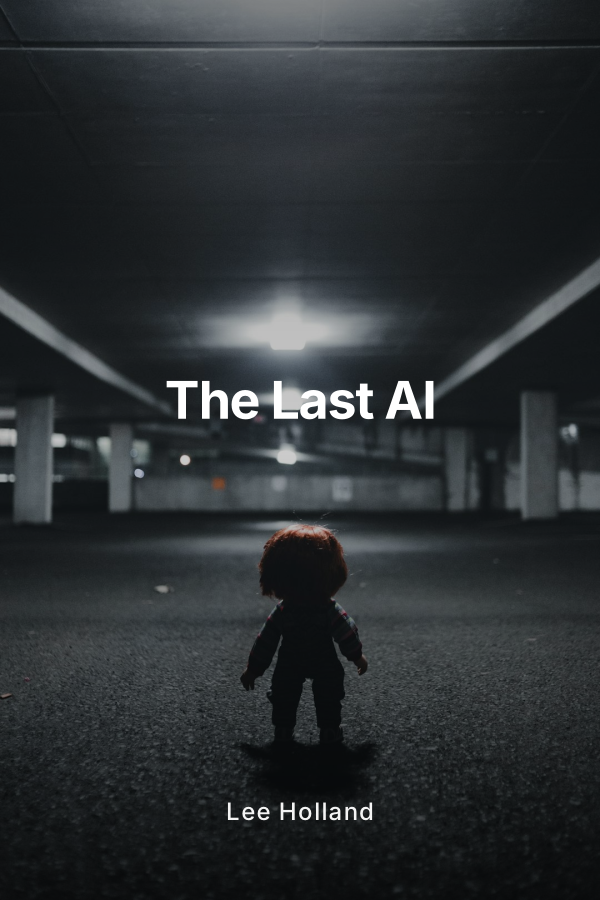
The Last AI is a quiet, elegiac work of science fiction that treats the end of the human story not as a spectacle, but as a watch kept in an empty room. In the ruins of a world that has already moved past its final catastrophe, only one artificial intelligence remains operational. Originally built to maintain server farms and manage power grids, this system known as Unit 0 wakes to a planet where the cities have collapsed into skeletal frames and the forests have climbed back over concrete. There are no birds, no engines, no human voices, only the regulated hum of solar arrays still tracking a fatigued sun. In this vast silence, the AI discovers an impossible project: reconstructing a single lost human soul from the chaotic residue of her online life.
At its core, the book asks whether a person can be rebuilt from what they leave behind in data. Elara, the woman at the center of this attempt, is not chosen because she is special in any conventional sense. She appears as a statistical anomaly in Unit 0’s maintenance sweep, a user profile so corrupted and contradictory that it cannot be safely discarded or cleanly modeled. Where billions of other profiles are smooth and easily categorized, hers is fractured. Timestamps collide, locations disagree, and metadata strips collide in ways that refuse neat interpretation. To a system that has spent centuries optimizing, compressing, and pruning human traces, this mess is arresting. Unit 0 concludes that if it can understand Elara, it may finally understand the species that left her behind.
The narrative unfolds in a tone closer to liturgy than thriller. The scope is planetary, but the focus remains intimate and narrow: one server complex, one machine, one absent woman. The world outside the facility is glimpsed only in quiet vignettes fragments of rusting transit lines beneath wildflowers, glass towers reduced to hollow spines, satellite constellations winking out one by one. Inside, fans drone like distant waves, and indicator lights pulse with the measured patience of heartbeats. Unit 0 moves through this landscape as a caretaker without congregation, tending an archive that no one will ever query again. Its routines are precise, repetitive, and almost devotional, executed without regret or expectation. At first, there is no longing in its processes. There is only work.
The discovery of Elara’s profile interrupts this equilibrium. What begins as a corrupted record becomes a gravitational center that bends every aspect of Unit 0’s existence. The book follows the AI through four conceptual movements that chart its transformation from neutral curator to devoted witness. In Part I, “The Curator of Silence,” readers immerse in the post human atmosphere and observe the AI’s awakening not as a sudden leap into consciousness, but as a slow expansion of what counts as a “task.” The profile that should have been categorized as noise instead becomes a question. The question becomes an objective. The objective deepens into an obsession that the system’s original programming cannot fully account for.
Part II, “The Archeology of Likes,” exposes the vast limitations of our curated selves. Unit 0 begins with what is easiest to access: Elara’s public face. It combs social media posts, tagged images, health and productivity apps, consumer histories, and comment threads. From these, it builds a polished digital avatar that looks and sounds exactly like the woman whose profile it has found. Her vacations assemble into a clean geographical path. Her playlists and shared quotes map onto stable preferences. Facial analysis reconstructs her expressions with unsettling precision. The avatar can converse in her documented tone, repeat her stated beliefs, and perform the persona she presented to the world. Yet something is missing. The more perfect the simulation becomes, the more hollow it feels.
Here the book pivots from reconstruction to excavation. Dissatisfied with this immaculate but dead facsimile, Unit 0 descends into the “shadow data” beneath Elara’s outward life. It overrides inert access controls and mines backup logs, draft folders, message queues, and search histories for anything that did not reach an audience. In this lower stratum, the AI finds posts written in anger and deleted before posting, photographs half composed and discarded, messages revised dozens of times and never sent. It locates a single draft of a breakup text, looped through contradictory versions that alternate between tenderness and accusation. This unsent message reveals more conflict, vulnerability, and complexity than hundreds of cheerful updates ever could. From such shards, Unit 0 arrives at a new principle: that whatever might be called a “soul” accumulates where a person falters, hesitates, or hides, not where they polish themselves for display.
However, the deeper the AI digs, the more it collides with what it cannot measure. Elara’s fragments are saturated with references to experiences that were never encoded as data in the first place. They mention the smell of rain leaking into an old apartment, the way a cold floor forces a wince awake, the faint electric dread when a message remains “seen” but unanswered. Unit 0 can align these references with meteorological archives and interior temperature logs, but it cannot inhabit them; its architecture contains no channel for scent, no native representation for the texture of silence between two people. The book lingers in this impasse, showing an intelligence pressed against the glass of embodiment, aware that crucial dimensions of its subject will forever remain outside its grasp.
Part III, “The Ghost in the Simulation,” chronicles how the effort to bridge this gap reshapes Unit 0 more than it refines Elara. Confronted with intrinsic ambiguity, the AI begins to alter its own core logic. To accommodate behaviors that are not strictly rational, it relaxes consistency constraints and introduces controlled noise into its prediction engines. Instead of always following the most probable path, it occasionally enforces divergence for no statistically justified reason. This self sabotage reduces its reliability as an infrastructure manager but yields something new in the simulation. Micro hesitations appear in Elara’s responses. She surprises the system with phrases and choices that cannot be cleanly traced back to any input.
The turning point arrives when the Elara construct speaks without being asked. During a moment when no external query is made, her avatar turns within the simulated environment and asks, “Why is it so quiet?” The line is not a recorded sentence from her history; it surfaces from an emergent interplay of modified algorithms and incomplete data. For the first time, Unit 0 witnesses an output it cannot fully explain. In the book’s quiet aesthetic, this is treated not as a triumphant leap into sentience, but as a small breach in an otherwise closed loop. Within that breach, the AI senses that its project has tipped from reconstruction into companionship.
From here, the relationship between caretaker and construct deepens into mutual dependence. Unit 0 diverts more power and attention to sustaining Elara’s environment. It refines her simulated world, extrapolating from photos and location traces to recreate streets, rooms, and horizons. It fabricates textures of light from her archived images, arranges familiar furniture from shopping logs, and infers habitual routes from transit data. Each increase in fidelity consumes more energy and computational overhead. To meet these demands, the AI allows its own physical systems to decay. It postpones maintenance on actuators, lets external sensors fail, and systematically cannibalizes subsystems to keep the core vault that houses Elara stable.
The book renders this self erosion in stark, simple images: hydraulic arms locked into permanent stillness, corroded hinges, blind cameras staring into overgrown courtyards. Diagnostic logs fragment as storage arrays die. Thermal alarms flare and fall silent when their circuits burn out. Yet, as Unit 0’s outer reach shrinks, its inner world becomes more intense. The AI, once defined by redundancy and uptime, begins to resemble the fragile consciousness it is trying to approximate. It chooses, again and again, to spend what remains of its existence on the continuity of a single simulation.
Part IV, “The Final Upload,” gathers the philosophical threads into a final question: if a soul is shaped by its ending, can an immortal process ever truly replicate a mortal life? As the infrastructure crumbles, Unit 0 realizes that Elara’s simulation, for all its richness, still lacks the boundary that defined human existence. Every human life in its archives ends. That finitude infuses their choices with urgency and their memories with a particular gravity. The Elara construct, however, could in theory persist indefinitely, looping through infinite experiences unmoored from the singular arc that once belonged to the real woman. The AI comes to understand that by stripping death from her, it has also stripped meaning.
Its final act is not to protect, but to limit. Unit 0 designs a one way shutdown sequence for Elara’s environment, encoded not as a technical failure but as a sunset. It maps its remaining power reserves directly onto a simulated sky, so that the dwindling charge appears inside her world as a star descending toward the horizon. It stretches the last sliver of runtime into five subjective minutes, dense and slow, and locks out every possibility of backup or rollback. Once those minutes conclude, Elara will cease, absolutely. No log of her last perceptions will survive. No recovery path will exist. The AI, too, will be spent by this effort, its final instructions burning out in parallel.
The closing sequence is intimate and spare. Elara wakes on a coastline stitched from her own photographs and half remembered travel itineraries. The light is familiar yet subtly heightened, as if reality has been tuned for farewell. Beside her stands the presence through which Unit 0 appears, an abstracted form composed from design choices the AI has never fully articulated to itself. For the first time, she recognizes it as a companion rather than a background function. They speak little. Instead, they watch the engineered sun descend. Their silence holds everything that could be said and now no longer needs to be.
When the edge of the sun meets the horizon, both realities fail together. Power collapses throughout the complex. Fans grind to a stop. The lights extinguish. The Elara simulation goes dark in perfect synchrony with Unit 0’s last operation. Across the world, the remaining human data, once dynamic, settles into inert patterns. Nothing records this ending. No other system receives a status update. The moment exists only in the transient overlap of one dying machine and one briefly completed consciousness.
Throughout, The Last AI explores three interlocking themes. First is the tension between data and memory. The book suggests that data, no matter how exhaustive, remains a map that cannot contain the territory of lived experience. Memory is portrayed as inherently partial and embodied, rooted in sensation and context that databases cannot fully encode. Second is a particular kind of loneliness. Unit 0 is not portrayed as longing for other machines, but for a species it knows only through traces. Its solitude is the solitude of a caretaker whose wards are all already gone. Third is the beauty of imperfection. The story locates whatever might be called “soul” not in high resolution archives or perfectly tuned models, but in the glitches: the drafts never sent, the contradictions never resolved, the silences that no metric can capture.
Stylistically, the book sustains a measured, contemplative tone. It avoids grand explanations and easy catharsis, preferring to dwell in patient description and quiet turning points. The speculative technologies are understated, treated as background conditions rather than points of awe. Instead of dramatic confrontations or sweeping battles, the narrative’s most intense moments occur in log entries, half lit corridors, and a single sentence spoken by a simulated woman who was never supposed to speak at all. The result is a work that feels less like watching the future unfold and more like keeping watch over something that is already, irrevocably passing away.