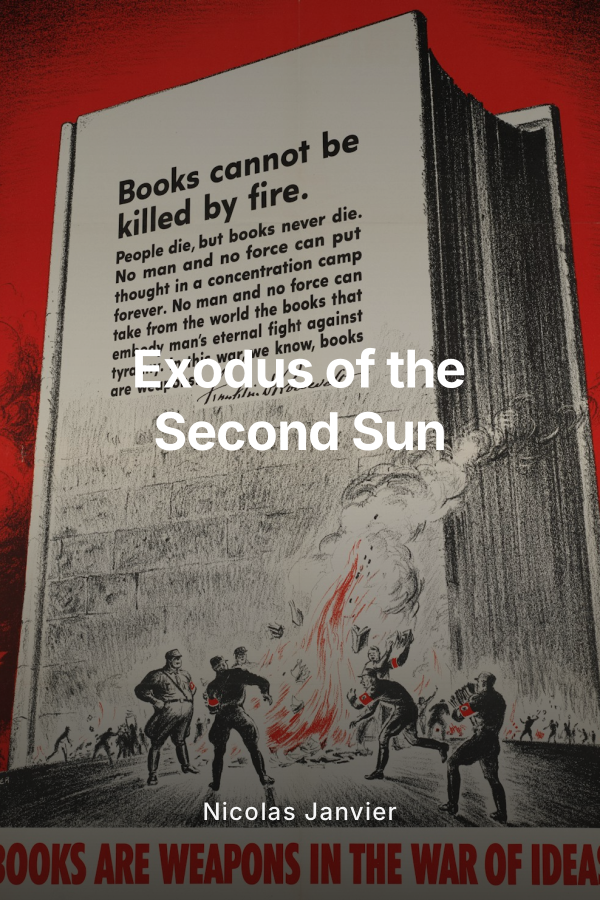
Book One: Architects of Departure
In Exodus of the Second Sun, the first book opens not with ships in the sky, but with a man who has already seen the endgame.
Across five decades and a shifting American landscape, we follow a quiet financial savant who understands that numbers are the skeleton of an empire. Publicly, he is a respected economist and strategist. Privately, he is the unseen architect of the most audacious political and moral experiment in modern history: a meticulously orchestrated plan to extract tens of millions of Black people from the United States and relocate them to an independent Black nation on sovereign soil.
Drawing on currents already present in Black political thought and history, he does not invent the longing for self-rule so much as weaponize it. He studies the Great Migration, the Black nationalist projects that never quite took root, the waves of activism that rose and fell from civil rights to Black Lives Matter, and he reaches a relentless conclusion: the goalposts will never stop moving, and a people cannot be free inside a system designed to absorb and blunt their demands.
From that conclusion, a fifty‑year strategy is born.
We watch him assemble his inner circle: a technologist who can build secure, decentralized networks and cloak communication against an increasingly intrusive surveillance state, a historian who can root their vision in a lineage of resistance and nation-building, and a health visionary who insists that no revolution matters if bodies and minds remain broken. Together, they form the nucleus of what will be known, in whispers, as the Exodus Project.
Sanctuary, a remote archipelago in the South Atlantic, is identified and patiently acquired through a web of front companies, diplomatic pressure, and “win‑win” development deals. What looks like a benign special economic zone becomes, clause by clause, the legal seed of full sovereignty. Sanctuary is chosen for its resources, defensibility, and the diplomatic ambiguity that will allow a Black nation to be birthed without triggering immediate open conflict.
Beneath that high strategy, the book narrows to the granular mechanics that make Exodus more than fantasy. We see clandestine recruiters embedded in churches, credit unions, barbershops, and universities, their task not to agitate mass revolt but to quietly locate the people who are already tired in a very specific way. Not the loudest voices, but those whose endurance has hardened into a calm refusal to keep begging for their humanity.
Exodus is framed not as escape, but as strategic relocation. The recruiters bring personal testimonies from early settlers and technical dossiers on Sanctuary’s infrastructure and economic models. They promise not paradise, but tools, training, and collective responsibility: a society where every contribution matters and no one’s health or dignity is sacrificed to maintain someone else’s illusion of progress.
Within this machinery, the book introduces the city that will become the human heart of the trilogy: a mid‑size Southern city with a proud civil‑rights lineage, recently “revitalized” into a glossy façade. Juneteenth festivities are quietly defunded, museums of slavery and resistance close under the pressure of budget cuts and “curriculum reform,” and any vocal objection is caricatured as playing the race card. Laws are rewritten in neutral language that erases Black experience from memory while insisting that the work of justice is already complete.
Behind closed doors, this city is one of the architect’s most carefully cultivated crucibles. Scholarships redirect promising Black students into particular universities. Corporate transfers and “once‑in‑a‑lifetime” job offers nudge key parents back home. A pastor is offered a national platform only if he relocates his ministry. None of them know that the offers are not random, that their relocations are strands in a long weave designed to place specific families, over time, in one school district, down the street from each other.
Book One tracks five to six rotating points of view. Some are fully initiated into the project: the financier architect, his technologist ally, and a community organizer who moves across decades, never seeming to age so much as deepen. Others are civilians who believe their lives are unfolding by chance: two Black couples making uneasy peace with the city’s “revival,” and a white woman who marries into a Black family, unaware that her presence has been quietly anticipated.
Between them, the book shows two maps of America.
On one, the official story of progress: civil‑rights milestones, symbolic firsts, diversity campaigns. On the other, a submerged cartography of ongoing harm: relentless microaggressions, the erasure of Black history from public memory, the criminalization of dissent, the slow, grinding realization that each movement’s gains are met with new forms of containment.
As the decades turn, the Exodus Project scales up from idea to infrastructure. Sanctuary’s ports deepen. Hidden shipyards across the globe fabricate modular hulls that look, on paper, like industrial barges and specialized cargo vessels, but are in fact the skeletons of an armada. Each ship is a self‑contained city: power generation, water, food production, schools, clinics, and communications all integrated behind an aura of normal commerce.
The architect’s genius lies not just in engineering logistics and finance, but in manipulating attention. Simulated labor disputes, staged supply chain disruptions, and localized fake crises draw surveillance resources elsewhere while genuine Exodus activity moves under the cover of ordinary traffic. Social media debates are steered to obsess over culture wars as recruitment and fleet‑building advance in the blind spots.
Throughout, Book One uses historical markers as silent chapter pillars. The assassinations and marches once studied in Black household photo albums give way to newer uprisings and hashtags. Each wave seems stronger than the last, yet each ends at a seemingly invisible ceiling. The architect and his circle note every crest and crash and tighten their resolve: the United States will never willingly restructure itself to yield true Black self-determination.
By 2026, the machinery is complete.
The final chapters accelerate into a launch‑countdown thriller. Quiet identifiers assigned to each recruited person and family, tested for years in benign pilot programs, now light up the network. A date and time ripple across encrypted channels and analog whispers. At first there is no spectacle, only decisions: kitchen‑table arguments, last visits to graves, silent drives through neighborhoods that will soon be hollow.
Then the walkout begins.
Across all fifty states, in workplaces and schools and courthouses, in refineries and call centers and gleaming tech campuses, Black people stand up and leave. Some carry cardboard boxes of personal items. Some carry nothing at all. Cameras capture a bizarre, synchronized fracture as streets fill with a river of Black bodies moving, for once, not at the margins but at the center of every frame.
In our Southern city, three middle‑school friends walk out together for what they think is an extraordinary protest. Two of their families have quietly prepared for this moment for years. The third has not. His Black father is torn between the call of Exodus and his white wife’s terror of being left behind in a country that is already reeling. Their argument will shatter him, and that fracture will be the seed of his arc in later books.
On the coasts, the horizon fills with steel.
To the panicked eyes of U.S. officials, a line of ships materializes like an invading navy. To those who have waited a lifetime for this signal, they are rescue, not conquest. The book closes in tight POV as sirens wail, news anchors scramble to explain what they are seeing, and the architect—old now, his health failing—watches from a secure, undisclosed location as the vessels he financed and the nation he imagined finally step from design into reality.
He dies shortly after, leaving behind a labyrinth of journals, models, and correspondence that future generations will mine like scripture and evidence both.
Book Two: Children of the Great Departure
The second book shifts the lens from the architects to the passengers.
Centered in the same Southern city that Book One quietly curated into a convergence point, the narrative follows three interlinked families whose children attend the same middle school and whose friendship has become its own small republic.
Two of the families are Black and fully committed to Exodus. Their living rooms have, for years, been quiet training grounds: teaching children to read maps and question news narratives, introducing them to stories of liberation that stretch back to the Underground Railroad, Reconstruction, the Great Migration, and beyond. They see Exodus not as erasing those struggles, but as their fulfillment.
The third family is deliberately complicated. The father is Black, his lineage steeped in the city’s civil‑rights past, his memories full of marches and jail cells and burnt churches. His wife is white, raised on the mythology of a country forever “getting better,” and deeply aware that she, and their mixed‑race child, will be read very differently if he leaves. For them, Exodus is not a clean moral question but a tearing of the family fabric. Their son is best friends with the other two children, and through their trio, Book Two finds an intimate way to stage the global argument: Do we leave, or do we stay?
The book is built as a grounded, TV‑ready political thriller woven through a family saga. It stays largely in that city and on the routes and vessels that carry its people away, but filters the experience through multiple perspectives: parents who see echoes of past betrayals and promised lands, children whose future has always contained worlds their elders could not imagine, community organizers torn between duty to those departing and those who refuse.
Crucially, Book Two refuses to romanticize unanimity. The Black community in the city is fractally divided. Some elders cannot bear to abandon the graves of their ancestors. Interracial couples argue over whether leaving is an indictment of love or a necessary shield for children. Mixed‑race teenagers resent being told which parts of their identity matter more. White family members, deeply enmeshed in Black households through marriage, adoption, or history, find themselves suddenly on the wrong side of lines that were, until now, theoretical.
The mass walkout that ended Book One becomes the first act of Book Two. We stay close to the children as they leave school together, to the teachers who silently step aside, to the principal who chooses that moment to resign rather than lock the doors. We see the kids’ WhatsApp threads and TikTok feeds go silent and then erupt, as rumor, official denial, and raw imagery collide.
From there, the story expands into the logistics of the Great Departure. Families funnel toward designated hubs camouflaged as agricultural depots, industrial parks, and “emergency shelters.” Convoys of buses and trucks, pre‑positioned and disguised, crisscross backroads to avoid highly surveilled arteries. Each person’s unique identifier, introduced obliquely in Book One as part of innocuous civic and financial programs, now governs boarding priority, vessel assignment, and pre‑planned community clusters.
Ordinary life and extraordinary engineering intersect on every page. The children experience the journey as a terrifying adventure: being herded onto ships the size of skyscrapers, seeing their city from the water for the first and last time, navigating new social hierarchies in cramped, humming corridors. Parents grapple with claustrophobia, grief, and an almost paralyzing hope.
Book Two takes time to make the fleet feel real. The reader moves through mess halls where food is rationed but shared with care, medical bays where chronic conditions begin to stabilize for the first time, classrooms hastily assembled so that lessons can continue in motion. Each vessel is a floating municipality, a prototype of the society they plan to build on Sanctuary: power decentralization, waste recycling, water purification, and hydroponic food production balanced with communal rituals that preserve culture and sanity.
Parallel to this, the narrative tracks the United States’ reaction. Four political and agency figures, introduced in Book One at different levels of power, now face an unprecedented crisis. The President scrambles to project control while advisors quietly admit that they never believed Exodus could be real. Intelligence officials piece together fragments of data and belatedly realize the extent to which their own institutions were infiltrated and misdirected by Exodus operatives. State governors rage or plead on cable news. Some call for immediate military intervention to block the boarding and departure. Others argue that shooting at their own citizens, even citizens who are leaving, would tear what remains of the nation’s legitimacy beyond repair.
The international community watches in disbelief as aerial footage reveals highways clogged with Black families walking toward the sea, Midwest fields dotted with makeshift camps, and hundreds of ships pulling away from American shores without a single shot fired. The absence that Book One described in eerie, post‑exodus stillness begins here as a visible unspooling: empty church pews, abandoned sports leagues, cultural institutions hollowed out overnight.
At the emotional core, however, Book Two is always drawn back to the three children.
Two of them board different ships bound for Sanctuary, their lives diverging as their families slot into new roles: one into agricultural development and infrastructure, the other into education and health services. Their POVs carry us through sea‑borne storms, onboard crises, and the first sight of Sanctuary’s shores. We witness their first steps on soil that is both alien and intimately theirs, the beginning of settlements that start as tent cities and modular units and slowly, stubbornly, turn into towns.
The third child stays behind, left standing with his mother and father on a pier they have not been cleared to cross. His final goodbye with his friends is raw, confused, and laced with adolescent promises: We will find a way to see each other again. Maybe later. Maybe when this is over.
It is not over.
In the years that follow, this child grows up in a United States that has not recovered. Economically, entire regions have collapsed without the Black workforce and consumer base they relied on. Culturally, the vacuum left by Black art, innovation, and spiritual leadership has rendered the nation strangely hollow, its attempts at reinvention oscillating between forced optimism and reactionary rage. Politically, the Exodus becomes a partisan weapon, a taboo, a myth, or a rallying cry, depending on who is speaking.
By the end of Book Two, that child, now a young man, has made his decision. He enlists in a U.S. military apparatus that is quietly, and then openly, reorienting itself toward the Black nation it once dismissed as fantasy. He does this not out of loyalty to the state that failed his community, but as an embedded conscience. His goal is to gain access to the sensitive intelligence and operational plans that will one day threaten the land his friends now call home, and to quietly divert, leak, and misdirect enough to keep them alive.
Book Two ends on a double image: fireworks and lights over Sanctuary as the new nation celebrates its hard‑won stability, and a dimly lit briefing room in Washington where the first serious war‑planning documents—cold, euphemistic, and illegal by any reasonable standard—are slid across a polished table.
Book Three: War of the Promised Land
The third book stretches across seventy‑five years, tracing the arc from the uneasy peace of early independence to the eruption of a conventional and cyber war that tests every founding principle of the new nation.
Sanctuary has grown from encampments and provisional councils into a mature society with codified law, evolved institutions, and its own internal contradictions. Generational distance from the Great Departure has brought confidence and, with it, complacency. While the official narrative still canonizes the Exodus as near‑sacred, younger citizens wrestle with a more complicated reality: class stratification, brain drain, and the tension between the founding ethos of equity and the pressures of global capitalism.
On the other side of the ocean, the United States is both wounded and dangerous. The Exodus forced a partial reckoning with its history of racial injustice, but that reckoning was uneven, and the absence of millions of Black citizens turned some potential reforms into abstract exercises. In parts of the country, the departure is treated as shame, in others as relief, and in others as a forbidden topic that must be caricatured or denied.
As Sanctuary signs trade agreements, pioneers clean‑energy technologies, and mediates conflicts on other continents, its existence becomes an intolerable mirror. It is living proof that Black people, when given self‑determination and resources, can not only survive but thrive on their own terms. This success is quietly celebrated across the global south and within diasporic communities, but in certain American halls of power, it is interpreted as a declaration of war in all but name.
The pretext for actual war is manufactured, as such pretexts often are: a border incident at sea, a disputed cyber intrusion, accusations of Sanctuary harboring American dissidents. But the underlying motive is simpler and more poisonous: rage that those once deemed dependent have surpassed their former captor, and a desperate belief that reclaiming control over Sanctuary—political, economic, or literal—might somehow restore a fading American supremacy.
Book Three weaves frontline soldiers, civilian life, and war‑room strategy into a single, relentless tapestry.
We see Sanctuary’s defenders: young men and women raised on the songs of the Great Journey who now face the prospect of fighting the very country their grandparents fled. Some believe wholeheartedly in the necessity of the war, convinced that lack of resistance would invite eventual annihilation. Others are torn, acutely aware that the weapons now turned outward were built in defiance of the violence they were supposed to leave behind.
We see civilians: descendants of the original three families from Book Two, now spread across professions and regions. One is a doctor in a coastal city when the first missiles fall. Another is a teacher tasked with explaining air‑raid sirens to children whose sense of the world has never included the idea of being targeted en masse. They experience the war not as abstract geopolitics, but as collapsed homes, contaminated water, and the seismic realization that sovereignty does not confer immunity from harm.
We see leaders in war rooms on both sides. Sanctuary’s council debates preemptive cyber strikes versus purely defensive posture, the ethics of targeting American infrastructure given the millions of innocent lives tethered to those grids, and the risk that losing too much blood will transform their just struggle into a mirror of the empire they rejected. U.S. officials, fragmented by internal politics and economic desperation, oscillate between rational calculation and vindictive impulse.
Threaded through it all is the POV of the young man who stayed behind in Book Two and chose to embed himself in the U.S. military apparatus. By now, he is seasoned, having risen to a position that grants access to targeting data, logistical plans, and classified assessments of Sanctuary’s vulnerabilities. He lives in constant tension: every subtle misdirection that saves Sanctuary lives also risks exposure as treason. He feeds Sanctuary’s cyber units information that allows them to pre‑empt attacks, redirect missiles into open water, and evacuate populations just hours before strikes. Close calls accumulate: a corrupted file traced too near his terminal, a superior who notices patterns in failed operations, a polygraph session that he survives by sheer force of will and buried rage.
He fights not only to keep his friends alive, but to redeem, in some small way, the choice his family made to stay in a country that now wages open war against his people’s promised land.
The war scenes are unflinching when they must be. Naval campaigns scar Sanctuary’s coastline. Urban bombardments leave neighborhoods in ruin and legacy statues cracked. Cyber attacks plunge American cities into darkness and halt supply chains, revealing how fragile the old superpower has become. Soldiers bleed and break on both sides, and the narrative refuses to flatten them into heroes or villains. The moral center remains with those who still insist on seeing the humanity of the enemy while fighting to protect their own.
In parallel with the bombs and bytes, Book Three unfurls the most intimate battle of all: the fight over memory and meaning.
Posthumous publication of the architect’s journals and correspondence—curated, leaked, redacted, and weaponized in turn—forces Sanctuary to confront the ethical compromises at its origin. Citizens learn that key bloodlines, families, and even friendships were nudged into place by design. Scholarships, housing policies, job placements, and even seemingly chance meetings that produced the second book’s friend group were in fact deliberate, long‑range moves in a generational game.
For some, this revelation is shattering. The founder’s genius begins to resemble a kind of benevolent tyranny. Did they truly choose Exodus, or were they shepherded toward it like pieces on a board? Did their nation arise from collective will, or from one man’s unshakable conviction that he knew what was best?
For others, the revelation deepens rather than diminishes their sense of purpose. They argue that all liberation movements, at scale, require manipulation of existing systems and that faced with an intractable regime, the architect had no moral alternative but to stack the deck in favor of his people’s survival. His work becomes a mirror in which they recognize both the enemy’s methods and their own necessity to sometimes fight on similar terrain.
The book refuses to resolve this argument neatly. Public forums, media channels, academic conferences, and kitchen‑table debates across Sanctuary and the remaining United States keep circling the same questions. Was Exodus justified? Were its means? What debt, if any, do the descendants of both nations owe each other now?
The trilogy closes not with a final victory or annihilation, but with a partial ceasefire and a fragile, enforced peace that leaves both nations scarred and changed. Sanctuary survives, though wounded. The United States continues, though diminished and forced to live alongside a constant reminder of its failures and of what might have been.
In the final chapters, the surviving members of the original friend group—those who left and the one who stayed—are reunited at last on Sanctuary’s soil. They are older, carrying scars both visible and hidden. Around them, a younger generation plays in streets that exist only because of decisions made decades before any of them were born.
One of them reads from the architect’s journals, not as scripture, but as one voice among many in a long, unfinished conversation about freedom. The book makes no claim to settle that conversation. Instead, it hands the question to the reader, as the narrative voice recedes:
Was the Exodus a betrayal or a fulfillment? A necessary wound or a preventable war? What, if anything, is owed to those who leave, and to those who stay?
In that space of unresolved judgment, Exodus of the Second Sun plants its deepest seed: that liberation is never a single event, but a perpetual negotiation between memory and possibility, between what we refuse to endure and what we are willing to become in order to be free.