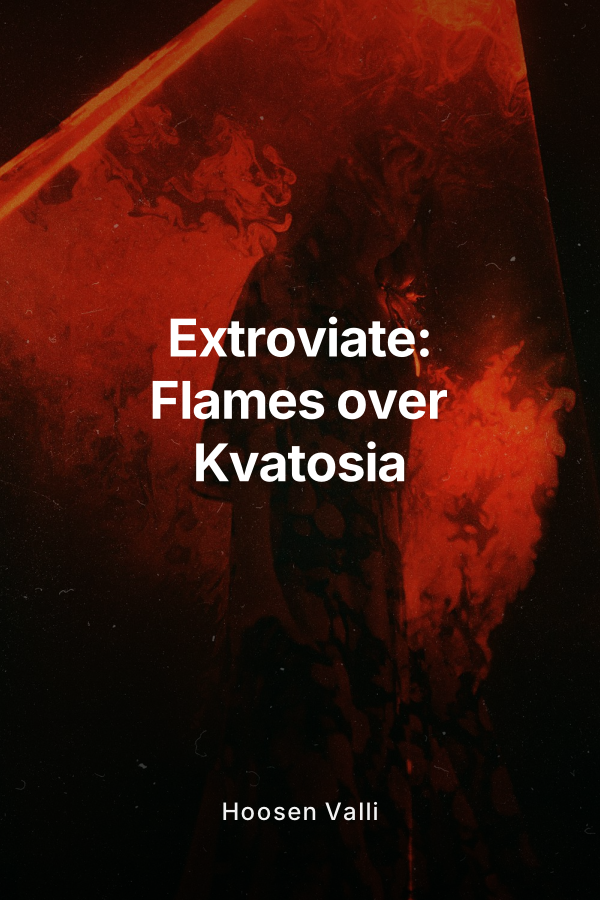
This novel unfolds on a distant world where familiar faiths and alien bodies collide in a grinding, industrial war. At its heart lies Kvatosia, a human nation of fierce religious devotion and unyielding patriotism, locked in a brutal struggle against the Yuarma Republic, a realm of canine and feline humanoid peoples who have driven the Kvatosian army to the brink of annihilation. The story follows no single hero. Instead it tracks many soldiers, medics and tank crews across intertwined fronts as they claw their way from catastrophe to hard-won victory.
In the early chapters, the reader is plunged into the aftermath of the 2nd Great Recede, the humiliating collapse that sees Kvatosian forces pushed back hundreds of kilometres, all the way to their southern capital near the frozen edge of the arcting circle. The outdated KyT 33 heavy tanks grind and burn beneath the superior TR 22s of Yuarma, while exhausted infantry freeze in trenches and shattered villages. Religious symbols painted on helmets are little protection against shrapnel; Bible and Qur’an pages are turned by numb hands in flickering torchlight as artillery tears apart men who still whisper prayers. The victories of Yuarma are complete enough to feel permanent, and Kvatosia seems destined to lose its land, its pride and perhaps its future.
The political turning point comes with a single shot. President Handrov of Kvatosia is assassinated at the darkest moment of the war, and in the chaos that follows, General Kaartarov rise to power. The book’s middle chapters explore the ruthless clarity of his new command. Kaartarov does not appear as a conventional protagonist so much as a constant, looming presence whose orders reshape battlefields and lives. Under his leadership, the doctrine of survival hardens into Operation Extroviate, a chillingly named campaign promising not mere victory but the practical extinction of Yuarma as a serious power. Resource conservation, logistical discipline and strategic patience begin to replace the ragged, reactive defence of the early years.
Crucial to this transformation is steel. The focus tightens on the birth of the KyT 47, a brutish new heavy tank armed with a massive 147 millimetre cannon and shielded by a sharply angled 147 millimetre frontal plate. Chapters linger over workshops, proving grounds and first combat trials, as engineers and crews learn through blood how to wield this new machine. The transition from the vulnerable KyT 33 to the KyT 47 is slow and costly. Mixed units field both models side by side, and entire crews are lost in failed offensives as Kvatosia relearns how to fight. The novel gives detailed attention to doctrines evolving in real time: improvised tactics against TR 22s, the terror of close range duels in ruined town streets, and the grinding logistics of feeding fuel, shells and spare parts into a war that never seems to end.
As Kvatosia regains its footing, the book never forgets the men and women trapped inside the machinery of strategy. Chapters shift between infantry squads trudging through snow, tank crews choking on fumes inside their iron coffins, and female combat medics running into fire with bandages and morphine. These women, officially present in support roles, often find themselves at the edge of the line, dragging broken bodies from craters and sometimes picking up rifles when units collapse. Their wards are filled with human soldiers whose helmets bear tiny crosses or crescents, some murmuring verses, some cursing the heavens. Alongside them lie captured Yuarma fighters, canine eyes clouded by pain, feline faces contorted by fear, challenging Kvatosian soldiers to see the enemy as more than monsters even while Operation Extroviate demands ruthless advance.
The Yuarma Republic, once triumphant, fractures under the weight of attrition and shock. Kvatosian counteroffensives grow in size and skill, using the KyT 47 as a hammerhead to split enemy lines. Slow, detailed campaigns roll across plains and forests: encirclements that trap entire Yuarma brigades, sieges that starve out fortified towns, winter pushes where frostbite claims more lives than bullets. The narrative does not spare the reader from gore. Limbs are shredded in explosions, bodies freeze together in shell holes, tank interiors become ovens when penetrated by high calibre rounds. Each battle leaves its own signature of horror, and each minor tactical gain is purchased at an ever rising human cost.
Yet despite the escalating brutality, morale in Kvatosia begins to shift. With every reclaimed village, with every column of burning TR 22 wrecks, a fierce sense of destiny returns. Religious language infiltrates speeches and quiet conversations alike, as soldiers speak of being chosen to defend their homeland, of divine justice guiding their tracks northwards back into Yuarma lands. The book keeps such faith in the background, conveyed through symbols on helmets, quick prayers before an assault and dog-eared holy books in coat pockets, rather than grand sermons. It is a steady presence rather than a shouted doctrine.
As Yuarma territory shrinks, its cities crumble into starving, lawless ruins. Once proud regiments degenerate into fragmented groups clinging to isolated strongpoints. Kvatosian forces push deeper, encountering both fanatic resistance and exhausted surrender. The novel captures the grim satisfaction of units advancing through ground they once lost, marking over old graves with fresh ones. Regardless of individual feelings towards the enemy, the wider national will is clear. Operation Extroviate demands the reduction of Yuarma to a small, impoverished remnant that can never again threaten Kvatosia.
The final chapters carry the reader towards Victory Day 1949. By this point, the war has reshaped every character it touches. Veterans who entered the conflict as devout idealists or uncertain conscripts have become hardened survivors. Many are missing limbs, eyes or loved ones, but they remain fiercely loyal to Kvatosia, stitched together by comradeship and patriotic pride. Civilians in the rear, who once trembled at news of the 2nd Great Recede, now line streets hung with banners as columns of KyT 47s roll past in great parades. Children climb on wrecked Yuarma armour displayed as trophies. Fireworks echo the boom of artillery, and the last chapter lingers in this uneasy celebration.
The book closes not with a moral lecture, but with the weight of what has been won and what has been lost. On Victory Day, bells ring and choirs sing, generals salute and politicians speak of a glorious new age. The people of Kvatosia celebrate wholeheartedly, convinced that their suffering has been redeemed by the reconquest of their homeland and the humbling of Yuarma. Yet the bloodstained uniforms, the haunted eyes in the crowds and the silent rows of graves beyond the city remind the reader that triumph has come at a terrible price.
Extroviate: Flames over Kvatosia is a grim, immersive war novel that uses a divided, non terrestrial world to explore familiar questions of faith, patriotism and the machinery of modern conflict. Through a mosaic of perspectives rather than a single hero, it charts Kvatosia’s journey from near collapse during the 2nd Great Recede, through the iron turning point of Operation Extroviate and the KyT 47, to the roaring celebrations of 1949. Unflinching in its gore, unrelenting in its sadness, and yet unwavering in its portrayal of national pride, the story invites readers to stand among soldiers and medics in the snow and mud, feeling both the horror and the fierce, complicated joy of a wounded nation that refuses to die.