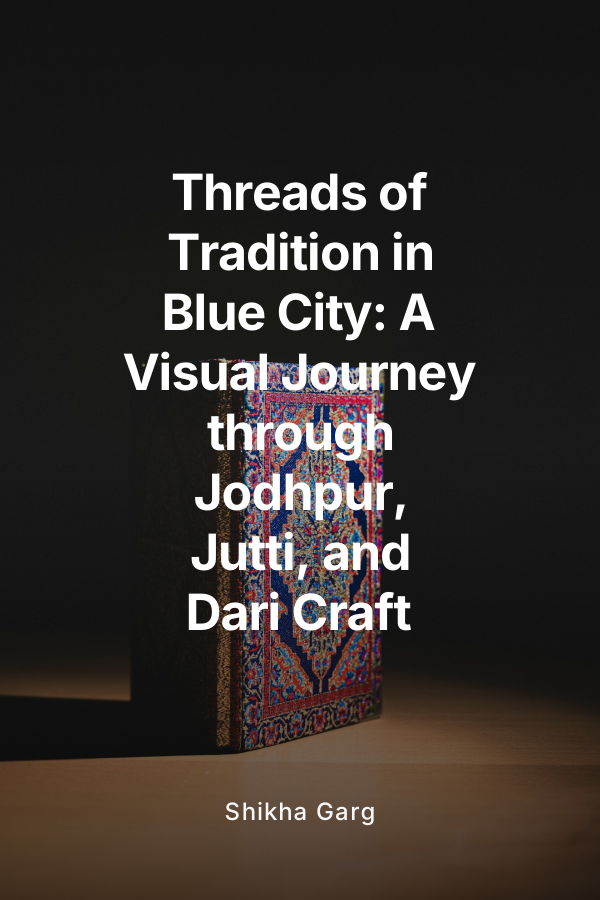
This book presents a concise yet visually rich exploration of Jodhpur in Rajasthan as a living craft landscape, designed especially for college students who need an informative, academically oriented project with strong visual support. It blends simple bilingual communication with slightly academic analysis, focusing on the socio‑economic impact, traditional knowledge systems, and contemporary challenges faced by two iconic crafts of the region: leather jutti making and cotton/wool dari weaving.
The opening section introduces Jodhpur as the “Blue City” and “Gateway to the Thar,” situating it geographically and culturally within Rajasthan. Students are guided through the old city’s narrow lanes, blue‑washed houses, bustling bazaars, and key heritage spaces that are directly connected to craft activity, such as local markets where juttis and daris are sold, and artisan neighborhoods where production still takes place. The introduction uses English for explanation while employing clear Hindi headings and selected Hindi captions to create a bilingual atmosphere that remains easy to follow. This dual‑language approach is intended to help readers appreciate how local people actually speak about their city and crafts, while still keeping the main academic narrative in English for project purposes.
The section on Jodhpur’s social and cultural environment highlights how climate, history, and trade routes shaped a city where crafts became integral to daily life. Here, the book explains that traditional crafts are not only aesthetic objects but also carriers of identity, memory, and social status. The reader learns how local festivals, weddings, and religious practices have long depended on products like ornate juttis and handwoven daris. At the same time, the text points out the influence of tourism, urban growth, and globalized markets in changing how these objects are produced, sold, and appreciated. This part sets the stage for understanding why documenting jutti and dari crafts is important for both cultural and economic reasons.
The book then moves into a detailed visual and textual documentation of jutti making in Jodhpur. Students are introduced to jutti as a traditional leather footwear known for its curved toe, colorful embroidery, and suitability for the region’s climate. A short overview explains the historical role of juttis in royal courts and among common people, leading to current uses by tourists and urban consumers. The main body of this section is organized around a clear pattern that is repeated later for dari: a short conceptual overview, a list of tools and materials, a step‑by‑step process, an outline of challenges, and a forward‑looking discussion of the craft’s future.
In simple but precise language, the jutti section explains the selection of leather, cutting of patterns, soaking and softening processes, hand‑stitching, decorative work, and final finishing. Each major step is supported by suggested photo placements that show artisans engaged in specific tasks, such as tracing patterns, punching holes, stitching uppers to soles, and adding decorative threads or embellishments. Captions in Hindi name the tools and actions in a familiar way, helping readers connect the technical process to everyday vocabulary. Through this, the book emphasizes that jutti making is a skilled craft rooted in traditional knowledge systems, often passed down within families.
Alongside process, the jutti chapter raises questions of socio‑economic impact. It explains how many jutti artisans work from small home‑based units, with limited access to formal marketing channels or social security. Issues like fluctuating raw material prices, competition from machine‑made footwear, and changing consumer tastes are described in accessible academic language. The text also highlights how tourism and online platforms can create new opportunities, but only if artisans receive adequate support in design innovation, quality control, and digital literacy. Instead of personal interviews, the discussion remains general and factual, yet it encourages students to think critically about what “handmade” means in today’s economy.
The next major section turns to dari making, presenting it as a complementary craft that transforms cotton, wool, and other fibers into flat woven floor coverings. The overview explains where daris are commonly used in Rajasthan homes, guesthouses, and tourist spaces, and how patterns often draw inspiration from local architecture, desert landscapes, and traditional motifs. Like the jutti chapter, the dari section follows a clear structure: overview, tools and materials, step‑by‑step process, challenges, and future.
Readers are guided through the basic elements of the weaving set‑up, such as the loom, warp and weft threads, shuttles, beating combs, and pattern charts. The step‑by‑step description shows how threads are arranged, how the design is planned, how colors are changed during weaving, and how the edges and finishing are handled. Suggested images show close‑ups of hands moving shuttles, feet operating loom pedals, and partially completed patterns growing row by row. Hindi headings and short captions underline key terms like दरी, करघा, and बुनाई, making it easier for bilingual students to recall technical vocabulary.
The socio‑economic analysis of dari weaving points to similar but not identical challenges when compared with jutti production. The book discusses issues such as low wage rates, long working hours, dependency on middlemen, and the pressure to produce cheaper, faster pieces that may compromise quality. It also notes the cultural and environmental advantages of handwoven daris, such as the use of natural fibers and the preservation of traditional designs, which can be important selling points in both domestic and international markets. Students are encouraged to recognize how market demand, government schemes, and craft promotion initiatives could influence whether this traditional knowledge survives or fades.
Beyond the core craft processes, the book devotes focused pages to the lives of artisans themselves. Without claiming to be based on specific interviews, it presents typical patterns in artisan families: multiple generations engaged in the same craft, early learning by observation and practice, and a delicate balance between preserving heritage and seeking more secure livelihoods. Separate space is given to jutti artisans and dari weavers, so the reader can notice differences in working environments, gender roles, and market linkages. For example, one part might describe family‑run jutti workshops located close to busy bazaars, whereas another shows dari looms set up in residential courtyards or small village clusters connected to Jodhpur.
The book also considers the role of tourists and visitors in sustaining or reshaping these crafts. It describes how tourists encounter juttis and daris in shops, street stalls, and handicraft fairs, often focusing more on appearance and price than on the labor and knowledge behind each piece. At the same time, the text notes how some tourists increasingly value “authentic” and “ethical” products, which can encourage more direct contact with artisans and support fairer compensation. Suggested photographs show tourists browsing in local markets, interacting with craftsmen, and taking pictures of looms or workshops, reinforcing the connection between cultural experience and economic support.
In the final part, the book brings together insights from all sections into a short, academically toned reflection on challenges and future directions. It identifies three main areas of concern that run through both jutti and dari crafts: economic vulnerability, erosion of traditional designs, and intense competition from industrial, machine‑made products. These pages encourage students to think in terms of policy, design, and education. For instance, they are invited to consider how design schools, government agencies, NGOs, and private companies could collaborate with artisan communities to develop new patterns, improve quality, and open new markets while still respecting local control and cultural meanings.
The concluding pages argue that the future of Jodhpur’s jutti and dari crafts will depend on how successfully they can adapt without losing their core identity. Concepts like “traditional knowledge systems,” “intangible cultural heritage,” and “socio‑economic sustainability” are introduced in simple but academically acceptable language, giving students useful terminology for their projects and presentations. The book stresses that documentation itself is a form of support: by recording processes, tools, terms, and visual details, young learners help keep knowledge alive and visible.
Throughout, the structure is consciously aligned with the needs of a 40‑page college project: short, focused English paragraphs, clear Hindi headings for key sections, selective Hindi captions that label scenes and tools, and frequent spaces reserved for photographs. This balance allows the project to function simultaneously as an academic report, a visual portfolio, and a respectful tribute to the artisans of Jodhpur. In doing so, it invites readers not only to admire beautiful juttis and colorful daris, but also to recognize the human stories and complex systems of knowledge woven into every stitch and thread.