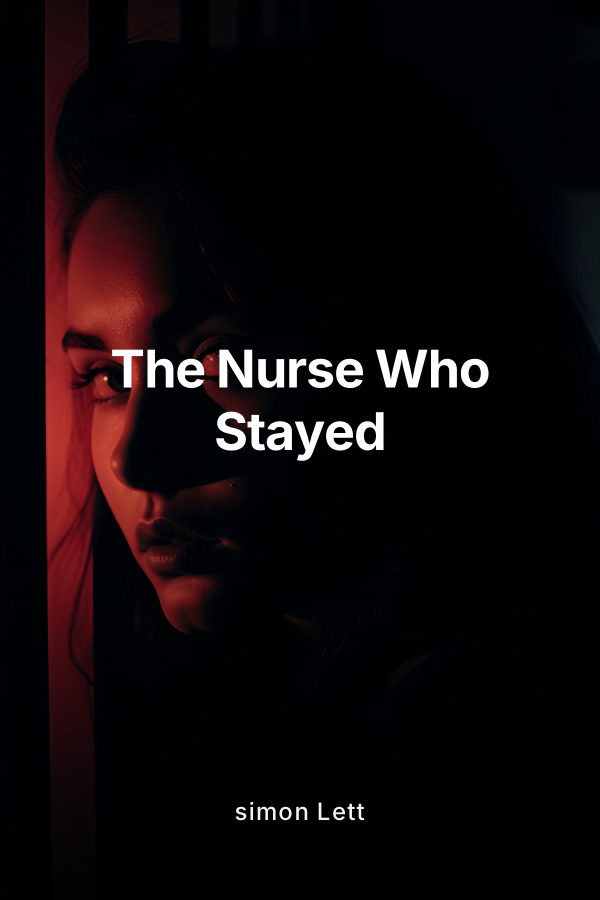
Sarah arrives at the hospital a broken daughter, not a fighter. Her mother is dead. The woman who should have walked out alive left in a body bag instead. In the blur of shock and grief, one face stands out as kind and steady. Nurse Fiona. Warm voice. Soft hands. The one who stayed when everyone else went home.
No one knows Fiona killed Sarah’s mother.
No one knows Fiona is poisoning Sarah too.
Fiona makes sure of that. She volunteers for extra shifts. She brings Sarah tea. Adjusts her drip. Speaks for her when Sarah is too weak and numb to care. Soon Fiona has maneuvered it so she has sole care of Sarah, something the overworked staff welcome with relief. The grateful doctors call her dedicated. The other nurses call her an angel. Sarah calls her the only person she can trust.
Trust is exactly what Fiona needs to finish what she started.
At first Sarah’s symptoms are written off as grief and stress. Headaches. Nausea. Sudden waves of fatigue. Fiona is always there with an explanation and a solution. Another pill. Another bag on the IV stand. Another signature on a chart that no one really reads. The poisoning is subtle, clever, designed to look like Sarah is simply falling apart.
Then Sarah wakes one night to the sound of paper. A quiet rustle in the dim hospital room. Fiona is in the chair by her bed, not with a chart in her hands, but a folder from Sarah’s mother’s things. Bank statements. Insurance documents. Numbers that make no sense in the context of simple care.
Fiona freezes when she realizes Sarah is awake.
For the first time, Sarah sees something cold behind the nurse’s gentle smile.
That moment is the crack in the glass. The point where naive, trusting Sarah begins to fracture. She does not confront Fiona outright. Not yet. She has learned, the hard way, that the person everyone admires most can be the one holding the knife. Or the syringe.
Sarah starts to watch.
She watches the way Fiona hovers over medication trolleys. The way certain patients decline after Fiona takes over their care. The way Fiona’s eyes linger too long on financial paperwork and next-of-kin forms. And she remembers the odd gaps in Fiona’s stories about her past. Different hospitals. Different towns. Always leaving for “a better opportunity” right after a patient dies in her care.
The hospital becomes a maze of murmured conversations and shadowed corridors. Sarah’s small flat, once a refuge, turns into a second battleground as she recovers enough to leave the ward but cannot shake Fiona’s presence. Texts. Calls. Unexpected visits. Fiona positions herself as the supportive friend who got Sarah through the worst. Everyone praises her devotion.
Only Sarah knows that devotion feels like a noose.
As the fog of drugs clears, Sarah’s personality shifts. The woman who once assumed the best in people starts assuming nothing. She combs through her mother’s finances and finds transfers, withdrawals, and signatures that do not belong. She recognizes Fiona’s handwriting where it has no right to be. She digs into hospital records and sees patterns she cannot ignore. A trail of vulnerable patients with complex estates and sudden declines.
Fiona is not just a killer.
She is a planner.
And she has done this before.
The more Sarah uncovers, the more dangerous the game becomes. Fiona senses the change in her. The way Sarah’s eyes stay sharp and steady now, the way she asks questions that cut too close. Fiona’s kindness grows sharper. Her concern feels performative, like a costume she puts on in front of others. Underneath, Sarah glimpses the predator.
Sarah, once the perfect victim, refuses to play her assigned role.
Quietly, she starts to build a trap. She learns how to access restricted files without triggering alarms. She records conversations. She lures Fiona into saying just enough at just the right moments. She plays weak when it serves her. Strong when it unsettles Fiona. At work, she cultivates allies without ever calling them that. A junior doctor who dislikes Fiona. A records clerk who talks too much. A cleaner who knows which bins get burned and which get missed.
Every move Sarah makes has two faces. One visible, one hidden.
As she grows fiercer, she edges closer to Fiona’s own moral line. She lies. She manipulates. She withholds life-saving information from Fiona’s next target until she can be sure it will help bring Fiona down, not just save a stranger. In protecting future patients, she is willing to risk present ones. Her thirst for justice threatens to become its own kind of cruelty.
The secret she eventually unearths is not just that Fiona has killed before. It is that Fiona has built an entire life on stolen identities and vanished patients. Years earlier, under another name, Fiona had crossed paths with Sarah’s mother. There was a complaint, a near exposure, and a hurried transfer that saved Fiona from prison. Sarah’s mother was the one person who almost ruined her.
Now it looks like Fiona came back to finish the job.
Sarah discovers proof that Fiona engineered her mother’s final admission to the hospital, manipulated her treatment, and positioned herself to inherit a slice of money through forged documentation. The murder was not opportunistic. It was personal, planned, and intimately connected to a buried scandal from Fiona’s past.
The expected move would be to take the evidence to the police, the hospital board, the press. To step into the light as a survivor exposing a monster. Sarah considers it. She imagines Fiona in handcuffs, the public outrage, the headlines.
Then she remembers nights hooked to a drip she did not consent to, drugged into submission by a smiling face. She remembers being too weak to lift her head while Fiona whispered reassurances and tightened invisible strings.
Sarah decides legal justice is not enough.
Her revenge must hit where Fiona lives. Not just her freedom. Her sense of control. Her ability to vanish and start again.
The climactic twist of the story lies in how Sarah chooses to use the secret. Instead of simply outing Fiona, she turns Fiona’s methods back on her in a way no one expects. She creates a new narrative where Fiona appears increasingly unstable. She plants discrepancies in charts. She forges signatures that point to negligence not yet committed. She orchestrates minor but alarming “mistakes” that other staff will blame on Fiona. The hospital that once idolized her begins to doubt her judgment, then her sanity.
At the same time, Sarah quietly circulates select pieces of Fiona’s past under anonymous tips, never enough to expose the full horror, always enough to erode trust at strategic points. Applications Fiona has pending at other hospitals suddenly stall. A routine credential check flags something odd. A former colleague gets a message that reopens old suspicions.
Piece by piece, Sarah strips away Fiona’s exits.
When Fiona finally realizes she is trapped, her world is already collapsing. The colleagues who once defended her close ranks against her. Patients request different nurses. Administration opens an internal investigation that digs exactly where Sarah wants it to. Fiona lashes out, desperate, and in doing so confirms every doubt now swirling around her.
Sarah’s final move, the most unexpected of all, is not to watch Fiona be arrested.
It is to walk away before that happens.
She hands over only enough evidence to ensure Fiona cannot easily escape scrutiny or rebuild her life somewhere else. She keeps the darkest proof to herself, a private verdict. Fiona will face consequences, but not the clear-cut resolution of a courtroom confession. She will be suspended, investigated, whispered about, branded unsafe, and quietly blacklisted. No dramatic showdown. No headline that gives Fiona the twisted satisfaction of being recognized as a singular monster.
Fiona is erased in the way she tried to erase others. Reduced to rumors, warnings, and closed doors.
Sarah becomes something new in the process. No longer naive. No longer purely a victim or purely a hero. She is fierce, strong, and capable of the same cold strategy that once almost killed her. She chooses a form of justice that denies Fiona power, attention, and legacy.
The book ends with Sarah back in her flat, the hospital a looming presence in the background of her window. On her table lies a single folder, thick with what she did not share. Records of Fiona’s past, details of deaths that will never see a courtroom. Sarah could still destroy Fiona completely if she wanted to. Even from a distance, even after the investigations run their course, she holds the final blade.
Revenge, in this story, is not about a body count or a public fall.
It is about control. About turning the quiet, invisible methods of a killer against her, and then choosing when to stop.
The Nurse Who Stayed is a fast, tense psychological thriller set in sterile corridors and cramped flats, where every smile might hide a syringe and every kind act might be part of a plan. It follows Sarah’s sharp transformation from trusting patient to dangerous avenger, and Fiona’s unraveling from admired nurse to hunted predator. Secrets rooted in the past collide with present lies, and the most shocking twist is not just what Fiona did, but what Sarah is willing to do to make sure it never happens again.