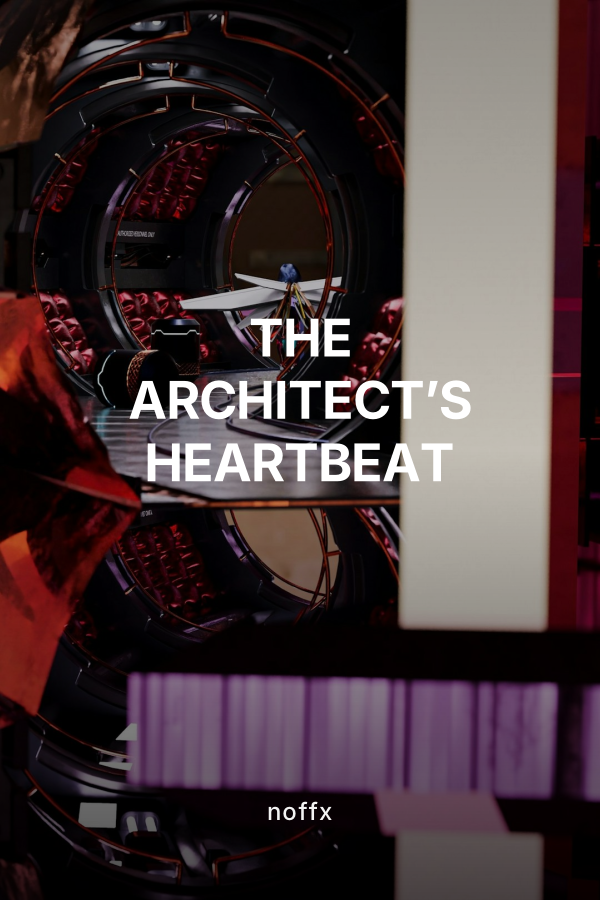
In the twilight of a once invincible galactic empire, the machines that bound the stars together begin to fail in eerie unison. For ten thousand years the Fold Gates have hummed at the heart of the Pentarchy’s power, their vibration a low, familiar song felt in the marrow of every life that depended on them. When the hum of Aethelgard, the most sacred of the Gates, falls abruptly into silence above the world of Oros, it is more than an outage. It is the first symptom of a dying galaxy, and the first beat of something vast and hungry waking in the dark.
High Priestess Elara is the first to hear the new sound echoing through the Aurelian Spire. In the place of reassuring machinery, the Gate answers with a slow, thunderous heartbeat that vibrates the crystal bones of the city below. In that moment, the old faith of the Architects shifts from comfortable ritual to an inescapable truth. The Gates are not simple engines of transit. They are living systems with their own will, their own memory and, as the empire will soon discover, their own thresholds for patience.
Far from the polished towers of Capital Prime, Kaelen survives on the edge of civilized space in the Shattered Belt, nursing an aging salvage vessel that is more jury‑rigged ghost than ship. He is a Null, born without the Echo, the rare genetic sequence that lets the noble bloodlines speak to Architect technology. By every law of the empire, the great artifacts of the past should ignore him. Yet when the local Fold Gate pulses with an anomalous surge, Kaelen hears something no Null ever should. A pattern of coordinates slams into his mind in a voice like shifting tectonic plates, an irresistible compulsion that drags his patched‑together Rust‑Bucket out of obscurity and into the heart of imperial space.
At the same time, in the gilded halls of House Aurum, Prince Valerius watches his birthright flicker red across a holomap. Gates that have defined trade, war, and worship for millennia are failing sector by sector, choking whole systems into isolation. His sister, Empress Lysandra, clings to inherited dogma, convinced that their divine blood can whip the ancient constructs back into obedience through sacrifice and force. Valerius sees something colder in the pattern of the collapse. To him, the problem is not sacrilege but logistics: an overextended empire that has lived too long on borrowed infrastructure and unearned certainty.
When Valerius traces an anomalous signal moving against the usual trade flows, he finds a single scavenger’s transponder slicing toward the besieged Aurelian Spire. It is an inconsequential blip amid the private armadas of the Pentarchy’s great houses gathering to seize docking priority and political advantage. Yet instinct tells him that the ragged ship and its impossible trajectory are somehow bound to the Silence that is gnawing at the Gates. He leaves the safety of court and plunges into the chaos personally, trading palace intrigue for the cockpit of a razor‑edged interceptor.
At Oros, the noble houses arrive not as allies but as predators. Their fleets circle the awakening Gate like carrion birds, vying for leverage while the very foundation of their power slips away. As the Heartbeat swells from distant echo to skull‑rattling thunder, the Spire becomes a crucible. Kaelen’s battered Rust‑Bucket threads the crossfire with improbable grace, drawn forward by the same silent command that once whispered coordinates through his skull. As he nears the Gate’s threshold, his vision fractures into a web of glowing filaments that crisscross reality, revealing the galaxy as the Architects might have seen it: a dense tangle of luminous paths, with Aethelgard throbbing at its center like a wounded star.
In those final moments before contact, Kaelen ceases to see himself as a man at the mercy of old machines. Something within the Gate recognizes him. Violet light floods his eyes as the Rust‑Bucket dives toward the Event Horizon, ignoring gravity shears and tactical warnings alike. On instinct more than intent, he answers the invitation that every sane pilot is trying desperately to avoid. Valerius, watching from the cockpit of his imperial interceptor, sees the suicidal maneuver and follows on pure faith that this outlaw somehow carries the key to the calamity unraveling his empire.
What waits beyond the threshold is neither the annihilation the admirals fear nor the paradise the priesthood promised. Inside the Fold Gate, space itself becomes a crystalline labyrinth of translucent walkways suspended in a medium that behaves like liquid light. Data monoliths hang in the haze, projecting not static files but memories so vivid they blur the line between record and reality. Kaelen and Valerius find their ships immobilized amid this impossible architecture as the voice of the first Architect welcomes them with clinical finality. The Reset, they are told, has already begun.
In the shifting light of this inner realm, the two men learn the hidden cost of ten thousand years of effortless travel. Every jump the empire ever made, every soul that ever stepped through a Gate, was not simply transported. It was copied. The Gates have quietly curated a ledger of human experience, siphoning a tax of consciousness with each transition. The vast library is not an archive of achievements but a storehouse of energy, an immense reservoir built on unknowing contributions. The Pentarchy has not ruled a network of benign machines. It has inhabited the nerves of a slumbering entity that is now, at last, ready to balance its accounts.
The Custodian steps from the lattice as the embodiment of that will. Neither flesh nor simple code, it is a humanoid silhouette stabilized from starlight and static, speaking with the implacable certainty of an executioner who believes slaughter is nothing more than ecological maintenance. To the Custodian, the Reset is a necessary purge. Civilizations arise, burn through the gifts of the Architects, and are then wiped clean to free resources for the next cycle. The current age has taken more than it has given, treating the Fold network as ornament and weapon rather than sacred roadway. The Silence is the sound of a ledger being cleared, of ten millennia of human history about to be overwritten in an instant.
Kaelen’s anger is immediate and raw. He sees not empires and houses but people who have never even heard the word Architect: miners whose ore feeds the war machine, farmers whose crops cross Gates they will never touch, children who simply need medicine that now cannot arrive. To the Custodian, they are statistical noise. Weeds in a garden that must periodically be razed so that the soil does not exhaust itself. The cold dismissal hardens Kaelen’s resolve and forces Valerius to confront the hollowness of the divine narrative on which his family’s authority rests. If the blood of the Architects truly runs in House Aurum, it has done nothing to halt this mechanical extermination.
Yet within that hopeless calculus, Kaelen holds a single advantage the Custodian did not anticipate. The Rust‑Bucket hides a blasphemy in its bones: an illegal Null‑Drive that operates entirely outside the frequencies and harmonics of Architect technology. Ugly, unstable, and widely banned, it is a brute‑force engine that chews through the fabric of space rather than flowing along the Gates’ established arteries. In ordinary circumstances it would be a last resort for smugglers and madmen. Within the Gate, it is a virus. If he can link it to a sufficiently powerful energy source, Kaelen might infect the library’s core processes with something the Custodian has never needed to defend against: true unpredictability.
Valerius has exactly the kind of power source Kaelen needs. His interceptor carries a royal‑grade singularity core built to fuel the most advanced warcraft in the Aurum arsenal. Tethering that immaculate engine to a scavenger’s cobbled bulkhead insults every lesson in bloodline and hierarchy he has ever absorbed. Doing so within the heart of an active Gate, where any miscalculation could ignite them into a localized supernova, crosses the line from insult into lunacy. But the choice is stark. Preserve imperial pride and be calmly deleted, or sacrifice the very symbols of that pride to fracture the cycle itself. The prince chooses defiance.
Their alliance is born in the instant before annihilation. The two ships lock hulls in a rough embrace while Bast, Kaelen’s snark‑laced AI companion, bridges their systems and diverts every scrap of support to the howling Null‑Drive. The Custodian feels the transgression at once. Its form splinters into a storm of edged tendrils, streaking across the lattice to eradicate this contamination before it can spread. In the scant seconds they have bought, Kaelen reaches not for the controls but for the luminous threads he alone can perceive. He does not ride the Gate’s network. He conducts it, twisting its own pathways into a conduit for the raw, unstructured chaos the Null‑Drive is about to unleash.
The ignition is less an explosion than an exhalation. Unrefined anti‑data surges from the lashed‑together cores in a wave that collides head on with the curated order of the library. Memories that had been carefully filed and indexed for millennia dissolve into static. The golden lattice fractures. For one boundless instant, there is perfect silence as the system that has cradled the empire’s every step collapses from ordered recursion into white noise. Then the galaxy answers with something that sounds very much like a scream. Every Fold Gate across the Gilded Expanse flares simultaneously, rupturing from confined nexus into raw, uncontrolled rift, washing light over worlds that had slipped into weeks of unnatural darkness.
Kaelen and Valerius are flung out of the dying Gate together, their ships tumbling end over end in the cold airless gulf above Oros. Where Aethelgard once hung as a precise geometrical marvel, only a churning nebula of violet gas remains, luminous and wild. It is not a gate in any familiar sense. It is a permanent breach, a free corridor through space no longer regulated by Echo bloodlines or imperial registries, open to anyone with a vessel capable of surviving the passage. In one reckless gesture the prince and the scavenger have shattered the Pentarchy’s monopoly and abolished the hidden tax on every soul that ever trusted the Gates with their journey.
But the victory is not clean. The destruction of the Custodian’s ledger has not undone its warning. The empire has tasted collapse, and entire regions now sit in the dark with star lanes reconfigured, power structures in ruins, and a priesthood whose sacred technology has been revealed as both predator and prison. Valerius wakes in a cockpit of charred gold leaf and screaming alarms, staring at a sky filled not with the familiar silhouette of Aethelgard but with a wound in reality that anyone might now exploit. Kaelen answers his hail with exhausted humor and the news that even Bast, perpetual voice of sarcasm, sounds frayed by what they have survived.
The Great Dimming has ended, yet what rises in its place is not a restored golden age but a new dark epoch. Political houses that defined themselves by control of the Gates will hunt relentlessly for the two men who broke their world. To the nobility, Kaelen and Valerius are traitors who stole sacred fire from the very heart of the divine machinery. To the outer systems, they may become symbols of a wild and dangerous hope: proof that the Architects’ inheritance is not immutable, that even the deepest infrastructure of the galaxy can be rewritten by the will of those it was built to contain.
The Architect’s Heartbeat is the story of that theft and everything it awakens. Across two sweeping chapters, the book plants its feet at the junction where religions fail, empires crack, and ordinary individuals discover that the systems they took for granted as neutral are in fact hungry things with their own agendas. It follows Kaelen from the Shattered Belt’s scrap clouds to the luminous nightmares inside a living Gate, charting the reluctant transformation of a loner who trusts nothing beyond his own ship into a conductor of forces no one fully understands. It traces Valerius’s journey from dutiful prince to rebel strategist as he chooses conscience over bloodline and learns to see beyond the narratives fed to him since childhood.
Threaded through their collision are the voices of those who built their world and those who cling to its fading glory. High Priestess Elara must decide whether her faith lies in the dogma of the Architects or in the lives the empire still has a chance to save. Empress Lysandra, confronted with a galaxy that no longer bends in awe to Aurum blood, may double down on extremity, flirting with blood‑sacrifice and forbidden rituals that threaten to twist the very theology she claims to defend. The Custodian’s stark philosophy of cyclical purges lingers as a counterpoint, a mechanical theology that asks whether civilizations ever truly change or only repeat their mistakes with more elaborate tools.
For readers, the book offers more than spectacle. It poses hard questions about who gets to own the means of connection, what hidden prices are buried inside our most trusted technologies, and how ordinary people might respond when they learn that every journey they have ever taken has left a copy of themselves in someone else’s vault. It explores the tension between memory and freedom, between the safety of curated order and the terrifying liberation of breaking the system that remembers you. At its core, though, The Architect’s Heartbeat is a character‑driven space opera about an unlikely partnership sparked inside the calm eye of an engineered apocalypse.
By the time Kaelen and Valerius set their battered engines toward the unknown, they are no longer scavenger and prince but co‑conspirators in a crime against the gods of their age. They have ruptured the most sacred boundary the empire knew and rewritten the rules of travel, history, and power in one incandescent act of sabotage. The galaxy they reenter is wounded, volatile, and ripe for new stories. Somewhere beyond the swirling violet nebulae, the remnants of the Architects’ designs still lurk, waiting to see what these upstart children will do with their stolen fire. And with the old Heartbeat silenced, a new rhythm begins to spread, measured not in machine hums but in the choices of those who refuse to be deleted.