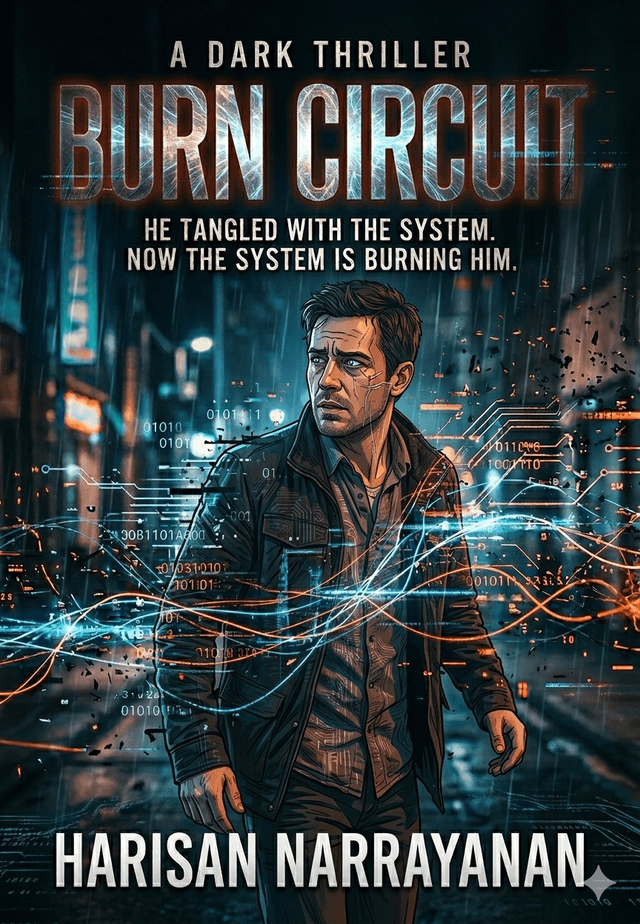
In the heart of a brutal modern city, where glass towers glow over broken streets and power moves through hidden channels, Burn Circuit follows an ordinary man dragged into an extraordinary nightmare. The protagonist is a skilled but uncelebrated head of hardware at a tech company, a practical worker whose life is built on long hours, technical precision, and a quiet belief that competence and honesty still matter. That belief shatters the night he notices suspicious hardware activity inside his company’s infrastructure, a pattern of off-record machine use that leads him to a buried cache of secret files. What he uncovers is not a technical anomaly but evidence of concealed cash transfers tied to stolen money, routed through the company under the protection of powerful men who know how to turn institutions into weapons.
Before he can decide what to do, the system closes around him. The company’s wealthy sponsor, a polished and untouchable businessman with deep influence across the city, moves swiftly to protect himself. Corrupt police officers, already on his payroll, shape the investigation before it begins. Evidence appears where it should not exist. Financial records are twisted. Devices are planted. Testimony is prepared. The protagonist is arrested for cash fraud and publicly branded as the architect of a financial crime he was actually trying to expose. In one devastating blow, he loses his job, his reputation, and the fragile trust holding his family together. Worse, no one believes him. In a city built on perception, innocence means nothing once the right people decide on your guilt.
The novel’s central tension grows from confinement and disbelief. Inside jail, the protagonist is stripped of status and certainty, forced to survive among men who read weakness instantly. There he meets a cellmate driven by revenge, a man hardened by the system yet sharp enough to recognize that the case smells wrong. At the same time, a lawyer enters the story seeming to offer the one thing the protagonist no longer has: a path back to justice. Together, these two figures create the unstable axis of the book. One knows the criminal logic of the city from the inside. The other knows the legal machinery that crushes the innocent while protecting the rich. The protagonist begins to fight back the only way he can, by thinking like an engineer in a world ruled by predators. He starts tracing patterns, testing stories, and rebuilding the truth from fragments that powerful people assumed would stay buried.
As the investigation deepens, the novel becomes more than a story of wrongful imprisonment. It becomes a descent into layered betrayal. The tech company did not merely abandon him under pressure. It set him up deliberately after he discovered too much. The suspicious hardware use that first drew his attention was part of a hidden system designed to move illicit funds while disguising their origin. Every safeguard in the company existed not to prevent corruption, but to hide it behind plausible complexity. The protagonist realizes that the fraud was engineered with chilling precision, and that he was chosen as the scapegoat because he was close enough to the truth to be dangerous, yet ordinary enough that no one powerful would defend him.
The personal betrayal cuts even deeper than the corporate one. As he hunts for proof from inside a collapsing life, he learns that a sibling helped frame him. Buried under heavy debt and driven by greed, that family member made a deal with the company’s owner and planted evidence that helped secure the arrest. This revelation gives the story its emotional core: the protagonist is not only fighting the state, the company, and the police, but also the collapse of blood loyalty itself. The person who shared his history helped erase his future. That wound reshapes the book, turning it from a procedural thriller into a darker meditation on how money corrupts intimacy, and how betrayal is most devastating when it comes from someone who already knows where to cut.
The lawyer, initially framed as a possible instrument of justice, becomes one of the story’s sharpest twists. Rather than a flawed ally or a compromised survivor, this figure is revealed as fully corrupt and deeply embedded in the conspiracy. He is not merely taking advantage of a broken system. He is working directly for the businessman behind the fraud, guiding the case toward conviction while presenting himself as indispensable to the defense. His role transforms every earlier interaction, recasting advice as manipulation and support as containment. By the time the protagonist understands the lawyer’s true allegiance, the trap has already tightened around him. This twist reinforces the novel’s darkest theme: in a city ruled by money, even the people assigned to protect the innocent may be architects of their destruction.
What gives Burn Circuit its momentum is the protagonist’s refusal to surrender his mind. He does not become an action hero or criminal mastermind. He remains what he always was: a technically gifted ordinary person who knows how systems work. His strength comes from persistence, pattern recognition, and the ability to see meaning in hidden architecture. These qualities allow him to connect the stolen money, the hardware anomalies, the fabricated evidence, the bribed police, and the invisible hand of the sponsor controlling it all. Working with his cellmate and maneuvering around the lawyer’s deceptions, he begins to gather the evidence necessary to strike back. The city remains hostile at every turn, but his growing clarity becomes its own form of resistance.
The thriller builds toward a live press event that serves as both climax and reckoning. Rather than ending in the sealed language of court filings or quiet plea bargains, the truth erupts into public view. In a setting designed for image control and damage management, the protagonist turns exposure into a weapon. The same city that condemned him on spectacle is forced to witness the unmasking of the businessman, the company, and the police who protected the scheme. Files surface. Transfers are linked. Lies collapse under the weight of their own coordination. The public reveal carries both narrative and symbolic power: it is not enough for the guilty to be privately known. In this world, truth must be made visible to survive.
Yet the ending does not offer clean comfort. The final twist drives home that the betrayal went deeper from the beginning, with rot running through family, business, law enforcement, and legal defense alike. Even as the businessman and lawyer are exposed publicly, the damage done to the protagonist cannot be easily undone. Freedom comes scarred. Vindication arrives too late to restore what was taken whole. The novel closes on a hard, unsettling truth fitting its dark and gritty tone: surviving corruption is not the same as escaping it. The city may finally know his name for the right reasons, but he has seen too much to believe that justice and innocence are ever fully repaired once power decides to feed on them.
Burn Circuit is a suspense-driven thriller about false accusation, institutional rot, and the terrible intimacy of betrayal. It promises a fast, tense descent through jail cells, corporate secrets, bribed cops, counterfeit alliances, and family treachery, all anchored by an ordinary protagonist forced to become dangerous simply to remain alive. With its big-city darkness, escalating twists, and shocking revelations, the story offers a relentless emotional and psychological ride, asking how far one person can be pushed before truth becomes the only weapon left.