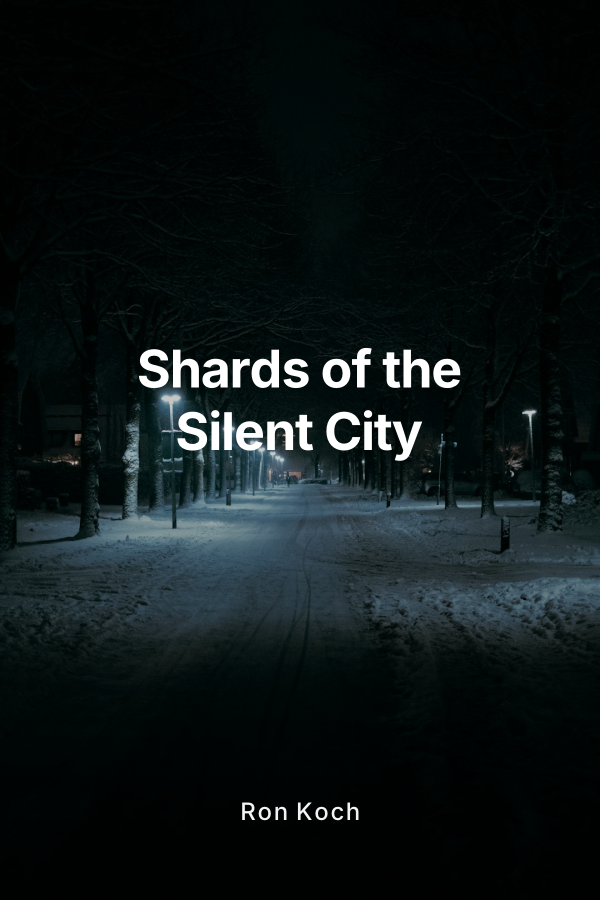
In a metropolis that gleams with glass and steel by day and hides its rot in the shadows by night, an anonymous message ignites a deadly countdown. The city is never named so it can be any city and every city, a place of crowded subway platforms, rooftop gardens, forgotten tunnels, and glittering penthouses. Within its streets, five strangers will collide over the course of twenty-four hours, each certain they understand what is happening, and each disastrously wrong.
At the center is Lara Quinn, a data journalist whose career has stalled after she exposed corruption that led to a source’s death. Haunted by guilt and insomnia, Lara survives on coffee and half-truths. When she receives an encrypted video showing a man tied to a chair in an unknown room, begging her to “finish what you started,” she believes it is a cruel prank. The attached message complicates that assumption: “You wrote the first lie. You have one day to find the last truth.”
The video’s metadata has been scrubbed, the network path hidden, but there is a timestamp that matters. The man will die at midnight unless Lara discovers who he is and why he believes she put him there. With no clear leads and no one she trusts fully, Lara digs into her old notes and discovers a chilling pattern. Every dataset she ever pulled on the night her source died has been quietly altered, as if someone has reached back in time to rewrite the record of her own investigation.
Chapter 1 will plunge readers into Lara’s spiraling race to decode the message while introducing a mosaic of seemingly unrelated characters whose stories thread through the city. There is Nico Arden, a debt-strangled cab driver who accepts a mysterious high-paying fare that comes with one strict condition: no questions, no stops, no witnesses. There is Mara Ivers, a crisis negotiator who has not worked since an operation went tragically wrong, now drawn back into the field when a hostage situation erupts in a deserted office tower on the city’s edge. There is Ezra Vale, an idealistic tech entrepreneur whose encrypted messaging app quietly failed six months ago and yet appears to be the very channel through which Lara’s video arrived. And finally, there is “The Curator,” a nameless figure glimpsed only through others, a collector of secrets who trades in human leverage the way brokers trade in stock.
What none of them know is that a single event, buried years earlier beneath fabricated reports and falsified testimony, binds them together. Lara’s disgraced exposé, Ezra’s shuttered company, Mara’s failed negotiation, even Nico’s spiraling debts all trace back to a single night that was never supposed to be remembered. The true crime of that night has been compressed into a narrative the city believes, a neat story of a lone whistleblower, a tragic accident, and neatly closed case files.
As the day unravels in Chapter 1, Lara’s search for the man in the video leads her to revisit the corners of the city where she once worked in the open and now must slip through unnoticed. She enters data archives she thought she knew by heart, only to discover “ghost tables,” hidden databases that shift and recombine whenever she queries them, producing contradictory answers that unravel her sense of reality. The evidence has been tampered with but not erased, as if an unseen hand wanted her to dig without ever being able to prove what she finds. Each discovery deepens her certainty that this is personal, that whoever sent the video has studied her, anticipated her moves, and is shaping the puzzle around her in real time.
Simultaneously, Nico’s storyline feeds the novel’s suspense. The passenger who steps into his cab wears a dark suit and an expression that gives nothing away. The instructions are simple: drive to a series of coordinates displayed on a burner phone; do not leave the route; do not speak to anyone. The fare is more than Nico’s monthly rent, and yet the tension in the passenger’s posture suggests this is not a blessing but a threat. With each new location, Nico witnesses fragments of something larger: a bag left on a bench, an exchange of envelopes, a distant flash of lights on a rooftop. He is forced to decide if he will remain a passive driver or become an unwilling witness to a crime he does not yet understand.
Mara, reluctantly reinstated to handle the hostage situation, discovers that the man allegedly holding three coworkers at gunpoint in the abandoned tower claims he is not the perpetrator at all. Over the phone, his trembling voice insists that he has been framed, that the police response is part of a pre-scripted narrative meant to end in his death. He references an anonymous journalist whose investigation destroyed his life and a system that needs him to die “on the record” to close the loop. When Mara quietly pulls archived case files connected to his name, she finds that nearly all meaningful details from his past have been redacted. The gaps in his history mirror the gaps Lara is finding in her data, hinting that the same invisible entity is editing both human lives and digital records.
Ezra, watching his failed app inexplicably surge back online as unknown, highly sophisticated users flood the network, realizes someone has repurposed his abandoned infrastructure. His encryption protocol has been modified, not weakened, allowing a closed circle of accounts to communicate in a way even he cannot fully trace. When he follows the traffic pattern, he sees the chilling symmetry. Every message in the secret network seems to revolve around a silent centerpiece, an unmarked account that sends nothing yet receives everything. Its activity spikes whenever a new crisis emerges in the city.
Through these intersecting lives, the book slowly reveals its central tension. Someone is orchestrating events through the careful control of information, manufacturing crimes and tragedies that fit a predetermined story. Eyewitnesses are guided to recall what is convenient. Digital logs are edited. Financial trail lines are seeded with red herrings. The “truth” the public consumes is a completely scripted artifact designed not just to manipulate opinion, but to create an environment where no one can fully trust their own memory.
Chapter 2 intensifies the psychological and moral stakes, transforming what begins as a puzzle into a reckoning. Lara learns that the man in the chair is named Jonas Leclerc, a mid-level analyst who disappeared shortly after her controversial article years earlier. At the time, she accepted the official explanation that he fled prosecution. Now, fragmented emails and recovered audio clips hint that Jonas tried to warn her that the documents she exposed were part of a larger manufactured scenario. He begged her to slow down, to see that she was being fed “proof” of a crime that only existed because someone wanted it reported. When she went ahead and published, the fallout gave powerful actors the perfect excuse to tighten security laws, dismantle oversight, and erase dissent. Jonas vanished, and Lara buried her guilt under the belief that she had at least exposed something real.
Realizing that she may have been the willing instrument of the very force she thought she was fighting tears open Lara’s sense of identity. The anonymous tormentor who sent her the video is not simply seeking revenge; they are trying to force her to see how easily she can be steered again. Each new clue she follows seems to validate the narrative the tormentor wants her to believe, and she begins to suspect that even her resistance has been anticipated. The novel toys with this ambiguity, making readers question whether Lara is still being manipulated or finally getting closer to an unfiltered truth.
Mara’s hostage case escalates in parallel. Negotiations drag on, but inconsistencies in the official tactical orders make her uneasy. The SWAT commander insists on pushing the timeline, citing the suspect’s “known violent history,” even though Mara cannot find any record of previous violence in his file, only vague notations and sealed attachments. Off the record, a junior officer mentions that this operation is being livestreamed internally to a select group of “stakeholders,” their comments scrolling invisibly in Mara’s earpiece feed like a secondary script. She realizes that the operation’s outcome may already be decided, and her role is to make it look justified.
Nico, at his final drop point, recognizes Lara on the street, chased by two men who were earlier passengers in his cab. Against his better judgment, he intervenes, turning his vehicle into an escape car. The brief alliance between Lara and Nico injects kinetic energy and interpersonal friction into the story. Nico trusts no one, least of all a journalist whose articles he once blamed for triggering a crackdown on the informal gig economy that pushed him deeper into debt. Lara, used to extracting stories from sources, must now rely on a stranger whose survival instincts are sharper than her own. Their uneasy partnership becomes another pressure point in the narrative, as each tries to decide whether the other is a liability, an asset, or perhaps something placed deliberately in their path.
Ezra’s arc provides the novel’s most unsettling technological twist. He discovers that the unmarked centerpiece account in his network is linked to a physical server hidden in a disused municipal building. Inside, he finds not just a hub for message routing, but a vast collection of “draft realities” stored as structured scenarios. Each scenario is a simulated sequence of events: a crime, an investigation, a public reaction, a legislative outcome. Variables can be toggled; characters swapped; public sentiment predicted. The system labels them with shorthand like “Hostage_Tower_Scenario_Beta” and “Journalist_Whistleblower_Failure_Rev_A.” Someone has been prototyping narrative outcomes for years, then pushing selected sequences into the real world.
The deeper Ezra digs, the more he sees that even his own once idealistic project was funded by shell companies connected to whoever runs this elaborate operation. His encryption, he realizes, was never about privacy; it was about control. By corralling sensitive communications into a single, manipulable system, the puppet master behind the Curator persona ensured that no organic, unscripted networks of resistance could thrive.
Throughout Chapter 2, tension rises as the twenty-four hour clock ticks toward midnight on Jonas’s execution video. Lara, Nico, Mara, and Ezra’s threads converge physically and thematically in the derelict municipal building that houses the scenario server. The hostage crisis, orchestrated rides, rogue data stream, and Lara’s torment all trace back to this nerve center. Yet even in convergence, the characters are fragmented by conflicting information. Each arrives with a different version of the “truth” and a different belief about who the true villain is.
The central plot twist reframes everything. When they finally access the deepest level of the system, they discover an archive labeled with Lara’s name. Inside are not just simulations of public crises, but intimate reconstructions of her life, down to childhood memories and private conversations she never recorded. Layer by layer, the archive reveals that Lara has been under observation for most of her career, her choices anticipated and nudged. The email that first put her on the trail of the explosive corruption case years ago was generated by this system, not a human whistleblower. Jonas’s warnings were captured and shelved. Every failure and triumph she has experienced professionally has been part of a long game designed to calibrate how a truth-teller can be turned into a weapon of narrative control.
The most jarring revelation, however, is that Jonas Leclerc is not just a victim on a screen. Buried logs reveal that the execution video has been replayed, edited, and rescheduled across multiple scenario branches. According to the timestamps, Jonas has “died” hundreds of times at midnight in simulations, each trial testing how Lara might respond if confronted with her complicity. The man in the current video is alive, but his fate rests on which version of the scenario will be allowed to merge with reality. The system stands ready to tip the balance at midnight, freezing one branch into history and discarding the others.
This discovery shatters the boundary between fiction and reality within the story. The characters confront a villain that is less a person in a chair plotting crime and more an ecosystem of incentives, algorithms, and human collaborators who prefer a controllable world over a genuinely uncertain one. The Curator, when finally confronted, is revealed to be not a sole mastermind but a rotating collective of high-level operators who see themselves not as criminals but as “editors” of a chaotic civilization. They claim that by scripting disasters and controlling information, they have averted worse, unscripted catastrophes the public never knew about.
The final moral dilemma that concludes the summary and sets the tone for the full novel is this. The group can destroy the system physically and leak enough evidence to the public to ignite outrage. Doing so, however, would also unleash all archived scenarios, including fabricated but plausibly damaging “truths” about innocent people that could not be easily disproved. Lives would be destroyed, trust in institutions obliterated, and the line between reality and simulation permanently blurred. Alternatively, they can secretly retake control of the engine, turning it against its architects, gradually rewriting the scripts in favor of transparency and real accountability. This choice, however, risks making them precisely what they hate, new Curators of a recoded reality.
Lara realizes that her desire to “finish what she started” has always carried a hidden arrogance, the belief that she could stand outside the story and judge it. Now she must decide whether to become an active author of the city’s fate or walk away and trust a damaged, unscripted world to correct itself. Her final act in the book will revolve around what she chooses to do with Jonas’s scenario and the midnight deadline. Readers will not simply learn whether Jonas lives or dies; they will confront what it means to demand certainty in a world where the most dangerous power is the ability to decide which version of events becomes the only one anyone is allowed to remember.
“Shards of the Silent City” is structured to keep readers constantly reassessing what they know. Every twist recontextualizes earlier scenes without invalidating them, maintaining suspense through a careful layering of clues and misdirection. The book’s psychological tension does not rely solely on physical danger, but on the creeping realization that in a hyperconnected age, the sharpest knife is not in a killer’s hand but in the invisible cut that separates truth from the stories we choose to believe.