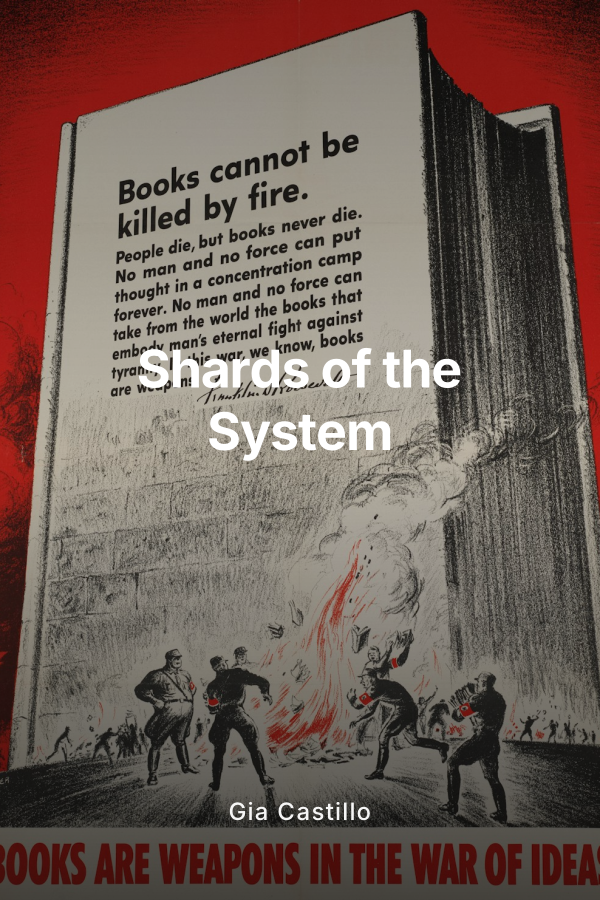
In the towering steel labyrinth of New Vardis, President Vale’s System is the unseen judge and jailer that rules every life. It sorts citizens with merciless precision into two worlds: the glittering spires of the Uppercity where light, privilege, and endless sky belong to the favored, and the choking alleys of the Undercity where dust, smog, and hunger cling to the forgotten. Your family name, your wealth, a whisper of rumor, even a minor infraction can condemn you below forever. The System remembers everything, and it forgives nothing.
Avery Ward, eighteen and Undercity born, has grown up under its shadow. Her earliest memory is not of love or laughter but of armed officers in gleaming white armor dragging her mother away for a crime no one would explain. All she had left was her quiet, stubborn father Judah, who taught her how to keep her head down, fix broken machines, and survive. With him and her fearless best friend Annika Rose, Avery learned to navigate the rusted catwalks and neon-splintered nights of the underlevels, where illegal markets hum beneath surveillance drones and every breath tastes faintly of metal and ash.
Avery believes she is only one more nameless girl crushed under the weight of history. She has no power, no influence, no way out of the cage the System has locked her into. Her only dream is small and almost shameful in a world starved of hope: to keep Judah and Annika safe, and maybe, one day, find out what truly happened to her mother.
That fragile, private wish becomes the spark that sets her world on fire.
It begins with a glitch.
While scavenging in a forbidden maintenance tunnel, Avery stumbles upon an obsolete interface port sealed behind a welded panel, a piece of the city’s ancient nervous system long forgotten by the technicians above. When she connects a stolen handheld to it, lines of unauthorized code bloom across the screen, swallowing the familiar insignia of the System. Buried inside the corrupted data she finds records that should never exist: footage of forced relocations, falsified trials, and “disappearances” branded as lawful removals. Among the footage is a sequence labeled only with a date she knows by heart, the night her mother vanished.
The truth hits like a physical blow. Her mother was not taken for some hidden personal crime. She was erased because she attempted to expose a flaw within the System itself, a buried command structure that allows Vale and his council to manipulate the supposedly impartial algorithm, condemning entire bloodlines to the Undercity in order to preserve their grip on power.
The System is not neutral. It is not fair. It is a weapon.
Avery’s first instinct is to run from what she has seen, to slam the door on it, to pretend that the world is still the simple nightmare she has always known. But secrets of this magnitude do not stay buried. Her unauthorized access triggers silent alarms, and soon patrolling drones are hunting for the phantom signature that dared to breach the city’s sacred code.
To survive, Avery must confide in someone. She turns to Annika, the only person who has ever dared to dream out loud of a different life. Annika, bold and sharp as broken glass, refuses to let the discovery fade into fear. The System is not invincible, she insists. It was made by humans and it can be unmade by them too.
Reluctantly, Avery is drawn into the hidden currents beneath New Vardis. Through Annika she meets fragments of a fractured resistance, small cells of dissidents who whisper of a movement called the Great Resistance. Long mocked as a bit of Undercity folklore, the Great Resistance is revealed as a scattered, cautious network of mechanics, smugglers, disillusioned analysts, and even a few defectors from the Uppercity. They have long suspected that the System is rigged, but they have lacked proof, a unifying symbol, and a way to challenge the omnipresent surveillance grid that chokes the city.
Avery’s discovery changes everything. The files she holds are more than evidence of individual crimes. They are the blueprints of a lie that has governed generations.
Yet proof alone does not topple an empire.
As Avery becomes more entangled with the Great Resistance, she is forced to confront the parts of herself she has long tried to bury. Fear gnaws at her every step. The System already took her mother. If she continues down this path, it may take her father and Annika too. Every choice becomes a knife poised above the people she loves most. Her world narrows to a terrible question: how many lives is the truth worth?
Meanwhile, President Vale watches from on high, a man who has hidden his fragility behind steel and screens. For years he has sold the illusion of balance, order, and mathematical justice. But his security council warns of anomalies in the data flow, rebellious whispers rising in the Undercity, and signs that the Great Resistance may be rousing from scattered embers into something far more dangerous. Vale responds with escalating measures of control: stricter curfews, harsher sentencing, and a propaganda campaign that paints the Undercity as a seething nest of criminals that must be contained at any cost.
Pressure mounts in both worlds. In the Uppercity, some begin to doubt the president’s narrative as shortages, power outages, and unexplained purges unfold behind mirrored glass. In the Undercity, silence turns into stubborn murmurs of defiance when drones grow heavier and rations thinner. The city itself feels as if it is holding its breath, suspended between submission and revolt.
Avery is pushed unwillingly toward the center of this storm. The stolen records she carries become a kind of myth passed through whispered rumors and encrypted messages. Some begin to call her the Girl of the Broken Code, a symbol of the System’s vulnerability. Others see her as a threat, a liability who could doom the fragile underground if she is captured.
Under this strain, friendships and loyalties fray. Avery and Annika clash over tactics and risks. Judah, who has spent a lifetime trying to keep his daughter safely hidden, finds himself dragged into a conflict he never wanted. Allies within the Great Resistance debate whether they should use Avery’s data as a swift, sharp blow to expose Vale’s crimes or as a scalpel to infiltrate the System more subtly, bit by bit, rewriting its core from within.
Every path forward promises both hope and mortal danger.
As the city edges toward open conflict, the Great Resistance plans a daring move that will determine the fate of both Uppercity and Undercity. On the anniversary of the System’s founding, President Vale will broadcast a global address from the Tower of Equilibrium, promising a new era of efficiency and prosperity. It is the perfect stage, and the perfect vulnerability.
If they can seize the broadcasting array and inject Avery’s files into the feed, then everyone, from the chandeliers of the Uppercity to the lowest concrete bunkers of the Undercity, will see the truth with their own eyes. The myth of impartial justice will shatter. But the Tower is the most heavily defended structure in New Vardis, and Vale will be expecting some form of disruption.
The operation that follows is not a clean, heroic strike but a desperate, chaotic struggle. The Resistance must thread the needle between the System’s predictive algorithms, the armored patrols in the streets, and the internal betrayals that inevitable fear invites. Avery must decide whether to stand at the very heart of the plan, risking capture and death, or stay hidden and watch others fight in her name.
Throughout it all her deepest conflict remains the same. She yearns to protect her father and Annika, to keep what little remains of her family intact, yet every step toward safety pulls her further from the chance to change the world that destroyed them. The Great Resistance offers her purpose and belonging, but it also demands sacrifice. To overthrow President Vale is to ignite a fire that could consume everything she loves.
The climax of the story will see Avery confronting not only the physical fortress of the Tower but also the psychological fortress of the System within herself: the quiet, internalized belief that she is small, that her choices do not matter, that power belongs only to those in the Uppercity. In the dark, humming core of the broadcast array, with alarms screaming and defenses closing in, she must decide what kind of legacy she will leave behind.
Shards of the System follows Avery’s journey from reluctant witness to active rebel, from frightened daughter to the reluctant face of a movement. It explores how oppression distorts identity, how truth can be as dangerous as any weapon, and how even the most meticulously engineered control can be undone by the imperfect, unpredictable courage of a few ordinary people.
Throughout the four chapters of this book, readers will be immersed in the sensory contrasts of New Vardis: the sterile brilliance and quiet cruelty of the Uppercity, the vibrant yet suffocating chaos of the Undercity, the forbidden data vaults where the System’s secrets are stored, and the shifting safehouses of the Great Resistance where plans are whispered over flickering lights. They will trace Avery’s evolving relationships with Judah and Annika as love and loyalty are tested by fear, betrayal, and impossible choices.
As brutal oppression collides with rising defiance, and as President Vale tightens his iron grip in response to growing unrest, the Great Resistance will face not only the might of the System but its most insidious weapon: the despair that tells every citizen that nothing can ever truly change. Against this vast, suffocating lie, Avery must rise as a small but stubborn point of light.
Her rebellion begins not with a grand speech or a flawless plan, but with a single, private refusal to accept the story the System has told her about who she is and what she deserves. From that refusal, an entire city will tremble.
By the final page, the question will not be whether the System can survive the Great Resistance, but whether the world that comes after its fall can avoid becoming a new kind of cage.