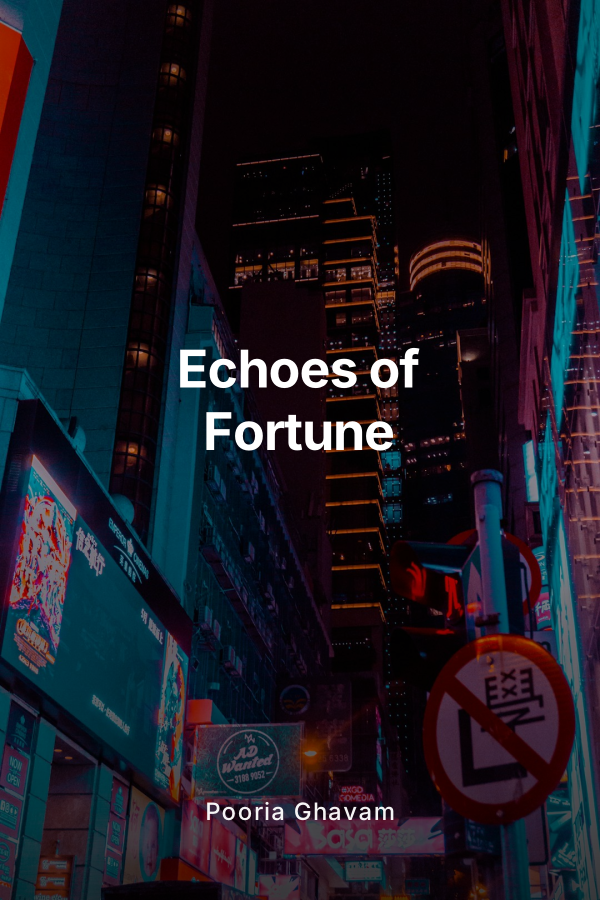
In the year 2330, Cairo is a vertical desert metropolis wrapped around resurrected pyramids and orbital trade lanes, a nerve node in a galactic economy denominated in Free World Coin. Human mortality has been engineered away, ancient pharaohs have been cloned from scraped DNA and locked in glass observatories, and alien species drift through the streets as easily as autonomous drones. At the center of this glittering system sits Interstellar Odds, a gaming conglomerate that pipes fully immersive simulations into every cortex in known space. Its flagship title, Undover, is a probability-engineered casino-universe that mints revenue from billions of players every second.
Vito Albrez is the architect of Undover. Once a basement-dwelling coder from a working class family, he now lives in a penthouse above the Nile, surrounded by designer substances, alien courtesans and a constant blizzard of digital credits. His most treasured object is an antique Rolex, a mechanical relic from Earth’s fossil-capitalist age that he bought with his first royalty check. To Vito, the watch is proof that effort and code can bend the universe. Luck, he insists, is a superstition that serious minds outgrow.
Then the data turns against him. Interstellar Odds stock collapses when Undover’s house edge vanishes overnight and players begin to win at statistically impossible rates. A hidden variable has entered Vito’s codebase. Profit models crater, capital markets wobble, and the corporation faces systemic failure within a single Earth year. In an emergency holo-conference, CEO Marclonus Reus publicly names Vito as the mind who will neutralize this contagion of “luck” before it destroys the company. In private, he strips the problem of euphemism: find and erase the source, or accept a termination that will not stop at Vito’s contract.
There is a catch. The anomaly does not originate inside Undover’s servers. Analytical traces point toward an unregulated sector of space, the Xum Xum quadrant, where sensor data shows a persistent distortion in noise distributions, as if probability itself is skewed. Vito, who prefers air-conditioned penthouses to vacuum-rated hulls, is ordered to leave Earth and travel physically to the disturbance. Interstellar Odds will not fund a corporate expedition. He must hire a freelance crew using his personal stipend, which he has already incinerated on clubs and orbital toys. Broke, hungover and terrified, Vito walks out of the boardroom realizing the only resource he has left is his reputation, and even that may not survive the week.
Chapter One of the book follows Vito’s forced exile from his comfort zone into the underbelly of the Free World’s gig economy, where he is only another soft-skinned client in a bazaar of mercenary starfarers and modular ships. In Cairo’s subterranean Junk Yard - a scrapyard built from obsolete war machines, fossilized land cars and discarded combat drones - he meets Mathilde, known as Math, a human pilot with a reputation for smuggling humanitarian cargo through warlord-controlled space. She commands a patchwork vessel shaped inconveniently like a pizza slice, a ship appropriately named Pizza, crewed by a misfit ensemble that includes a probabilistic physicist called Dr Professor, the cybernetic parent-child pair CD and Rom, and Welma, a systems specialist whose warmth toward Vito hides a private contract with Interstellar Odds itself.
For Vito, Math is an anomaly more dangerous than any statistics glitch. She has built an ethical life at the margins of the same hypercapitalist system that made him rich. She runs animal-rescue ops in defiance of Reegni warlords, ferries contraband vaccines and food, and treats her crew like family instead of disposable labor. She also demands a price he cannot fully pay up front. Their negotiation for transport to the anomaly - a tiny solar system known colloquially as TheBTCuniverse - becomes the first of many collisions between their values, their survival instincts and their emerging attraction.
The Pizza’s transit out of the Free World becomes both a physical crossing and a conceptual one. As they weave through slipstreams and gravity wells, harried by a Reegni warship that wants back a hold of trafficked animals called Skunatoss that Math liberated, Vito is forced into close proximity with lives he has only ever abstracted as user metrics. On a derelict ship whose crew has starved at their consoles while gambling in Undover, he sees firsthand how immersive probability manipulation can cannibalize human agency. On a small planet ground into dust by addiction to his game, he sells his beloved Rolex to buy emergency supplies and witnesses Math’s shock as her image of him begins to fracture.
At the same time, Dr Professor’s sensor arrays capture a non-random pattern in the cascade of improbable “near misses” that protect the Pizza from destruction. What appears to be convenient luck has a structured correlation to Vito’s emotional state, particularly to moments when he acts against his individual financial interest in order to help strangers, or when unspoken tension between him and Math peaks. The closer they travel toward TheBTCuniverse, the stronger the field becomes. Vito, a lifelong rationalist, is dragged toward a hypothesis he despises: maybe luck is not a human superstition but an emergent property of a particular astrophysical system, modulated through consciousness and choice.
The midpoint of the book, closing Chapter One, detonates the personal and the systemic plots simultaneously. Vito uncovers proof that Welma is transmitting telemetry back to Marclonus and that she orchestrated an orbital bombardment on the impoverished planet they just tried to save, purely to create a crisis that would push them faster toward TheBTCuniverse. Confronted, Welma reveals a slice of a deeper conspiracy: Interstellar Odds intends to weaponize the luck source, reconfigure Undover into a monopoly engine and frame Vito as the rogue architect who broke the universe. She dangles blackmail as calmly as she offers salvation. Unless he complies, the corporation will void his parents’ contracts and reduce them to the same homelessness that now afflicts their alien neighbors in Cairo.
Vito stands at a decision boundary. Math, unaware of the full coercion at play, has already pushed him away romantically, insisting that cross-class fantasies have no place in vacuum operations. His love falters, the external luck field destabilizes, and across the galaxy players begin to lose catastrophically in Undover as if the universe itself disapproves. That interference pattern sets the cliffhanger. Chapter One concludes with the Pizza arriving at the luminous shell of TheBTCuniverse, a micro solar system whose metric signature violates every Monte Carlo model Vito has ever trusted, while his loyalties, his family’s safety and the stability of galactic finance all hang in a single decision that he does not yet know how to make.
Chapter Two pivots from exploration to revolution. Within TheBTCuniverse, the crew discovers a compact stellar architecture where quantum noise is not purely random but exhibits long-range coherence. This coherence behaves like a reservoir of low-entropy potential that can interfere with conventional probability distributions when coupled through entangled microdevices such as the implants used in Undover’s neural interfaces. In simpler terms, TheBTCuniverse is a natural engine that can bias outcomes in favor of or against any entity linked into its field. Interstellar Odds has been unknowingly harvesting this bias; now Marclonus wants exclusive control.
Working with Dr Professor, Vito maps the dynamic: ethical intention and relational bonds appear to synchronize more strongly with the field than greed or fear. The more he and Math align on a shared goal - protect the innocent, expose exploitation, choose each other over profit - the more dramatically the local luck gradient bends to their advantage. The outline of a strategy emerges. Instead of destroying TheBTCuniverse, they can cloak it, sever its integration with Undover’s servers, and then reflect its influence selectively, using tightly constrained interfaces that are mathematically provable as fair. Vito sees the shape of a new game, one that uses transparent algorithms rather than opaque house edges, and that channels positive-sum outcomes into communities rather than shareholders.
First they have to survive. Removing Welma from the ship isolates Marclonus but triggers his retaliation. He tightens the threat around Vito’s parents and saturates media feeds with disinformation that paints the Pizza’s crew as terrorists trying to destroy the Free World’s primary entertainment grid. Under this pressure, Vito and Math finally confront the tension that has pulsed between them since Cairo’s Junk Yard. She forces him to answer a question he has evaded his entire life: what do you actually want, independent of money, metrics or fear. His admission that he wants to dismantle Interstellar Odds and build something with her, as partners, acts as both emotional confession and systemic trigger. Their shared intention spikes the local luck amplitude, collapsing Marclonus’s financial models in real time as IO’s stock price implodes on every exchange.
From there, the narrative becomes a hybrid of technical heist and public trial. The Pizza returns to Earth under TheBTCuniverse’s veil, its location obscured from corporate sensors. The crew infiltrates Interstellar Odds headquarters inside the Keops pyramid, moving through server cathedrals where Undover’s simulation shards are stored. CD and Rom rig a live-stream through underground data channels so that every device in the Free World can witness what happens next. While security teams close in, Vito attempts to reconfigure the core algorithm that mediates between Undover and the luck field. Physical bullets, virtual exploits and probabilistic anomalies weave together in a single multi-layered battle where each emotional beat between him and Math alters the topology of the fight.
The climax fuses romance and physics. Cornered in the main server chamber with armed guards ready to kill them, Vito finally drops his last defenses. He wraps his arms around Math, admits that he has loved her since the instant she pulled thugs away from him in the Junk Yard, and kisses her in what he believes will be their final moment. That confession, a perfect entanglement of vulnerability and resolve, detonates a spike in the luck field so intense that it overloads the server’s integration hardware. The core glows red, Undover’s internal probabilities collapse into chaos, and Interstellar Odds’ stock value vaporizes in a flash crash transmitted live to billions of viewers. In the confusion, automated safeties halt the firing squads. Local law enforcement storms the building, not to protect the corporation but to arrest Marclonus for systemic fraud and crimes against sentient life.
The victory comes with a price. The death of Interstellar Odds destroys not only a predatory corporation but also the livelihood of billions who depended on its ecosystem. The book refuses to end on a simple triumph. Instead, Vito and Math confront the vacuum they helped create and choose to fill it with something structurally different. Leveraging TheBTCuniverse’s field under strict constraints and publishing their algorithms in auditable, cryptographically verified form, they launch TheBTCgame, a new network where players can see in real time how their odds are calculated and where every session routes a fraction of value into education, infrastructure and restitution for communities ravaged by Undover. They hire former IO employees into roles that emphasize stewardship over exploitation, appoint Dr Professor as director of luck research, and re-task the Pizza’s crew from smugglers into architects of a more transparent digital commons.
In its closing pages, the story returns to a quiet terrestrial scene. Vito and Math visit his parents in their modest home, who remained blissfully unaware of the galactic drama that nearly erased them from the socioeconomic map. Over a simple meal, they ask the same question any parents might ask their child after a long day at work: how is the job going. Vito and Math exchange a look loaded with unspoken data - of cloned kings in glass cages, of probability fields bent by human choice, of a watch pawned and a universe saved - and answer that it is complicated, but better. The implication is clear. In a galaxy saturated with simulations and algorithms, the real game is not about beating the odds. It is about deciding what kinds of systems we build, who they serve and what we are willing to risk for the possibility of something like justice, or love, becoming more than a statistical anomaly.