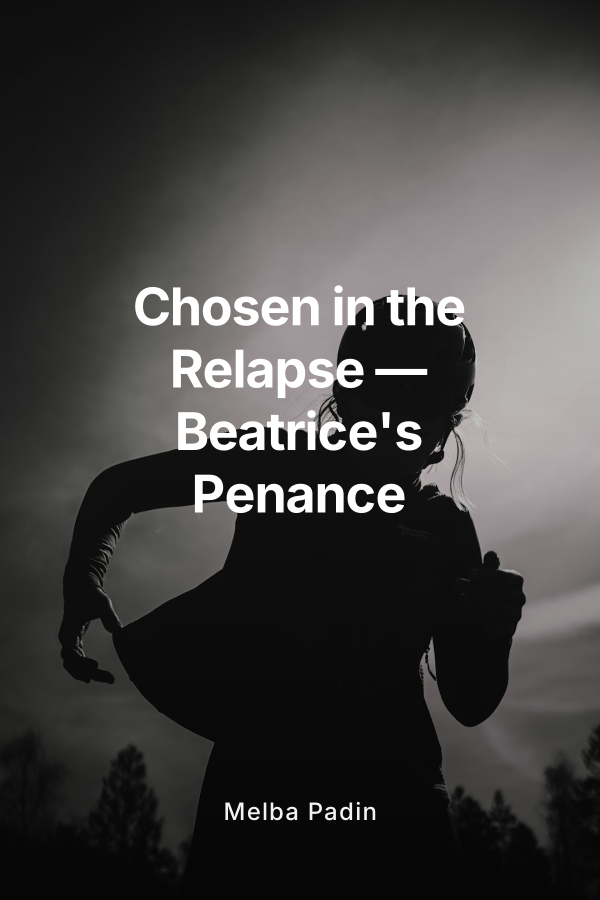
Chosen in the Relapse — Beatrice’s Penance
Subtitle: A Memoir-Guide for People Living With MS, the Caregivers Who Stand Beside Them, and a Public That Needs to See What Pain Looks Like When It’s Invisible
This is the second book in Beatrice’s story, continuing from The Consequences of Living a Life Without God — The Fantasies of Beatrice. It opens where the first ended: with a diagnosis that changed everything, exposing how a life that looked bright and beautiful can be recast in a single word—MS—and how its pain can remain unseen by nearly everyone.
Told in a candid, faith-aware voice and anchored in plain-language medical insight, Chosen in the Relapse — Beatrice’s Penance speaks first to people already living with Multiple Sclerosis, and second to those newly diagnosed. It promises recognition—your suffering will be seen—and a path to practical steadiness: how to navigate relapses, how to prepare for appointments, how to advocate for care, and how to help caregivers understand what the eye cannot measure. It also invites the broader public to “put MS on the map,” challenging the disbelief that follows a disease that can leave a person looking “fine” while living in relentless pain.
From a childhood on Puerto Rico’s mountain coffee farms—where prayer and books became lifelines amid poverty and parental conflict—to a young woman’s sprint into an appealing but untethered adulthood, Beatrice’s life is traced with unsparing honesty. The first book chronicled the miracle of survival and the drift from prayer; this book faces the long aftermath: the 24/7 pain, the losses of walking, running, dancing, driving; the shock of complications; the misunderstanding of friends; the limits of caregivers who do what they can and still can’t reach the pain that doesn’t sleep.
The narrative threads three strands in every chapter:
- Story: a close, lived moment—relapse days, heat and weakness, the hospital’s fluorescent midnight, the man in the suit who appears in Beatrice’s first relapse like a messenger of judgment and fear, the long rehab corridors, the private grief of memory slips, and the quiet heroism of getting through Tuesday.
- Medical clarity: short, accessible explainers on MS basics and beyond—relapse vs. pseudo-relapse; types of MS and progression; treatment classes and why adherence matters; common comorbidities and overlapping conditions (e.g., restless legs, ulcerative colitis, trigeminal neuralgia, spasticity, depression, anemia, arthritis, scoliosis), and a careful distinction between MS-related cognitive changes and dementia—with notes indicating where clinical facts will be properly attributed.
- Faith reflections: brief, clearly labeled personal notes on prayer, hope, doubt, and meaning—never in place of medicine, always alongside it—because Beatrice’s mind needed both science and the shelter of God to endure.
Against the myth that MS is “manageable if you look good,” the book documents the severity of invisible symptoms and the real consequences of delay and disbelief: a decade of unexplained suffering before diagnosis; a 13-hour back surgery with harrowing complications and recovery; an ignored fall in a flare that fractured her neck; the long, uneven road of infections, antibiotics, setbacks, and the stubborn will to begin again. The point is not shock—it is truth, so that readers see what MS takes and why fast recognition and treatment matter.
For caregivers, the book offers compassion and tools: scripts that turn “You look fine” into “What would make today easier?”; boundary-setting that protects both patient and helper; checklists for heat days, relapse days, and appointment prep; ways to hear fatigue, pain, and cognitive fog without defensiveness or shame. It honors their limits while insisting on a shared language that makes care workable.
For people with MS, it offers three promises:
- Hope that is not naïve: MS has no cure yet, and still there is a way to live, love, organize care, manage energy, and be believed.
- Practical steadiness: strategies for treatment adherence, symptom tracking, safety planning, mobility and skin protection, medication questions to ask, and how to handle disbelief from people who remember your “before.”
- A voice that refuses erasure: tools to “bring MS to light”—from sharing your story to mobilizing your circle, joining advocacy, and building community so the next person is diagnosed sooner and suffers less.
Chosen in the Relapse — Beatrice’s Penance is a memoir-guide with a mission: to change how MS is seen, to equip those living it, to help caregivers walk beside pain they cannot feel, and to invite a public response proportionate to the devastation MS causes. It calls for attention, compassion, research, and action—so that no one with MS has to argue for their suffering before they receive care. It is Beatrice’s penance and her offering: a fierce insistence that our stories can save time, save dignity, and, one day, help save lives.
Free Preview
9 pages leftUnlock full book for just $2.99