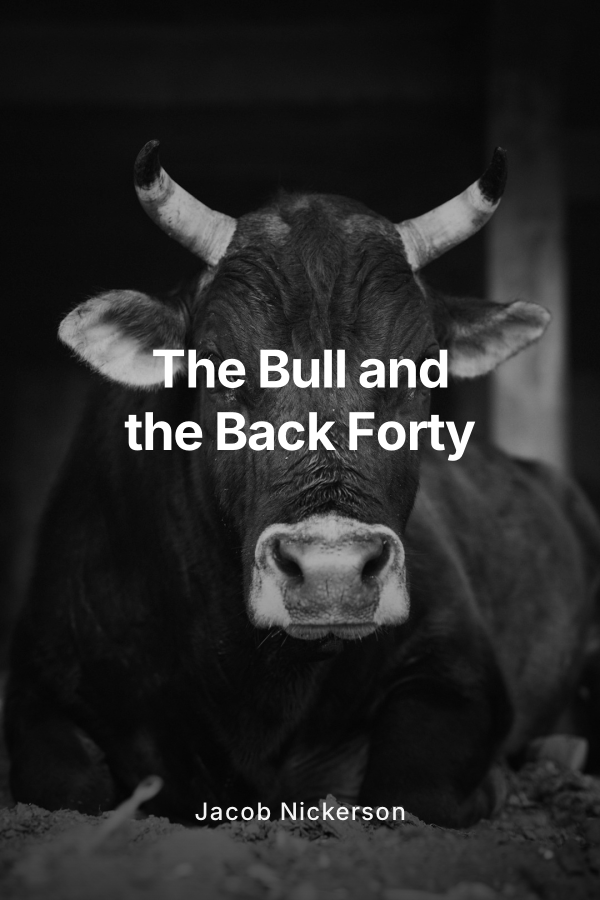
Jake "The Bull" Schmidt used to be the kind of hometown legend people shared stories about over cheap beer and bar smoke, a name tied to muddy football fields, hard hits, and louder laughter. Now the same Oregon town that raised him has traded hay fields for cul de sacs, and Jake has become something else entirely, a problem property, a police report waiting to happen, the last stubborn patch of working dirt in a Willamette Valley that has taught itself to be embarrassed by its own mud.
At thirty five, Jake still carries the thick shoulders and bull neck he built on the mill floor and under Friday night stadium lights. His body remembers every load of lumber, every busted axle, every late shift running tow calls for his father before that little business drowned in drugs and bad deals. The family trucking empire his immigrant grandparents carved out of nothing has been sold, dissolved, or pawned off piece by piece, leaving Jake with no real inheritance except a few battered acres and a bone deep habit of working until something gives.
Those acres are everything. On one side of the road sprawls the Schmidt compound, more a tangle than a homestead, barns sagging into themselves, trailers patched with sheet metal, ghetto 4x4s and lowriders up on blocks, and a back forty that refuses to grow what the bank would prefer. On the other side rises a carefully curated grid of new money and imported taste. Lawns without a single dandelion, security cameras at the corners, ornamental trees arranged for real estate photos. The new neighbors bought their slice of the rural dream, just not the people who came with it, and Jake's noisy tools, bonfires, barking dogs, and smoke stained sky offend their idea of what the valley should smell like.
Jake survives the way he always has, by stapling together too many hustles and calling it a living. Part time farmer, small scale mechanic, dealer in junk that might yet roar back to life, he flips wrecked trucks and lowriders in the dirt driveway, improvises side jobs that hover somewhere between legal and not, and ruins his own margins in card rooms where the line between survival and self sabotage blurs fast. He drinks hard, chases uppers when the crash starts to sound like his father's history repeating, and rides a rhythm of high highs and deep collapses that scares anyone who needs him to be steady.
Underneath the chaos, there is a rigid code. Jake is ferociously loyal to the few people he counts as his own. His long term girlfriend is as fiery as he is stubborn, the two of them locked in a messy, magnetic orbit that alternates between fighting, scheming, and holding each other up. Her young son, a kid Jake has taken on as if Schmidt were printed on the birth certificate, is the one presence that can mute his worst impulses for a night. Above all of them stands his mother, keeper of family stories and unpaid emotional accountant, the one person he will not lie to, even when the truth tempts disaster. In a life full of bendable rules, Jake holds to two that will not move, you do not betray your own, and you do not feed your mother a false story to make your own easier.
The town around him, hungry for order and rising property values, decides Jake is an open case that needs closing. It starts with the neighbors, their anonymous complaints, their phone cameras lifted at every late night engine test. A cluster of homeowners association threads turns Jake into a boogeyman across the road, a symbol of everything their mortgage payments were supposed to drive out of sight. Patrol cars begin to idle at the end of his driveway, their slow crawl counting rust spots, their lights a quiet promise that this man on this land will one day be brought to heel.
At the heart of this attention stands Sergeant Darren Kline, short tempered in stature and spirit, a veteran of old grudges. Years ago Jake flattened him on a football field in front of the whole town. That hit has lived rent free in Kline's memory ever since, and now, in a uniform and a squad car, he sees the chance to rewrite the story. Bringing down The Bull will prove something, to himself if not to the law.
When a stolen truck appears half burned in the dry grass along Jake's fence line, the town finally gets the story it has been rehearsing. Soon after, officers "discover" a cache of stripped parts behind one of Jake's barns, tucked away with a neatness that feels theatrical. The picture writes itself, washed up high school star, crooked father, a yard full of vehicles, a gambling habit, a temper. By the time charges are filed, the narrative is already circulating over espresso and craft beer, Jake Schmidt as mastermind of a vehicle theft operation that has plagued the county.
Behind what looks like a neat case, the truth is bleaker and more personal. Jake's cousin has been quietly bleeding the family for years, skimming cash, selling equipment that is not his, and warming all sides of every fence in town. The developers who built that gleaming subdivision across the road have their own secret ledgers, their projects greased with under the table agreements and favors traded in the back rooms of planning meetings. Jake's land, inconvenient and stubborn, sits right where certain investors would prefer another row of houses. A convicted Schmidt would be easier to pressure, easier to buy out. For Sergeant Kline and his friends, justice is only one item on a crowded to do list.
Dragged into court, Jake steps into a world where every hallway feels like a casino in which the house always wins. Cops trade smirks as he passes. Judges beam down at him from campaign posters still staked in manicured lawns that used to be his neighbors' fields. Clerks and prosecutors see not a complicated man but a tidy stereotype, one more file confirming what they think they already know about people who live on gravel roads and keep broken vehicles in their yard.
The only surprise is his lawyer. Reed Malloy, court appointed and chronically late, arrives in a suit that looks slept in, trailing the stale scent of burned coffee and worse nights. He cracks jokes that push the edges of contempt, mangles judicial titles just enough to make the bench twitch, and collects courthouse gossip the way other attorneys file motions. At first, Jake mistakes Malloy for another piece of a broken system, a clown dancing in front of the guillotine. Then he notices the way the man listens, the speed with which he spots a contradiction in an officer's report, the pleasure he takes in prying open a seam in the official story. Malloy is unprofessional, irreverent, and quite possibly the only person in the building who is thrilled to fight the script everyone else has already agreed to follow.
While indictments and hearings grind forward, Jake's life at home begins to fray. Neighbors repeat their own lies often enough that they start to sound like memories. The driveway conversations grow meaner, and even people who once waved from their pickups now glance away at intersections. His girlfriend hears whispers at work, sees headlines online, begins to ask sharper questions about what really happens in the shop after midnight. An old high school flame returns to the valley, nostalgic smile intact, her arrival timed so perfectly it feels purchased. The stories she tells about the Jake she remembers make him look exactly like the man the prosecution wants the jury to see, stunted, reckless, unchanged.
Under pressure, Jake leans harder on the vices that have always kept him from splitting apart. He drinks more, jokes darker, takes wilder swings at the card table, convincing himself that one towering win might plug every leak at once. His temper flares at the worst possible moments, fists landing where lawyers most wish they would not, each scuffle another brick in the wall Kline is building around him. The book's mood tightens between comedy and danger, between scenes that play like bar laughs and moments where one wrong gesture could mean years in a cage.
Slowly, Malloy pulls Jake from defendant to accomplice in his own defense. Their investigation is improvised and unglamorous, two men in a battered truck following money trails through campaign finance reports, stakeouts conducted from behind hay bales that smell of dust and sweat, whispered arguments over whose boots stink worse while they spy on illicit meetings between Jake's cousin and contractors tied to the development across the road. Piece by ugly piece, they uncover how the torched truck, the planted parts, the cousin's quiet theft, and the town's hunger for a convenient villain all converge.
The moral center of the story crystallizes around a single choice. When the prosecution drags Jake's mother into the witness box, hoping blood ties will either condemn him or fracture him, Malloy suggests a path that would protect Jake at the cost of twisting her understanding of what her son has become. To take it would mean lying through her, using the one person he swore never to manipulate. To refuse would leave him exposed in a courtroom already leaning against him. The suspense in that moment is not just legal, it is personal. Jake must decide what kind of man he is willing to be in order to survive.
He tells the truth. It does not make him a saint, and it does not magically fix the trial. What it does is crack the tidy narrative that painted him as a convenient monster. The same stubbornness that kept him on the land, that fueled every bad bet and late night hustle, now anchors his testimony. Malloy seizes every opening that honesty creates, turning small admissions into leverage, using the cousins lies and the developers' paper trails to reframe Jake not as harmless, but as targeted.
In the end, Jake walks out of the courthouse, but nothing about the victory is clean. Some neighbors offer thin apologies in parking lots, then cross the street when they see him at the gas pump. Friendships that once felt unbreakable stall in half finished sentences. His cousin pays a price that leaves empty chairs at family gatherings, a hole that no one quite mentions but everyone measures. Jake's permanent record collects new scars that will flash red every time someone runs his name.
Yet the anchors he fought for hold. The land stays in Schmidt hands, the back forty still muddy, still stubborn, still his. The girlfriend who packed imaginary suitcases on the worst nights chooses the ragged comfort of their trailer and field over the clean lines of the subdivision. The boy who watched his father figure led away in cuffs sees him return, damaged and defiant, and begins to understand that adults can be disasters and still choose to stand between their family and the storm. A carefully negotiated settlement and a few secrets turned to leverage leave Jake with a bank account that, for once, looks wide enough to breathe.
What redemption means for Jake is not sobriety, sainthood, or a glossy second act. He does not trade beer for herbal tea or poker nights for mindful breathing. He still laughs at jokes that would curdle polite dinner parties. He still keeps the yard cluttered with vehicles in various states of resurrection. His pulse still quickens at the thought of one more hand, one more bet, one more reckless scheme that might just work. What has changed is aim. The same chaotic energy that once burned through his own life without direction now turns outward, a rough shield for the little piece of world he refuses to surrender.
The final image of The Bull and the Back Forty holds him at the edge of his land, leaning on a dented fender, cigarette curling smoke into the valley air, beer sweating in his free hand, watching a patrol car nose slowly past while some neighbor peeks from behind expensive glass. Jake knows precisely what they think he is. He also knows what he has already survived, and what he is willing to bleed for again. The town may belong, on paper, to developers, committees, and men in dark uniforms, but this stubborn stretch of dirt still answers to him. He has not become a different man, only a sharper version of the one he has always been, standing his ground in a place that keeps trying and failing to push him off the map.
In three sweeping chapters that move from the raw comedy of small town grudges, through the suffocating corridors of a bent justice system, to a bruised and unsentimental kind of survival, the novel becomes a darkly comic thriller about class, loyalty, and the price of refusing to pretend. At its center stands Jake "The Bull" Schmidt, a flawed man who never learns to behave, but does learn exactly what he will and will not trade away, even when the whole valley is betting against him.