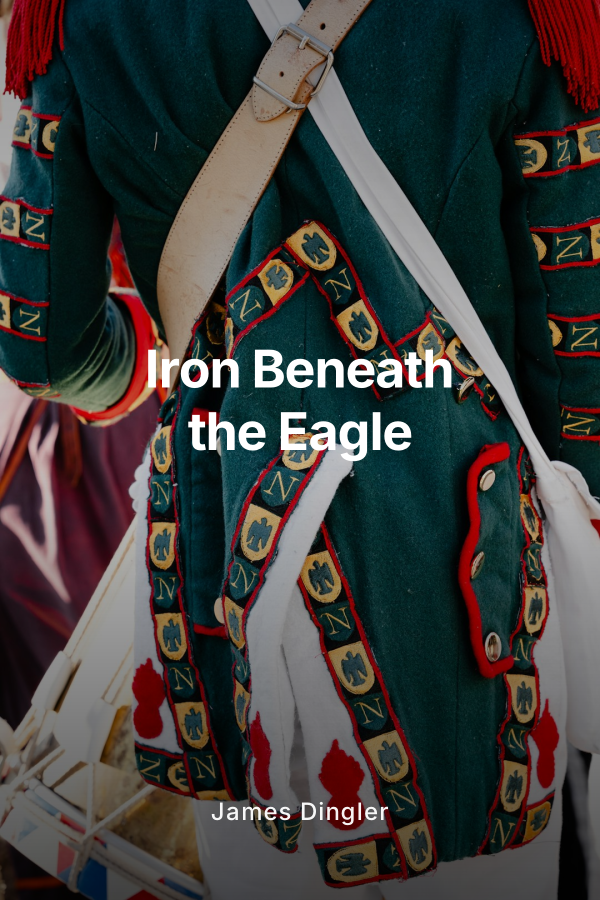
Set against the fractured power struggles of the medieval Holy Roman Empire, this novel follows a knight whose life is shaped by real historical battles, political unrest, and the brutal demands of loyalty in an age where war defines both nations and souls. The story is designed for history fans and centers on a knight protagonist within a narrative grounded in real conflict rather than fantasy, as established in the provided context .
The novel begins with a young nobleman raised on the ideals of chivalry, piety, and feudal duty, only to discover that the realities of war are harsher than the songs sung in great halls. Born into a minor but respectable family within the Holy Roman Empire, he is trained from childhood to serve on horseback, to command men, and to uphold the honor of his house. Yet the Empire around him is unstable, divided by rival princes, competing bishops, shifting alliances, and the constant tension between imperial authority and local ambition. As he comes of age, he enters a world in which every oath has a political cost and every victory leaves scars that cannot be seen beneath armor.
The central arc of the book follows his passage through a sequence of major military campaigns inspired by real medieval battles in imperial lands. Rather than presenting warfare as a backdrop alone, the novel uses each battle to transform the knight’s inner life. At first, he seeks glory. He wants to prove himself worthy of his lineage and believes that courage in combat will bring him honor, status, and clarity. Instead, his first experiences reveal confusion, mud, terror, and the helplessness of watching plans collapse in the noise of steel and prayer. What he thought would be a path to greatness becomes an education in fear, discipline, and moral compromise.
As the wars intensify, the knight is drawn into the machinery of imperial politics. He serves powerful lords whose causes are dressed in the language of justice but driven by greed, inheritance, vengeance, or survival. He witnesses how castles are not merely symbols of power but instruments of hunger and siege. He sees towns burn because rulers need examples. He learns that mounted nobles may decide the course of a field, but it is often common infantry, camp followers, engineers, priests, and messengers who carry the true burden of war. Through these experiences, the novel widens from the story of one warrior to a portrait of an entire civilization at war with itself.
A major strength of the book lies in the tension between public duty and private conscience. The knight is bound by oath to obey, yet repeated campaigns force him to confront moments where obedience and righteousness are no longer the same. Prisoners are executed to save supplies. Villages are stripped to feed armies. Allies betray allies in the name of expedience. Religious language is used to justify bloodshed that has more to do with power than holiness. The protagonist begins to understand that the greatest threat to his soul is not death in battle, but the slow habit of accepting cruelty as necessity.
The historical battles themselves form the spine of the narrative. Each one is presented not only as a military event but as a crucible of character. In one campaign, the knight experiences the chaos of cavalry charges and discovers how quickly noble order can dissolve into slaughter. In another, he endures a prolonged siege that reveals the exhausting reality of waiting, disease, engineering, and attrition. In yet another, he confronts the consequences of strategic brilliance when victory is purchased with the ruin of civilians and the destruction of lands meant to be governed afterward. The novel’s realism comes from showing war as a chain of human decisions rather than a pageant of banners.
Alongside the battles, the story explores the social structure of the Empire. Princes, bishops, abbots, burghers, mercenaries, peasants, and rival knightly houses all shape the world through their conflicting interests. The protagonist learns to move between court and camp, chapel and battlefield, feast and funeral. He comes to understand that the Holy Roman Empire is not a unified realm but a contested mosaic, brilliant in ceremony and deeply fragile in practice. This setting gives the novel rich dramatic tension, because every march to war is also a negotiation of status, privilege, and competing law.
The knight’s personal relationships provide the emotional depth that anchors the larger historical canvas. He begins with comrades he admires and superiors he trusts, but war tests every bond. Friendships formed in training harden into battlefield brotherhood, then fracture under jealousy, ambition, and trauma. A father figure among the older nobles teaches him the old code of service, only to reveal its limits when dynastic interests are threatened. A rival knight becomes both mirror and warning, showing what happens when martial excellence is joined to moral emptiness. Through these relationships, the protagonist’s development feels intimate even as the stakes remain political and military.
The novel also traces the transformation of knighthood itself. At first, the protagonist sees the knight as an ideal: mounted, honored, decisive, and chosen by God for a station above common violence. Over time, he realizes that a knight is also a tool of lords, vulnerable to economics, logistics, wounds, ransom, and reputation. Armor can protect the body, but not certainty. The code that once gave his life meaning becomes more difficult to interpret in a world where enemies are Christian, rivals are lawful, and justice belongs to whoever survives long enough to write terms of peace. This internal conflict gives the story philosophical weight without losing its momentum.
As the narrative advances, the knight rises in experience and authority. He is no longer the eager young warrior on the edge of the line. He becomes a commander responsible for other men’s lives, and this change forces him into deeper moral reckoning. It is one thing to survive another man’s orders. It is another to give orders that send boys and veterans alike into killing ground. Leadership strips away illusion. The protagonist begins to grasp that history remembers banners and outcomes, but those who fight remember screams, weather, hesitation, and regret. The burden of command becomes one of the central themes of the novel.
The climax emerges when the knight must take part in a decisive historical confrontation that will shape the balance of power within the Empire. By this stage, he has won renown, but the cost is severe. He has lost friends, compromised principles, and seen enough of victory to distrust it. The final battle is therefore not simply a test of martial skill but the culmination of every question the book has raised: What does loyalty mean when rulers are flawed? Can a man remain honorable inside a system sustained by violence? Is survival itself a kind of surrender, or the only ground from which renewal can begin?
In the aftermath, the novel resists easy triumph. Even where one faction prevails, the land remains wounded and the moral debts of war remain unpaid. The protagonist returns from the field altered in body, spirit, and understanding. He has not become the flawless hero of legend, but something more compelling: a man forged by history who now sees clearly the difference between glory and endurance. He understands that war may shape realms, but it also narrows and breaks the lives inside them. What remains is not the shining image of knighthood, but the harder and more human question of what kind of man can live honestly after doing what history required of him.
Overall, this book is a sweeping historical war novel that combines the scale of medieval conflict with the intimate psychological journey of a knight in the Holy Roman Empire, matching the user’s request for a novel centered on famous battles, real history, and a knight protagonist for an audience of history fans . It promises action, authenticity, political intrigue, and emotional depth, presenting medieval warfare not as distant spectacle but as lived experience shaped by fear, belief, ambition, and sacrifice.