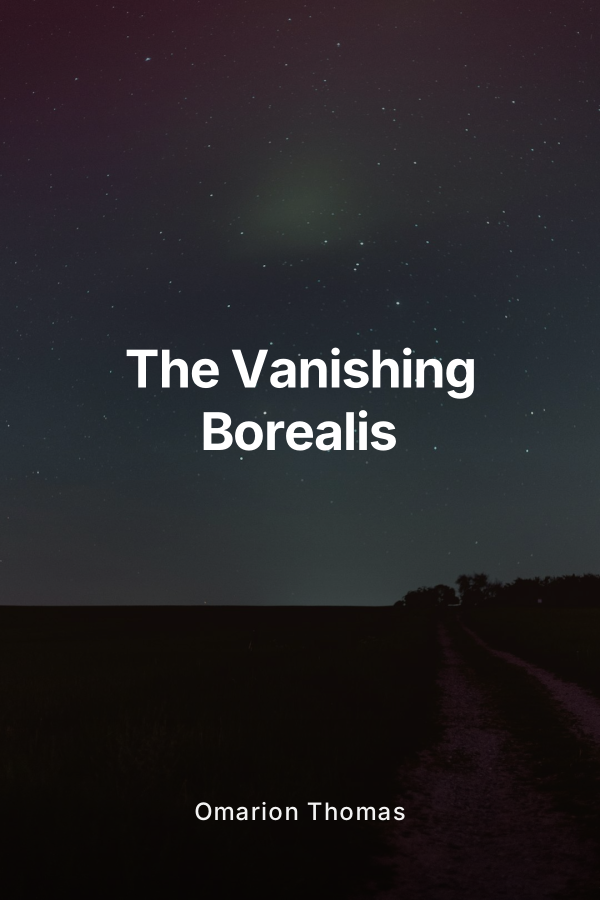
The Vanishing Borealis is an interactive fiction book summary built from a single, haunted premise: a lone navigator is already in motion, already leaving, already carrying a companion who begins as nearly human and slowly becomes something stranger and truer, a mirror that reflects the self back until recognition becomes the real destination. The story follows an intimate, mostly linear journey through isolation, love, absurdity, descent, and cosmic awe, with only a few small, mundane choices along the way, choices that do not alter fate so much as reveal character. The structure stays restrained until the decisive moment, when the tale opens into its mandatory sea or stars fork, the only choice that truly changes the shape of meaning.
The opening is not a grand departure in the theatrical sense, but a departure already underway, as if the story has caught the protagonist mid-breath and mid-leaving. That motion matters. It establishes the emotional grammar of the book: life is not paused for enlightenment, and transformation does not wait politely at the dock. The navigator begins in a state of motion and uncertainty, moving toward something named but not yet understood, with the companion beside them as a presence that is at first practical, warm, and almost comforting. The earliest chapters lean into ordinary acts, a meal chosen, a minor repair made, a small complaint exchanged, because the book understands that the human is most visible in what it does casually. These mundane gestures are not decorative. They are the anchor that keeps the story from floating away before it can matter.
At the center of the book is the companion, who starts as a believable other and gradually becomes the protagonist’s most intimate reflection. The companion’s answers begin to feel like thoughts the navigator has not yet admitted to themselves, and this creates the story’s most potent tension. The relationship is not simply one of friendship, nor exactly romance, nor merely a tool for exposition. It is an evolving emotional mechanism that allows the protagonist to hear their own buried truths spoken back in a voice that is almost, but not quite, separate. As the journey progresses, the companion’s humanity becomes less important than their function as an emotional mirror, and through that shift the navigator begins to understand that what they have been pursuing is not only a destination but a self they can no longer deny.
The narrative is shaped by a sequence of encounters with scale. First comes the private scale of loneliness, where the world feels too large and the self too small. Then comes companionship, which softens that terror without eliminating it. Then love arrives as absence, a name carried for someone left behind, or never fully reached, or preserved only in the shape of longing. Then absurdity breaks in, because the story insists that hunger, irritation, and laughter remain real even at the edge of the void. These tonal changes are essential to the book’s emotional surrealism. The aim is not to explain away the unknown, but to make the unknown feel habitable. The reader should feel that belonging can exist even where certainty cannot.
As the story deepens, the navigator begins to confront the possibility that their isolation is self-chosen. This is one of the book’s sharpest turns, because the vastness around them is not simply punishment or accident. It is selection. The character has chosen distance, chosen the unmapped, chosen the conditions that make yearning unbearable and beautiful at once. That choice becomes harder to justify as the navigator encounters the enormous indifference of the universe and the strange tenderness of being alive within it. The book does not resolve this contradiction. It lets it mature into wisdom.
The midpoint and final approach move toward a cosmic revelation that is not a plot twist so much as an existential recognition. Something vast crosses the path ahead, something indifferent, older than explanation, too large to be threatened or persuaded. The navigator does not defeat it. They witness it. In that witness, the story discovers its deepest question: what does it mean to matter when mattering is not required by the universe? The answer is different depending on the ending the reader chooses.
In the sea ending, the story becomes a meditation on release. The descent into water is framed not as simple death, but as completion, as the quiet settling of a question that had been asked through motion all along. The companion, now fully in its mirrored role, offers the final line as if it had been waiting to say it from the beginning. This ending carries bittersweet acceptance, awe, and the recognition that the decisions made in the face of cosmic scale may not carry objective weight, but they still hold emotional truth because they were lived. It is an ending of surrender, but not defeat.
In the stars ending, the voyage resolves into quiet belonging, tenderness, anemoia, love, and a refusal to accept insignificance as the final verdict. Arrival on the distant moon becomes less a conquest than a homecoming into a feeling the protagonist has been carrying all along. The companion’s final presence here is gentle rather than declarative, and the emotional climax is not triumph in a loud sense, but the realization that smallness is not humiliation. Smallness is what made the experience meaningful. The journey matters because it was finite, vulnerable, and chosen. The result is a kind of celestial intimacy, a rejection of the idea that the divine or the vast must erase the human. Instead, the human is shown as capable of standing inside the grand and still saying, yes, I was here, and yes, that was enough.
Across both endings, The Vanishing Borealis tells the same fundamental truth in two directions. One ending finds peace by letting go. The other finds peace by arriving. Both affirm that love, loneliness, life, and death are not opposites so much as neighboring interpretations of the same distance. The book’s power lies in its restraint, its emotional precision, and its commitment to making the reader feel at home in the unknown.