In the borderlands between history and myth, Paititi has haunted maps and imaginations for five centuries. It is said to be the final refuge of the Inca royal court, hidden deep in the eastern jungles beyond the Andes, where the Sapa Inca carried gold, sacred objects, and something far older than the empire itself: a vault of stone tablets carved in an unknown script, a language said to predate every civilization that followed.
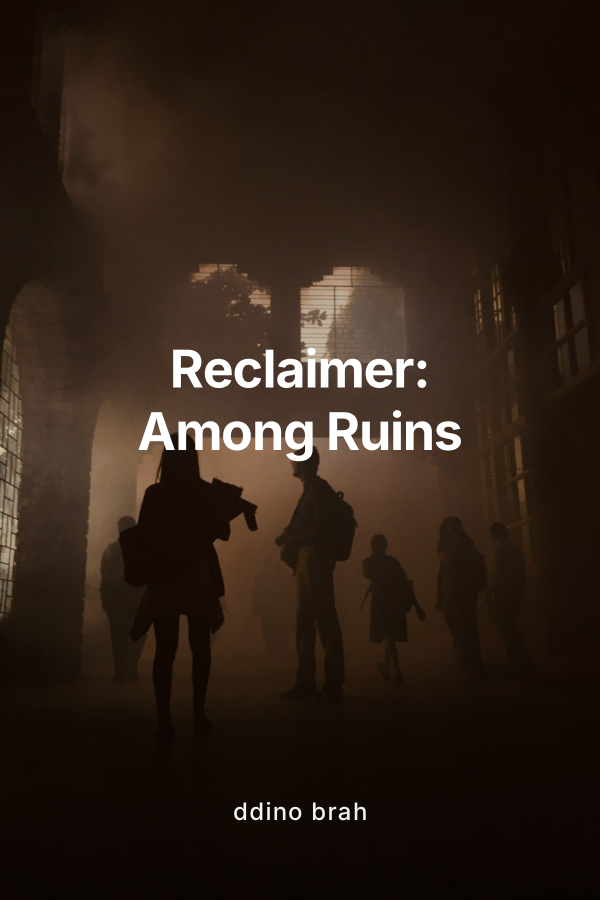
Reclaimer: Among Ruins is a contemporary treasure thriller that braids together a buried colonial crime, Victorian secrecy, and modern-day artifact smuggling into one relentless pursuit. At its core stands David Cartier, a street-raised American treasure hunter who believes the lost city is not only real but bound to his own history. For David, Paititi is the only place on earth that might answer the question that has haunted him since childhood: whether his mother died chasing a legend or a truth so dangerous that powerful men have been hiding it for centuries.
The story opens with the legend itself. In 1537, Franciscan friar Fray Alejandro Cros follows a Pizarro-era expedition east from Cusco, ostensibly to map tributary rivers. Fluent in Quechua and respected among Indigenous communities, Cros hears the Paititi stories not as campfire rumor but as precise geography. What the expedition finds is more astonishing than any tale. Paititi exists, draped in jungle above the confluence of two rivers, its terraces and causeways half-swallowed by centuries of overgrowth. The conquistadors see endless gold and dream of caravans to the coast. Cros steps into a sealed ceremonial complex that local guides call the place where the first kings sleep and emerges with his faith in history changed forever.
Inside, he finds more than treasure. Lining the vault walls are stone tablets covered in an unrecognizable script, a written record that seems to belong to an older, vanished civilization that once taught the Inca to build and to rule. Cros spends two days alone in the dark, copying as much of the inscriptions as he can into a private journal. Then he faces a choice. If the Spanish crown learns of Paititi, the city and its knowledge will be looted and lost. Cros chooses treachery for the sake of preservation. He hides his notes in the stonework of the vault, misleads his fellow conquistadors, and ensures that none of them returns alive. To the colonial authorities he reports that the eastern territories are swamp and nothing more. To the future, he leaves a locked box in a Peruvian monastery archive, labeled only for the one who already knows where to look.
Centuries later, in 1891, British explorer Sir Clements Markham stumbles across that same locked box in Lima while deep in his own obsession with Inca civilization. A rare European scholar fluent in Quechua, he recognizes the significance of Cros’s journal at once. Markham quietly acquires the box, brings it back to England, and spends years building a private research document that attempts to triangulate Paititi’s location from expedition notes, river courses, and fragmentary translations of the mysterious script. He concludes that the city likely still stands, sealed somewhere in the jungle, untouched since Cros walked its vaults. Rather than publish, Markham hides his findings in a single manuscript he titles The First Kings: Notes Toward a Location.
When Markham dies, his private papers pass into the custody of the Royal Geographical Society in London. Most are catalogued. A select few, flagged as sensitive, are entrusted to the personal discretion of the Society’s next president, Sir Francis Younghusband. A veteran explorer himself, Younghusband understands at once what Markham has left him. He also understands how catastrophically this knowledge could be misused if it surfaces as merely another file on a shelf. Too old to lead an Amazon expedition of his own, he instead chooses quiet concealment. Younghusband removes the Paititi document from the public record and arranges for it to be entombed with him in a sealed recess of his mausoleum on his Devon estate. There, he believes, the right seeker will one day find it.
A lifetime later, that seeker appears in a form Younghusband never imagined.
David Cartier is not an academic, not a museum-backed archaeologist, and not a man anyone high in government would willingly trust. Orphaned at eight when his archaeologist mother dies of a lung condition earned in the dust of remote dig sites, David is abandoned to a Catholic orphanage after his grieving father sells off every artifact she owned. The only relic that escapes the liquidation is her personal journal, half in English and half in Latin, filled with field notes that suggest she was chasing something in the Peruvian archives that no one else had noticed.
The boy grows up fluent in Latin, nimble on rooftops, and allergic to authority. At thirteen he escapes the orphanage with Henry Whitaker, a two-years-older foster kid already hustling on the edges of Boston’s criminal underworld. The pair fall in with Vicente Durán, an aging but sharp Chilean antiques dealer whose Boston warehouse masks a thriving gray market in stolen and “misplaced” historical objects. Under Vic’s rough mentorship, David and Henry become specialists in the kind of jobs that require both brains and risk: slipping into church vaults, old estates, and forgotten strongrooms to extract artifacts for buyers who value profit over provenance.
For six years they survive as a compact unit. Henry acts as muscle and improvisational strategist, driven by a lifelong scarcity around money. Vic provides contacts, cover stories, and an unspoken paternal loyalty. David serves as researcher, linguist, and planner, the one who can read inscriptions, trace ownership trails, and decide which rumors might actually be worth a plane ticket. It is David, sifting his mother’s old notes, who stumbles across a small thread about Fray Alejandro Cros, a monastery box, and a missing document that once passed through the hands of Clements Markham and Sir Francis Younghusband.
By 2003, that thread pulls the crew across the Atlantic. Under cover of night on a neglected Devon estate, David and Henry stand in the mist before Younghusband’s small, corroded mausoleum and debate whether they are about to commit the most meaningful break-in of their lives or an embarrassing waste of time. What they hope to find inside the stone recess is Markham’s lost research: the only surviving roadmap to Paititi and the vault of the First Kings. What they cannot yet see are the enemies already moving toward the same destination.
On another continent, Gabriel Kingsley, a polished English collector who has long blurred the line between curation and crime, has also heard whispers of Paititi’s reality. Kingsley employs Carlos, a disgraced South American academic whose career in archaeology imploded around accusations of unethical field practices. For Carlos, Paititi represents redemption and the permanent restoration of his name. For Kingsley, the lost city is a two-tier prize. The vast Inca treasury is a fortune. The stone tablets are something far rarer: an artifact of pure narrative power, an origin language that can be sold not only as an object but as a story.
To enforce his claim, Kingsley hires Antônio Pereira, a volatile Brazilian enforcer whose crew thrives in the lawless spaces of the Amazon basin. Their task is simple and brutal. Ensure that any competing expedition into the Paititi region experiences trouble at every turn.
As David, Henry, and Vic follow the paper trail from Devon to London to Lima and finally toward the jungle, they collide with Clara Benson, an American journalist whose grandfather spent his life chasing Paititi and returned shattered and silent. Clara arrives in Peru to write a feature on modern treasure seekers and instead discovers that her family history is entangled with the same city that consumed Roy Benson’s mind. Her determination to uncover the truth about Paititi, and about the cost of chasing it, puts her on a collision course with David’s crew and with Kingsley’s operation.
Across two chapters, Reclaimer: Among Ruins sets the stage for a larger saga. It explores the ethics of who owns the past, the price of protecting knowledge from those who would monetize it, and the way obsession can pass through generations like an inheritance. The book follows David Cartier from fog-dampened English graveyards to tropical river ports and archival reading rooms, always with one question pressing harder: If the language of the first world truly exists, who is worthy to reclaim it, and what are they willing to become in the process?