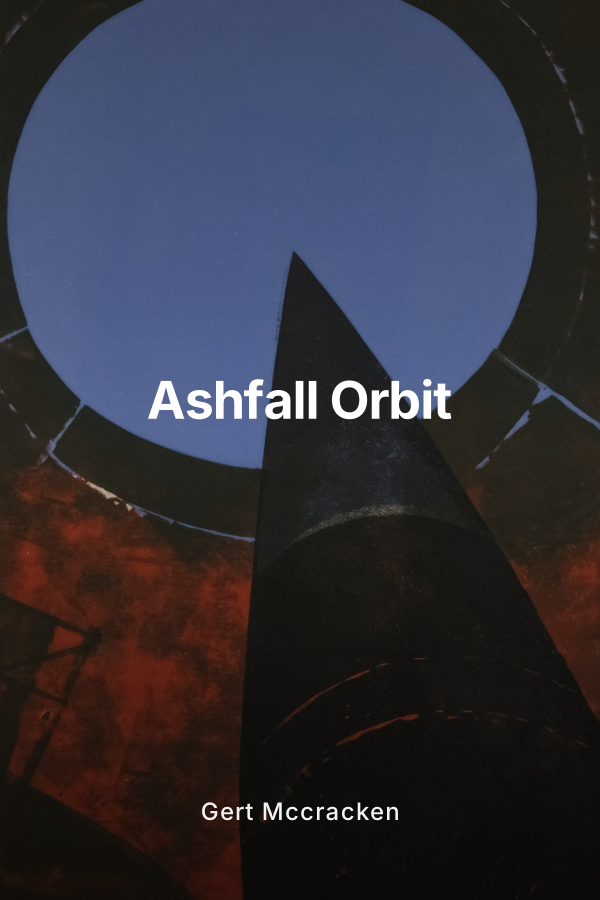
Kael Ashfall has already lost everything once.
Born on the dust‑scorched farming world of Varron‑6, Kael grows up under twin suns that burn skin to leather and hope to ash. His days are a grind of brittle soil, failing machinery, and the distant hum of a prison complex that dominates the horizon like a threat. His parents are kind but worn down, their lives mortgaged to systems designed to keep them small. Kael’s one dream is to leave, to escape the planet that feels less like a home and more like a slow execution.
He never gets the chance.
When a raider clan tears through the settlement during a prison lockdown, Kael’s world is destroyed in a single, brutal morning. He watches his mother die on the farmhouse floor. He watches the raider leader drive a blade through his father’s chest. In a haze of panic and fury, he kills one of the attackers and shoots the leader in the eye, then flees in a stolen Wraith‑class raider ship as his home burns behind him. He survives, but survival comes with a cost: Kael is left drifting through space with nothing but a dead world behind him, a murder in his memory, and the taste of his own helplessness lodged like shrapnel under his skin.
The ship’s locked autopilot drags him to Vorecillian, a bruised‑sky industrial world of neon canyons, scrap towers, and a perpetual hum of corruption. Six years later, Kael has become what he needs to be to stay alive: a lean, competent bounty hunter flying the same stolen Wraith, working the underside of the city for just enough credits to eat, refuel, and avoid thinking too long about Varron‑6.
He has rules now. Work alone. Never owe anyone. Never care.
Then Rhea Voss walks into his life and starts breaking his rules simply by existing.
Rhea is everything Kael is not: polished, precise, infuriatingly capable. She moves like someone who has already survived enough battles to know exactly where every exit is. On their first overlapping job, she snatches a bounty out from under him, walks away with the full payout, and leaves Kael seething with a mix of professional jealousy and reluctant respect. She teases him openly, collects his failed targets, and treats the whole thing like a mildly amusing game.
She also notices things he wishes she would not, like the way his eyes go flat at the sight of certain symbols, or how hard he clenches his jaw when someone mentions off‑world raiders.
Kael hates how good she is. He hates needing her even more.
Their rivalry shifts the first time they both go after the same high‑risk target in the scrapyard district. The job is supposed to prove Kael can handle dangerous work solo. Instead, he ends up pinned down by a heavily armed gang in a maze of rusted towers and shrapnel‑sharp alleys. Rhea arrives not as a savior, but as a competitor who just happens to dislike dying.
They survive only by fighting back‑to‑back, their skills meshing in spite of Kael’s determination to keep everyone at arm’s length. The target goes down, the payout is split, and Rhea leaves him with a taunting line that lodges somewhere between an insult and a promise: You’re welcome for not dying.
Kael tells himself he will never work with her again.
The universe does not care.
When a high‑priority bounty appears on Vorecillian’s board for a raider faction calling itself the Black Maw, Kael’s carefully constructed distance fractures. The symbol on the listing is the same white‑painted maw that marked the armor of the man who murdered his father. The job pays enough to change his life, but the money barely registers. For Kael, the bounty is not an opportunity. It is a ghost with a number attached.
He takes the contract before anyone else can blink.
To hunt down the Black Maw, Kael needs more than a single battered ship and the anger he has been nursing for six years. Against his instincts, he begins to build a crew.
First is Taven Rourke, a brilliant, broken engineer with oil in his veins and too much liquor in his blood. Taven recognizes the stolen Wraith on sight and is half impressed, half appalled that it still flies. Swayed by equal parts curiosity and desperation, he signs on to keep it running and to see just how far Kael is willing to go for this job.
Then there is Lira Dane, a medic and hacker surviving in Vorecillian’s medical slums, stitching together bodies the city would rather forget. When one of Kael’s early moves against the Black Maw goes disastrously wrong, it is Lira who drags him out of the fire with quick hands and quicker thinking. She hears the Varron‑6 dust in his accent and reveals that she carries the same world in her bones. Shared origin becomes shared rage; she joins the hunt not only as their conscience and lifeline, but as the one person who truly understands what it means to watch a planet eat your family.
Their bond is wary at first. Kael is furious with himself for needing to be saved. Lira is wary of his recklessness and the hollowness she sees behind his eyes. It takes a bloody raid on a Maw outpost and Lira nearly dying in the crossfire for something to shift between them. Holding her blood‑slicked hand while Taven fights to keep her alive, Kael is forced to confront the truth he has been running from: he has built another family without meaning to, and he cannot bear the thought of losing them.
Var Kell completes the core team: a stoic ex‑enforcer with a past written in scars and a name that still makes certain criminals flinch. He has his own history with the Black Maw, one he does not share easily. When he hears who Kael plans to hunt, he tries to walk away, then turns back with a single, grim warning: You’re not ready for what you’re chasing. He joins not out of loyalty, but out of a harsh understanding that some debts of blood never stay buried.
Hovering just outside this makeshift family is Rhea Voss.
She sees the Black Maw bounty. She sees the number attached to it. She sees Kael’s pulse stutter and his mask crack for the first time. Rhea wants in for reasons that have nothing to do with revenge and everything to do with ambition and survival. The payout would set her up for years. The challenge would keep her from dying of boredom long before then.
Kael refuses her outright.
She follows anyway.
On a raid that should have killed him ten times over, it is Rhea who cuts a path to his side, gunfire carving light through smoke, eyes hard and furious that he would be so stupid as to die without paying her a share. Saving his life forces a compromise: Kael will take the lead, but Rhea gets a place on the crew.
Their partnership is an exercise in tension.
Rhea mocks his brooding, calls him out when his anger makes him sloppy, and occasionally steps between him and his own worst impulses. She also hands him control when it matters, trusts his instincts when her own data runs thin, and quietly shoulders risk so his people make it home. Outwardly, it is all banter and barbs, an older, sharper hunter indulging the kid who keeps trying to outpace her.
Inwardly, Rhea is pulled toward the haunted gravity at Kael’s center. She sees the way he pushes help away, the way his jaw locks when Lira is hurt, the way he stares too long at the stars as if expecting a particular dead world to appear. She flirts in small, precise gestures: an extra power cell slipped onto his belt without comment, a steadying hand on his shoulder after a brutal fight, a rare, unguarded smile when he surprises her with a clever move.
Kael, who has already lost everyone he ever loved once, refuses to admit how much those moments undo him.
The deeper the crew digs into Black Maw territory, the more dangerous the hunt becomes. They sabotage raider convoys, steal weapons shipments, and start to make a name for themselves as a small, lethal problem on the Maw’s periphery. Each victory is costly. Each close call chips another layer off Kael’s armor.
Then they intercept a transmission that changes everything.
The Black Maw’s leader is alive.
Kade Rul, the man with the white‑painted maw on his armor and the cold, curious eyes Kael has never forgotten, now wears a plate of metal where his ruined eye used to be. He remembers the boy who took that eye. He has been waiting for him.
Old trauma surges back with fresh teeth. Kael’s nightmares sharpen. His judgment blurs. He starts taking risks that scare even Var, the man who has walked through more violence than most people can imagine. Missions become less about strategy and more about Kael’s need to stand in the same room as the man who destroyed his family.
The crew feels the shift.
Lira, still carrying wounds from the outpost raid, is the first to say what everyone senses: Kael is no longer hunting the Black Maw. He is letting them pull him back into the fire that made him. Taven responds by burying himself in planning and explosives, turning his fear into calculations. Var watches Kael with the hard gaze of someone who has seen men burn themselves to ash on the altar of revenge.
Rhea, who has built a life on staying detached and in control, finds herself pulled into the heart of Kael’s storm whether she likes it or not. She is the one who finally calls him out in a scrapyard lit by distant fires, voice stripped of its usual mocking edge. You are not the only one with something to lose here. You’re not allowed to trade your life for a ghost without asking the rest of us first.
Kael pushes back. He has spent six years believing that his survival was a mistake whose only possible redemption lay in killing the man who took his parents. Letting go of that belief feels like betrayal.
The story drives toward the Maw stronghold, a fortress of metal and rock bristling with guns and filled with ghosts. Getting inside requires everything the crew has become together: Taven’s dangerous genius, Lira’s scars and circuitry, Var’s silent efficiency, Rhea’s cool precision, and Kael’s intimate understanding of how the Maw thinks.
In the end, Kael does what he has been dreading and craving since the day he escaped Varron‑6. He stands face to face with Kade Rul.
The raider leader recognizes him instantly. The boy who took my eye. The farmer’s son who should have died screaming on a dirt floor. Their confrontation is brutal, messy, and laced with years of unspoken history. Kael fights with everything that was stolen from him: the memory of his mother’s stillness, the feel of his father’s hand on his shoulder, the dust of Varron‑6 still lodged in his lungs.
He wins.
But victory does not look like a clean execution.
Standing over Kade with a weapon in his hand and his crew bleeding and breathing behind him, Kael realizes that killing this man in rage will not bring his parents back. It will not erase the lockdown sirens or the letter he tore up in a field or the years he spent punishing himself for surviving. It will only chain him to the very violence that ruined his life.
For the first time since Varron‑6 burned, Kael chooses not to kill in cold blood.
The collapsing base makes the final choice for him, burying Kade Rul under fire and falling steel, but the decision matters. It is the moment Kael steps off the path that was written for him the day the Maw arrived at his door.
The crew barely escapes the destruction. In the chaos of their flight, Kael hits his limit. The years of compressed grief, guilt, rage, and isolation crack open all at once. He breaks in a way that is not loud, but absolute: shaking hands, silent tears, a man who has finally run out of ways to carry his own pain by himself.
Rhea is there when he falls. She does not tell him to be strong. She does not mock him back to his feet. She simply stays, one hand steady between his shoulder blades, offering the quiet, unspectacular truth that he does not have to bear the weight alone anymore.
Back on Vorecillian, the Black Maw bounty pays out in numbers that make Brann’s eyes water and every small‑time hunter in the district both jealous and afraid. It is enough for Kael to disappear, to buy passage off‑world, to finally outrun the shadows he has been following.
Instead, he stays.
The Wraith is repaired and refueled. Taven, Lira, and Var linger in the cargo bay, arguing good‑naturedly over upgrades and future jobs. Rhea leans against the ramp, arms folded, watching Kael with that same infuriating half‑smile that stopped feeling like mockery somewhere along the way.
“So,” she says, voice low and even. “Captain?”
Kael looks at the ship that once carried him away from everything he loved and now stands ready to carry something new. He looks at the people who nearly died for him and with him, who have become a family he never meant to find. He looks at Rhea, older and sharper and already attached to him in ways he is only beginning to admit he returns.
For the first time since he left Varron‑6, Kael Ashfall’s gaze lifts from the wreckage behind him to the possibilities ahead.
Ashfall Orbit is a dark, character‑driven space adventure about a young man raised in dust and violence who must learn that survival is not the same thing as living. It follows Kael’s journey from traumatized loner to reluctant leader, from boy haunted by the fire that took his parents to man who chooses his present crew over his past ghosts. Along the way, it traces the slow ignition of an enemies‑to‑lovers bond between Kael and Rhea, the fierce sibling‑like loyalty between Kael and Lira, and the rough, hard‑won trust of a crew that begins as a tactical choice and ends as a found family.
The novel balances the weight of grief and revenge with the sharp, kinetic energy of bounty hunts, heists, and raids in a galaxy where every alliance is a gamble. It asks what it costs to turn away from the easy simplicity of hate, what it means to forgive yourself for surviving, and how far you are willing to go to protect the people who finally make the universe feel wide again instead of empty.
For readers who want starships and gunfights stitched tightly to aching hearts and messy, believable bonds, Ashfall Orbit offers both a complete emotional arc and the open horizon of future journeys with a crew that has only just begun to find out who they are together.