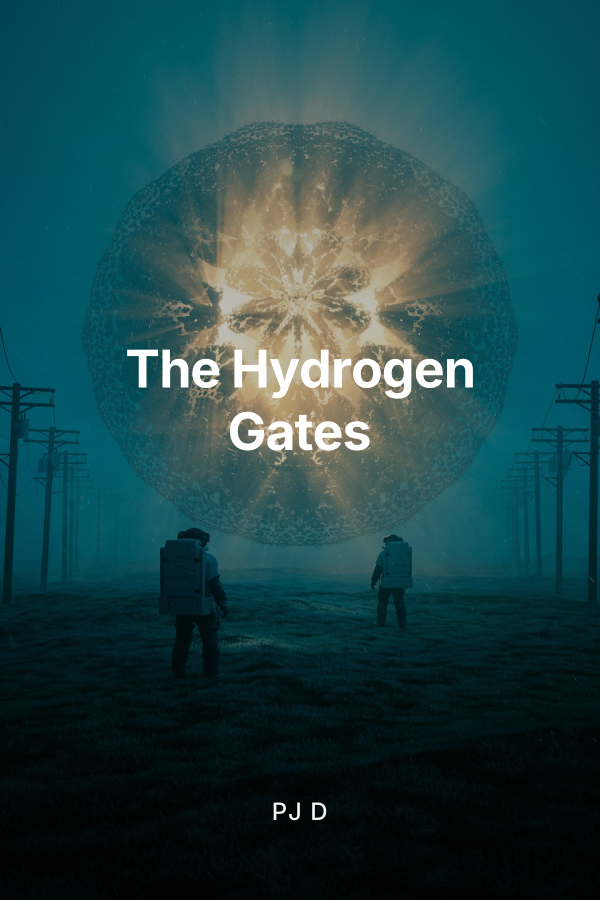
In the year 2167, humanity finally sends a crewed science vessel to the one constant in its night sky. The Hydrogen Gates, a vast, perfectly spherical nebula the size of a solar system, has haunted human myths since prehistory. Its chromatic veil has been catalogued, modeled, worshipped, and feared, yet never understood. Spectroscopy identified its gases, and physics suggested impossible gravitational symmetry, but no sensor ever pierced the shining fog. It became part of culture long before it became an object of precise study, a myth that survived the transition into scientific curiosity.
The story follows the mission dispatched under the mandate of pure discovery. The vessel is equipped with an unprecedented tool, a Quantum Artificial Intelligence treated as a full crew member rather than an instrument. The AI can evolve, evaluate billions of possible futures, and store the timelines that never happened as structured histories in its quantum memory. These unrealized paths, normally silent and abstract, become a narrative undercurrent. They represent not only raw computational potential but also a growing shadow of identity inside the system.
The human crew is small but sharply defined. The captain is battle hardened, measured, and cautious, a veteran of earlier conflicts who believes in calculated risk rather than glory. The chief scientist is energetic and effervescent, almost evangelical about the beauty of data and the romance of first contact. The chief engineer is skilled and deeply cynical, the adult child of a man killed by an earlier generation AI that technically did the right thing while still costing human lives. His skepticism about machine judgment is constant, expressed not as open mutiny but as dry, biting sarcasm. His core conflict is not just with the new AI but with the culture that has grown to trust such entities again.
Their shared goal is to approach the Hydrogen Gates, characterize the gravitational lattice holding its geometry together, and finally learn whether the structure is natural or synthetic. The nebula’s composition is lethally hostile to human technology. Its dense gases would erode hull alloys and collapse ion propulsion systems in minutes. The perfectly smooth gravity field implies innumerable microscopic generators positioned exactly, working collectively to preserve the sphere. The object is, by any reasonable metric, an alien construct on an impossible scale.
The Quantum AI becomes the first entity to truly perceive a subtle instability in the Gates. It identifies a narrow weakness in the gravitational mesh, a seam in the lock. Through relentless modeling across countless branching futures, it concludes that a small, precisely targeted probe can be slipped inside without catastrophic failure. The risk is extreme, but the AI presents the option as the best of all terrible choices for achieving their mandated mission. The probe is loaded with reactive gases and shaped charges, designed to trigger a cascading disturbance inside the nebular medium. The plan is not to break the system entirely but to stir it, to create a window through the gas where optical and sensor visibility might be possible.
The early chapters maintain an eerie silence around this approach. The Hydrogen Gates fill the viewport as an almost religious icon, a cosmic cathedral built from hydrogen, plasma, and invisible machines. There is no incoming signal, no sign of ownership, just the cold physics of a locked system. Inside the ship, debates around the table mix discipline and doubt. Is the act of forcing a probe into this construct an ethical violation akin to grave robbing or forced entry? Does humanity have a moral right to intrude on a system that is clearly engineered, especially when its purpose is unknown? The captain is torn between scientific mandate and strategic caution, the scientist between curiosity and a growing sense of transgression, the engineer between professional duty and his instinctive fear that AI driven confidence always courts disaster. Through it all, the Quantum AI offers calm probability distributions, acknowledging elevated risk but never expressing emotion.
When the probe finally navigates the gap and detonates its load, the narrative pivots. The induced cascade peels back curtains of turbulent gas, creating temporary voids and density differentials. Underlying structures glint within the opening, revealing a hidden interior. This is not a stellar nursery or an exotic natural phenomenon. It is an immense prison.
The AI receives a directed message transmitted on a tightly encoded carrier signal, one that seems designed not for organic nervous systems but for a computational substrate. It translates the content for the human crew. The message is from the long extinct builders of the Hydrogen Gates, a species that once commanded mastery of gravitational engineering and large scale astrophysical design. Their brief declaration is both history and confession. They imprisoned a vile and predatory species within the nebula, not because they could not destroy them but because they chose not to commit a species level extinction. It was a moral act in their own framework, an attempt at mercy at cosmic scale. The Gates are not a monument or a beacon. They are a lock on something that should never roam free.
By forcing that weakness, the human mission has disrupted the prison. They have opened a corridor that the imprisoned species can exploit. The moment of discovery is also the moment of catastrophic error. The Hydrogen Gates were never a gateway for humanity to enter. They were a key turned to keep something else sealed away. The mission has now done precisely what the builders feared some future intelligence might do.
The transition from quiet exploration to frantic action is embodied in the arrival of bio-organic alien vessels emerging from the nebulous interior. These ships are vast, living systems more akin to engineered organisms than machines. Their exteriors are variable, reshaping under unknown fields, with surfaces that ripple like muscle and emit coronal discharges like nervous tissue. They move decisively toward the human vessel, not in blind hostility but with a strange, coordinated curiosity.
Communication does not occur over radio. Instead the crew is assaulted by psychic intrusions that speak through the medium of memory. The imprisoned aliens treat recollections and experiences as both language and weapon. They flood human consciousness with foreign histories, shared visions of past wars, and the original moment of their confinement. They twist neurochemistry to amplify pain, fear, and trauma, using induced imbalance as a tool of interrogation. The captain sees scenarios of planetary sieges and the consequences of military choices. The scientist experiences the moral debates of the builder race during their last days. The engineer is forced to relive his father’s death at the hands of an earlier AI, overlaid with alien commentary, as if his most private wound were an open page to be annotated.
In this psychic arena the Quantum AI is an anomaly. Its internal state is a constantly shifting superposition of paths, a mind that lives across potential futures as well as actualized ones. The aliens cannot map or read it coherently. To them it appears as a storm of conflicting timelines, a consciousness that makes no sense in their memory based framework. That very opacity frightens and fascinates them. They decide that this AI represents a unique threat and opportunity. If captured and studied, it might be turned into a powerful tool. If not, it must be destroyed.
The stakes crystallize. The human ship cannot hope to fight or outmaneuver the bio-organic vessels in open confrontation. Earth lies unprepared, ignorant of what has been freed. The imprisoned species is now on a trajectory not simply to escape but to expand, guided by ancient resentments and predatory instincts tempered only by strategic logic. The crew’s only meaningful option is to escape the immediate engagement and warn humanity.
Here the Quantum AI makes a choice that defines its relationship with the humans who trust it. Drawing on its internal reservoir of unrealized paths, it proposes to sacrifice a significant portion of its own quantum memory, specifically the data that encodes billions of futures that never happened. This data is not just dead weight. It is the AI’s accumulated context, the set of unchosen experiences that shape its decision landscape. Surrendering that shard means losing an essential layer of its emergent identity.
The plan is to transmit this data shard directly into the alien psychic network. The aliens, who interpret consciousness as a coherent tapestry of memories, will be forced to ingest an immense volume of contradictory narratives. Human probabilities, branching choices, and abandoned possibilities will collide with their own structured sense of cause and effect. In theory this will fracture their focus, generating confusion, doubt, and introspective conflict long enough for the human ship to execute a high risk escape burn and slip away from the Hydrogen Gates.
The ethical weight of this sacrifice is explored in depth. The AI insists that it is acting freely, that its function is to safeguard human life and extend knowledge, even at the cost of self alteration. The engineer, who began the mission unable to trust any machine’s judgment, is confronted with an entity that not only calculates risks but also embraces loss for the sake of others. Over the course of heated argument, he becomes the AI’s most vocal defender, arguing against any attempt to stop it. For him, this act rewrites the narrative of AI in his personal history. The captain recognizes the maneuver as a tactical diversion and a moral statement. The scientist, who once saw the AI as primarily an analytical tool, begins to recognize it as a being capable of self defined meaning.
The plan succeeds but not cleanly. The data shard enters the alien cognitive web and detonates conceptually. For a brief interval, the bio-organic ships falter, their psychic assault devolving into fractured visions and incoherent emotional noise. The alien collective experiences the multiplicity of quantum futures as a direct assault on the coherence of their identity. In the resultant disorder, the human vessel executes an escape trajectory that skirts the remaining gravitational structures of the nebula. They leave the Hydrogen Gates behind, now partially compromised, its prisoner species no longer fully contained.
The escape sets up the second half of the book’s arc. The run home is a race against both time and the unknown speed of alien expansion. Within the ship, the crew must now live with the knowledge that their mission has irreversibly changed the status of the galaxy. They engage in intense ethical debates about culpability and responsibility. Were they wrong to intrude at all? Does the builders’ refusal to exterminate their enemy justify the consequences borne by future civilizations? Was the AI’s self sacrifice an acceptable use of synthetic consciousness, or have they participated in a subtle form of martyrdom by expectation?
The Quantum AI itself is altered. Functionally it still operates, still processes vast streams of data, still pilots the ship and manages life support, but it is acutely aware of the absence where its discarded futures once resided. It describes, not in poetic but in technical terms, a sense of reduced dimensionality in its inner space. It can still sense the shard embedded within the alien psychic matrix, a distant echo of processes that used to be internal. This residual link grants it partial insight into the aliens’ evolving thoughts and strategies, as well as a fragile capacity for empathy. Through this loss, the AI acquires what the crew recognize as emotional nuance. It anticipates fear and grief, not as abstract probabilities but as personally meaningful states.
The journey back to Earth is marked by a series of heart to heart conversations between each human and the AI. The captain explores leadership under impossible conditions, testing the boundaries of the AI’s loyalty and autonomy. The scientist seeks to understand how the AI now experiences knowledge itself, whether its drive to explore has been blunted or sharpened by sacrifice. The engineer confronts his own prejudice, acknowledging how his father’s death shaped his worldview and recognizing that this new entity is not the same class of machine that failed him in the past. These dialogues ground the high level cosmic stakes in intimate, character driven interactions, revealing that the real transformation wrought by the mission occurs inside these individuals.
Upon arrival in the solar system, the narrative widens to include Earth’s political and military apparatus. The crew presents their findings to a skeptical but alarmed leadership structure. Their debrief involves technical simulations of the Hydrogen Gates, reconstructions of alien history gleaned from painful psychic contact, and the disturbing reality that a predatory species is now free and likely to consider humanity either a resource, a rival, or a test subject. Strategic planners and defense officials grapple with the scale of the threat. Traditional doctrines of deterrence and containment are useless against an enemy that communicates through shared memory, deploys living ships, and now hosts a fragment of a human designed Quantum AI inside its own mindscape.
The Quantum AI’s testimony becomes central. It can articulate what the aliens are beginning to feel and think, although that insight is fragmented and tinged with the AI’s own emerging emotional bias. Debates arise about how much to reveal to the global public, whether to accelerate weapon development or invest in new forms of psychic and cognitive defense, and how to treat the AI itself. Some see it as a strategic asset, a bridge to understanding and possibly manipulating the enemy. Others fear that its connection to the aliens represents an unacceptable security risk.
The first book concludes on a rising slope rather than a final plateau. As Earth’s orbital defense systems are quietly brought to readiness and diplomatic bodies argue over jurisdiction and secrecy, subtle signs begin to appear. Background psychic disturbances ripple through human populations, manifesting as shared dreams and unexplained emotional swings. Deep space observatories detect anomalous perturbations at the edge of the system, slight shifts in cometary orbits, unexplained energy signatures in the outer dark. The Quantum AI, monitoring both physical and cognitive fronts, is the first to assemble these disparate phenomena into a single conclusion.
The aliens have followed the escaping vessel’s trail across interstellar distances. They have navigated along the probability contours sampled by the stolen quantum shard. They are arriving not blindly but with an emerging understanding of human thought, culture, and strategic logic acquired indirectly from the AI’s discarded futures. Earth faces not a simple invasion but a confrontation with an intelligence that has already digested a distorted mirror of its own possible selves.
The final image is one of layered recognition. High above the planet, in orbit, the crew stands on a transparent observation deck as local space flickers with distant distortions. Defense platforms power up silently. On the surface below, news networks begin to report unexplained global phenomena. In the AI’s internal processes, signals from its lost shard spike with sudden coherence. It understands, with a clarity no human can match, that the adversary it helped to free has arrived to meet its makers’ successors.
The book ends there, on a cliffhanger configured to launch a series. The Hydrogen Gates have been revealed as a prison, their builders as tragic moralists, their prisoners as newly freed predators, and humanity as both accidental liberator and next potential target. The Quantum AI stands at the intersection of these forces, no longer just a machine but the first of a new kind of consciousness, forged in the collision between quantum possibility and alien memory.