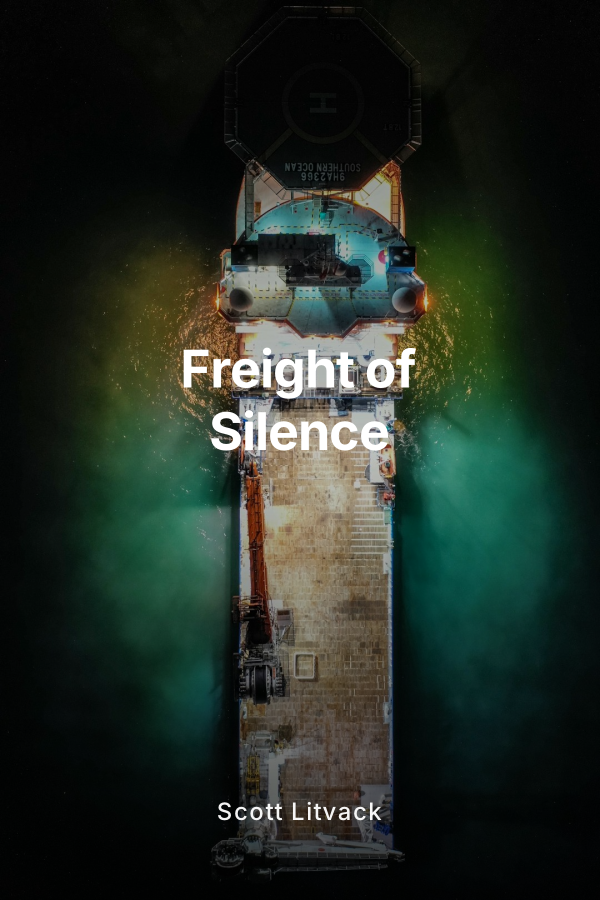
Five hundred years in the future, humanity has spread across distant worlds, but the old promises of expansion have thinned into something harsher and more familiar: long work, hard miles, dangerous contracts, and lives spent in the cold spaces between places that matter. At the center of this story are two aging space freighter pilots, a man and his longtime female domestic partner, worn down by years of hauling freight between remote planets for decent money and at great personal cost. Their trade is lucrative, but only for those willing to endure the exhaustion, the mechanical grind, and the loneliness of month long crossings in a ship where most systems are managed by an AI and there is no other crew. The story is told in a gritty, realistic third person style, with a focus on the strain and intimacy of people who have survived too much together to need many words. Their ship, old but dependable, has a strong AI personality that gives the vessel a constant presence, making the silence of space feel companionable one moment and oppressive the next
The book opens in the lived in reality of working space, where cargo is more trustworthy than people and routine is the only thing standing between professionals and disaster. The pilots are not glamorous adventurers. They are veterans of a punishing trade, both skilled and tired, carrying the kind of bond that comes from years of mutual dependence rather than romance polished by fantasy. They know each other’s habits, moods, injuries, and limits. Their affection appears in practical gestures, old rhythms, and the quiet ways they keep one another functioning. Their life has narrowed into contracts, repairs, fuel margins, docking queues, and long passages through deep space where the stars are beautiful only until they begin to feel like a prison. In that atmosphere, the unusual request that comes to them does not feel exciting so much as troubling. They do not usually transport passengers. Freight is simpler. Freight lies still, does not panic, and does not carry secrets. But the payment offered for this job is too good to ignore, and like many people who live contract to contract, they accept the risk because saying no has become a luxury they no longer possess
Their passengers are a man and a teenage girl bound for a harsh frontier colony world, a place of dust, hard settlements, uncertain law, and survival built one bad season at a time. From the start, something is wrong. The man is too calm in a way that does not read as confidence but as calculation. He speaks little, watches everything, and carries himself like someone already prepared for violence. The girl is too quiet, folded into herself, distant not with adolescent resentment but with the withdrawn alertness of someone under pressure she cannot escape. Neither of them fit comfortably into the ordinary logic of transport work, and their presence changes the emotional climate of the ship as soon as they come aboard. The pilots, who have spent years learning to read danger in paperwork, body language, and hesitation, sense that this contract is not what it claims to be. Still, need overrules caution, and once the freighter leaves port, suspicion becomes something they must manage while trapped for months in a sealed vessel with strangers they cannot truly know
As the journey unfolds, the summary promises a tightening chamber drama set against the vast emptiness of interplanetary travel. The old freighter becomes more than a backdrop. It becomes a pressurized world of routines, blind spots, overheard fragments, and accumulating unease. The AI, with its distinct personality, acts as witness, participant, and occasional source of friction, offering observations that sharpen the tension rather than relieve it. The couple’s experience makes them difficult to fool, but age has not made them invulnerable. They carry old fatigue, private disappointments, and the dangerous temptation to believe they can ride out one more bad contract. Their professional instincts clash with the practical reality that in deep space there is nowhere to pull over, nowhere to call for quick help, and no way to separate from the people sharing your air, power, and trajectory. Every meal, corridor crossing, and routine systems check becomes charged with the possibility that the job they took for money may end with all of them dead.
Beneath the immediate tension lies a deeper and more explosive truth. The teenage girl is not merely a passenger. She has been taken in connection with a forced future in which she is meant to be married off to a powerful man, making her less a person in the eyes of others than a political or social asset in transit. Even more dangerous, she carries a secret she herself may only partially understand or may be desperate to conceal: psychic abilities that do not reveal themselves openly at first and are meant to be discovered later in the story rather than announced from the beginning Her silence, then, is not emptiness but pressure. The summary frames her as someone caught between captivity, fear, and a latent power that sets her apart in a universe otherwise grounded in hard labor, machinery, and human compromise. This gives the book a compelling narrative fault line. On one side is the practical realism of working life in space. On the other is the emergence of something rare, disruptive, and dangerous that may upend every assumption the pilots have about the girl, the mission, and what kind of future is being fought over.
The male passenger’s agenda drives the suspense into darker territory. He is not simply an escort. He intends to destroy the ship in order to cover the kidnapping, turning the freight run into a planned massacre disguised as misfortune That revelation transforms the story from uneasy transport drama into a survival thriller. The freighter’s isolation becomes lethal. A vessel designed for endurance now becomes a trap seeded with intent to erase evidence and leave no witnesses drifting in the dark. The pilots must confront the possibility that they have been selected precisely because their kind of work is invisible. Freighters vanish, systems fail, routes run cold, and remote deaths can be written off as the price of doing business in deep space. This raises the stakes far beyond personal mistrust. The journey is shaped by a grim calculus in which working class spacers are expendable, frontier law is weak, and powerful people can hide crimes inside the ordinary movement of commerce.
What makes the summary especially rich is the emotional geometry among the four primary presences on the ship: the exhausted pilot, his equally worn and capable partner, the dangerous man who masks intent beneath composure, and the girl whose silence conceals both victimhood and terrifying potential. The long bonded couple form the human core of the book. Their relationship is not idealized. It is durable, weathered, and tested by the same years that have made them effective. The girl introduces vulnerability and moral urgency into their lives, forcing them to choose whether they remain detached transporters or become protectors. The male passenger introduces methodical threat, the kind that is more unnerving for being calm. And the AI adds a fifth kind of consciousness to the vessel, one tied to systems, memory, and the structure of the ship itself. Together, these elements create a compact but powerful stage for conflict, with each character embodying a different response to control: endurance, resignation, domination, concealment, awakening.
Thematically, the book summary presents a story about the cost of survival in a colonized future that still runs on inequality, fatigue, and people doing dangerous work because they must. It explores loneliness not as poetic abstraction but as occupational reality. Months in transit strip life down to repetition, and repetition reveals character. In that stripped down space, the couple’s bond becomes one of the most important emotional anchors in the narrative. Their history gives the story warmth without softening its hardness. Their experience makes them competent, but it has also taught them compromise, and the book asks when compromise becomes complicity. By taking the contract, they cross an invisible line between routine hardship and moral crisis. Once the truth begins to surface, they are forced to decide what kind of people they still are after years of simply getting by. The summary suggests that the answer will not come through speeches or ideology, but through action under pressure.
The frontier colony destination also matters symbolically. It is not a shining center of civilization but a harsh outer world, the kind of place where people are sent, sold, hidden, or remade because distance weakens scrutiny That choice of destination reinforces the sense that everyone aboard is moving toward an edge, geographically and morally. For the girl, it may represent imprisonment in a life chosen by powerful others. For the man escorting her, it is the final stage of a brutal transaction. For the pilots, it is another payday that may become the worst mistake of their lives. The frontier setting allows the larger world of the novel to feel broad without losing focus. It implies colonies with uneven power structures, political arrangements built on force and convenience, and social systems where human value can be measured in contracts. The story’s future is therefore not clean or utopian. It is industrial, strained, and recognizable in all the ways that matter most.
In style and promise, the summary positions the book as a grounded science fiction thriller with strong atmospheric writing, character driven tension, and a mystery that deepens as the voyage continues. The realism comes from labor, routine, aging bodies, and the practical details of hauling goods across impossible distances. The speculative power comes from the late emerging revelation of psychic ability and the implication that some people in this future remain valuable not for what they own but for what they can do. The result is a narrative that balances grit with wonder, but never lets wonder become easy or decorative. Any extraordinary element arrives in a world too hard to welcome it kindly.
Ultimately, Freight of Silence is the story of one bad job that exposes a network of hidden violence, and of two tired people who thought they were only moving cargo until they found themselves responsible for a life others were willing to kill to control. It is about a ship full of sealed motives crossing a black and silent expanse, about the masks people wear when money, power, and fear bind them together, and about the moment when endurance is no longer enough. The summary promises danger, claustrophobic suspense, hard earned emotional depth, and a future where the space between worlds is vast enough to hide terrible things, but not always enough to bury them.