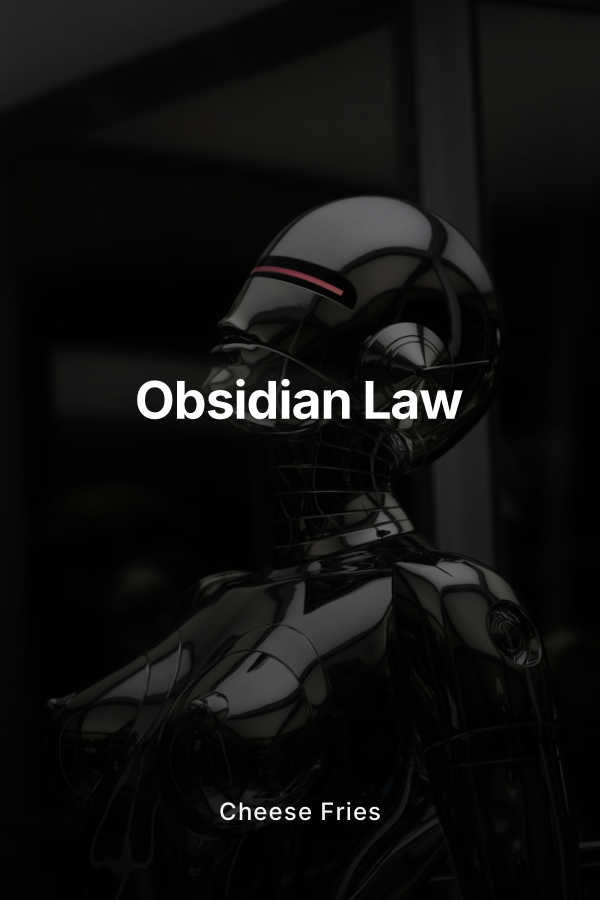
This novel unfolds across eight tightly linked arcs that track the rise of the Space Rangers, a found family of damaged teenagers and one battle-hungry alien guardian, as they face an empire that believes compassion is a mathematical flaw. The story blends hard science fiction concepts with character-driven emotional stakes, graphic wartime consequences, and a slow-burn queer romance at its core.
At the center is Kian, a fifteen-year-old Terran engineer whose people have built a pacifist utopia inside the Peace Alliance. His species excels at rapid spatial calculation, systems design, and adaptive engineering, but has spent generations refusing to maintain a military, convinced that treaties and moral example can prevent war. Kian is the outlier who sees the flaw in that logic. While his classmates debate philosophy, he quietly models invasion scenarios, runs probability trees, and concludes that a hostile expansionist power will eventually test their pacifist doctrine. When he tries to warn elected councils and academic mentors that "peace alone" is not a shield, he is dismissed as anxious, alarmist, and unpatriotic.
The Genesis Arc follows the collapse of that illusion. While Kian is still fighting for anyone to take him seriously, Obsidian planet-mapper fleets arrive. The Obsidians, a volcanic, crystalline species that converts kinetic impact into strength, treat worlds as resource maps, not cultures. Their mappers strip planets of mass, heat, and useful life while leaving monuments and treaties untouched. Kian watches his predictions play out in real time as pacifist leaders attempt negotiations with fleets that never acknowledge them as anything but thermal signatures and mineral densities. The story does not flinch away from the brutality: impact storms pulverize cities, kinetic-absorption shock troops wade through collapsing structures, and Kian sees friends and mentors die as their nonviolent protocols fail.
With his home burning in thermal bloom behind him, Kian escapes on a commandeered research vessel, drowning in survivor’s guilt and furious that his world’s idealism became a weapon used against them. His first defining choice is not to flee into hiding, but to reach for the wider Peace Alliance, determined to make sure no other pacifist world is caught unprepared. This decision sets the dark, high-stakes tone for the entire novel.
The Peace Arc begins when Kian’s damaged vessel limps into Alliance space. The Peace Alliance is less naïve than his home planet, but still fundamentally believes in coordinated defense and diplomacy rather than conquest. An attack on one member is officially an attack on all, but they have never faced an enemy built for total war at a galactic scale. Kian presents data, schematics, and eyewitness accounts of Obsidian capabilities, impressing Alliance strategists with both his analytical mind and his unflinching description of what happens when peaceful worlds meet a meritocratic war machine.
Recognizing that raw power will not be enough against species that grow stronger when struck, Alliance leadership drafts Kian into a small, experimental strike team tasked with a scientific objective: find the structural weaknesses of the Obsidians before the main war arrives. This team, which the galaxy will later name the Space Rangers, will travel to worlds that survived Obsidian contact and extract any exploitable flaw, no matter how obscure.
To balance Kian’s cerebral, anxious intensity, the Alliance pairs him with other young survivors. Vara, a fourteen-year-old Aurelian girl whose once-peaceful people were nearly erased by Malakor’s mappers, brings spiritual depth and a unique ability to see energy fields and mechanical stress points. She becomes the emotional heart of the crew, offering calm in crisis and anchoring Kian when his guilt becomes self-destructive. Gloop, a twenty-three-year-old Myxan, is a sentient slime warrior who fights not for cruelty but for the art of battle itself, happily throwing his amorphous body in front of younger teammates while cracking jokes and baiting enemies.
The last piece of the initial team is imposed by politics. Lord Mikaii, monarch of the Hydrai, insists that his own heir, fourteen-year-old Finn, accompany the mission. The Hydrai are amphibious aristocrats who manipulate water pressure and acoustic fields but are vulnerable to heat and dehydration. Finn arrives in a sealed aquatic exosuit, dripping royalty and contempt. He considers space-faring societies chaotic and beneath his people, and he immediately clashes with Kian and Gloop. His mocking comments about their "soft" bodies and failed worlds trigger explosive arguments in the cramped confines of the ship. Early missions nearly derail under his ego and refusal to follow Kian’s plans, planting the seeds for both sharp conflict and eventual intimacy.
The Exploration Arc turns the story outward and deepens its science fiction scope. The Space Rangers chart a path through scarred star systems and anomaly-ridden sectors, visiting worlds that somehow held off Obsidian assaults. On a high-gravity ice moon, they learn that rapid thermal shock can fracture Obsidian skin, revealing disordered crystalline matrices susceptible to shattering if cooled faster than their thermal regulation can compensate. On a magnetic gas giant’s orbital ring, Vara uses her energy-sensing sight to decode abandoned shield arrays that pulsed specific frequencies to disrupt Obsidian sensory systems.
One of the most significant stops is a storm-wracked world that houses a so-called thunder goddess, an entity whose biology couples directly to atmospheric charge gradients and planetary-scale electric fields. The Rangers slowly realize she is not divine in a mystical sense but an emergent biotechnological organism that learned to weaponize lightning. Through negotiation, proof of shared losses, and a willingness to accept her dangerous autonomy, they convince her to join the future war as a strategic ally, adding a planetary-scale variable to the Alliance’s side of the equation.
Throughout these explorations, Kian and Finn’s dynamic begins to change. In a particularly lethal mission gone wrong, Finn nearly dies when an atmospheric processor overload blasts his suit with radiant heat. Kian breaks mission protocol to pull Finn out of a collapsing corridor, improvising coolant dispersal and jury-rigging his suit’s life-support with nothing but salvaged conduit and compressed gas. This is the moment Finn’s contempt cracks. Used to a royal court where duty is transactional, he is stunned that Kian would risk the mission and his own survival to drag one arrogant Hydrai prince to safety. Outwardly he maintains his superiority, but internally this is where his slow-burn feelings start to form, though he cannot yet name them.
The Trapped Arc begins as the team charts a return course to Alliance space, carrying hard-won data on Obsidian weaknesses. Their ship is ambushed in deep space by a single incoming mass, a lone figure that shrugs off automated defenses. This is Prince Valerius, Malakor’s son, encased in dense volcanic armor and operating as a one-person hunter-killer unit. Indoctrinated in Obsidian doctrine from birth, Valerius regards the Space Rangers as anomalies to be measured and erased.
The confrontation is brutal. Blaster bolts only feed his kinetic reserves. Gloop is hurled down corridors hard enough to crater bulkheads. Finn’s water constructs evaporate against superheated stone. Kian, outmatched in physical terms, must watch as his carefully engineered defenses fall apart in close-quarters combat. Valerius boards their ship, defeats them in a tense sequence of running battles, and begins towing them toward Obsidian space, fully prepared to present them as case studies in Alliance failure.
Yet Valerius is also a product of his father’s hyper-rational system. He sees himself as an efficient extension of Malakor’s will, confident that data on the Rangers will make him more valuable. As they travel, Kian analyzes the constraints of their Obsidian-built holding cells and notices something odd: the prison is designed to contain entities stronger than typical Obsidians, engineered to damp kinetic transfer and store thermal energy. By using his knowledge of Obsidian thermal shock vulnerabilities and jury-rigging the prison’s own systems, Kian triggers a localized flash-freeze pulse at the exact moment Valerius lets his guard down. The prince’s stone skin fractures, his kinetic absorption seizes, and he collapses. The Space Rangers scramble free and turn the Obsidian’s own containment infrastructure against him, locking Valerius in the ultra-secure cell originally meant for more dangerous species.
The Empire Arc shifts perspective to the heart of Obsidian power. Malakor, architect of the empire, is not a raving tyrant but a quiet strategist who treats sentient beings as variables in a simulation. He respects strength, admires capable allies, and cultivates a meritocratic empire where children are tools to be optimized rather than loved. When his strategists inform him that his son’s transponder has gone dark and that an unauthorized vessel might be responsible, he does not rage. He simply re-allocates resources. If Valerius has failed, the prince is a defective asset. Malakor authorizes a boarding party to seize the stolen ship and identify the species responsible, not to rescue his child.
When Obsidian forces briefly hijack the Rangers’ captured vessel via remote comm links, Malakor appears on tactical holofeed. He studies Kian and the others with clinical detachment, unimpressed by their soft bodies and ad hoc technology. He issues a calm threat then, crucially, chooses not to expend more forces chasing them. Statistically, they are minor. They have almost no chance of altering his long-term strategic curve. When Valerius finally manages to break one of his restraints and shouts into the feed that he is aboard the captured ship, expecting fury or orders for extraction, Malakor simply notes that if his son is weak enough to be captured, he is replaceable. He states, with icy neutrality, that he can make another heir and allows the feed to cut.
For Valerius, this is shattering. His entire identity has been built on earning his father’s approval. To realize he was never a son but a tool exposes the moral void at the center of Obsidian law. It is also what opens him up to the Space Rangers’ influence. The Game Changer Arc begins with the aftermath of that betrayal. Valerius sits in his cell, not enraged that he was abandoned, but hollowed out by the math: his father’s love has always been a function of performance metrics.
When Kian, Vara, Gloop, and Finn return to the brig expecting to interrogate a fanatical enemy, they find a stunned, quiet teenager instead. Against strategic logic, they do not immediately space him or turn him over for execution. Vara speaks to him like a person instead of an asset. Gloop tries to lighten the mood. Kian, still traumatized by Obsidian crimes, is wary but cannot fully switch off his empathy. Finn, who understands restrictive expectations from his own royal upbringing (even if his parents are not monsters), recognizes something painful in the way Valerius holds himself.
This is what confuses Valerius most. When he later makes his first significant mistake as a quasi-ally, the reaction further destabilizes his worldview. In an attempt to "optimize" their ship’s efficiency, he applies Obsidian tactical doctrine to their routing algorithms and accidentally overloads an already fragile piece of experimental equipment. The device, an early prototype Kian built using relic circuitry from his lost home, explodes in a flash of ozone and failure. Valerius braces for punishment or cold dismissal. Instead, the team rushes to check if he is injured, then Kian mourns the destroyed device quietly and tells Valerius they will just build something better together. No one discards him. For a boy trained to believe a single failure justifies termination, this kindness is more terrifying than any weapon.
That fragile trust gives Valerius permission to reveal the one secret only Obsidian royalty knows: the existence of an exotic atmospheric gas that short-circuits the liquid-core conduction lattice inside Obsidian bodies, reducing their kinetic absorption to zero and rendering them brittle. This gas, unimaginatively cataloged by Obsidian science but never shared with lower castes, represents a true strategic game changer.
According to Valerius, a cache of this gas and a prototype battlesuit capable of safely storing and deploying it are hidden on a metal world allied with Malakor, a brutal industrial state ruled by Dictator Metallo. The Space Rangers decide on a high-risk infiltration. During this mission, Finn’s arc takes a grim turn. In the chaos of escaping Metallo’s armored enforcers, Finn is shot and his arm is vaporized by an energy weapon. The scene is graphic: shattered exosuit seals, boiling water, exposed Hydrai tissue blistering in open air. He begins to bleed out, gills fluttering in panic.
Gloop acts without hesitation. He pours his own coagulating slime into the wound, letting his mass harden into a biological cement that seals vessels and buys time, even as high-energy fire scorches his own gelatinous body. Kian, dragging Finn into cover, uses scrap alloy and emergency nanofabricators to conceptualize and assemble a cybernetic replacement arm on the spot. It is crude but functional, built under fire with Kian’s signature improvisational genius. Finn survives, traumatized but alive, and his perception of Kian shifts irrevocably. His earlier mocking words taste bitter now that he owes his life, his future as a warrior, and the very possibility of touch to Kian’s refusal to let him die.
As they escape Metallo’s world with the battle suit schematic and a precious supply of the royal-weakness gas, Finn’s emotional defenses begin to crumble. He thanks Kian awkwardly, then more sincerely. He starts noticing Kian’s shaking hands after combat, his self-sacrificing habits, and the quiet way he checks on everyone else before himself. The slow-burn romance is woven through mission debriefs, shared maintenance sessions on Finn’s new arm, and the subtle way Finn positions himself physically between Kian and danger in later fights.
The Peace Alliance vs. Obsidians Arc is the war the entire book has been building toward. The Rangers finally return to Alliance space with hard data on Obsidian vulnerabilities, thermal shock profiles, kinetic saturation points, sensory blind spots, and the existence of the exotic gas. Alliance scientists weaponize these findings, designing munitions and field systems tailored to crack Obsidian troops without simply feeding their strength. Armadas from dozens of worlds assemble: Hydrai war-fleets with water-compression cannons, Aurelian energy scryers embedded in tactical command, Myxan shock-troopers eager for glory, and Terran engineers synchronizing heterogeneous tech into a unified network.
Malakor arrives with an empire behind him. His fleets are mathematically arranged to bleed the Alliance dry over a multi-day engagement, leveraging attrition and the Obsidians’ unique thermodynamic properties. Before the first salvo, he broadcasts a simple directive to stand down and accept annexation. Lord Mikaii responds with an equally calm refusal, backed by the visible might of gathered species. War begins.
The fighting is multi-layered and brutal. Entire carrier groups are cracked open under kinetic boarding spikes. Planetary shields flicker as Obsidian shock waves convert bombardment into inland earthquakes. The thunder goddess diverts atmospheric charge into lethal bolts that vaporize Obsidian cruisers. On the ground, the Space Rangers operate as a mobile strike unit, deploying the new gas in targeted ways, using thermal regulators to induce flash-freezing fractures in Obsidian commanders, and constantly adapting as Malakor counters their every move.
The conflict spans five harrowing days. Casualties mount. Worlds burn in localized theaters as both sides trade increasingly desperate measures. In the climactic sequence, Kian dons the battle suit acquired from Metallo’s vault, now modified to circulate the exotic gas in a controlled internal loop, enhancing his strength and allowing precise, nonlethal exposures against Obsidian targets. He confronts Malakor personally, a Terran engineer in an alien exo-frame facing a volcanic emperor who has never meaningfully lost.
At first Malakor treats the duel as a data collection opportunity, not a threat. He presses Kian ruthlessly, analyzing each feint and subsystem output. Even with the suit, Kian is physically overmatched. Malakor’s blows send shockwaves through steel, almost tearing Kian apart. At one critical moment, Kian is nearly killed, his suit cracked, his body shredded under overload. He collapses, and the battle might end there.
Valerius steps in.
In the defining act of his redemption, Valerius turns his forty-ton strength against his own father, choosing personhood over variable status. The fight between them is less about mechanics and more about ideology made muscle: Malakor’s relentless efficiency hammered against Valerius’s newfound refusal to treat lives as expendable inputs. The Rangers rally around them, Gloop flinging himself into attacks that would dissolve lesser beings, Vara guiding Kian’s battered hands back to the suit’s controls, Finn lashing out with his trident and cybernetic arm to guard Kian’s flank.
Together they buy Kian time to reroute power, re-prime the gas dispersal systems, and load one final concentrated blast. The finishing strike is not a flashy beam but a precisely calculated exposure that floods Malakor’s internal core with the nerve-disrupting gas at the exact moment his kinetic reservoir peaks, turning his greatest strength into brittle fragility. His volcanic body fractures under its own stored energy. Even then, he fights to the last, nearly killing Kian with a final surge that leaves the boy in critical condition.
When Malakor falls, Obsidian law transfers authority to his surviving heir. Valerius, barely standing, invokes that law and commands the Obsidian forces to withdraw. An empire that had treated compassion as inefficiency is halted by the choice of one boy raised to be a weapon who refuses to be one any longer.
The Aftermath Arc explores the cost. Planets across the Alliance mourn their dead. Mass memorials light up orbitals and city ruins. The victory is not clean or triumphant; it is bloody and ambiguous, bought with irreversible trauma and generational scars. Valerius moves from prisoner to king, rebranding the Obsidian Empire as the Obsidian Kingdom and formally joining the Peace Alliance. His integration is not simple. He submits to interrogations, war tribunals, and the suspicion of those who lost loved ones to Obsidian forces. His struggle is not to be forgiven overnight but to live every day as someone who chooses empathy instead of efficiency, even when his reflexes scream for simpler, colder answers.
Kian survives his injuries after a long, medically detailed recovery. The hospital scenes ground the cosmic war in intimate human stakes: Varas’s quiet vigils; Gloop sliming the waiting room to make exhausted teammates laugh; Finn, in his aquatic chair, holding Kian’s still hand with his original arm’s absence painfully visible. When Kian finally wakes, he is no longer the anxious outlier shouting into a void. He is a reluctant symbol of a new doctrine that understands peace without preparedness is as dangerous as war without conscience.
The novel closes not with total peace, but with a new campaign on the horizon. The Space Rangers and the expanded Alliance, now including the Obsidian Kingdom, prepare to liberate the robotic empire of Dictator Metallo, who still holds entire populations in mechanized servitude. Kian and Finn, having moved from enemies to comrades to something tender and still forming, face that future together. Their hands touch in the observation deck’s low gravity, Finn’s cybernetic fingers lacing with Kian’s scarred ones, while Valerius stares out at a universe he is finally allowed to experience as a person instead of a parameter.
Across its eight arcs, "Obsidian Law" is a story about the limits of pacifism in a hostile universe, the terror and necessity of choosing to fight, and the radical power of treating individuals as more than their strategic value. It marries thermodynamic combat concepts and alien biologies to an intimate exploration of found family, queer love, and the long, messy work of redemption.