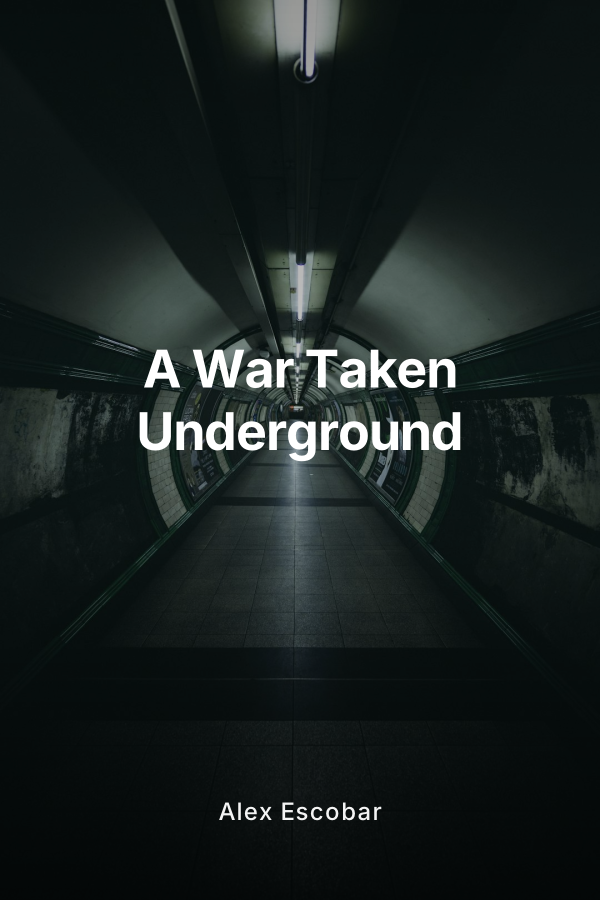
In a world where the surface has been burned into a dead wasteland, the last war of humanity crawls into the earth. The Golden Empire, ruled by a single queen, and the Royal Nation, ruled by a fractious democracy of kings, have turned their hatred into a conflict that no longer claims land or glory. It feeds only on famine and fear. With oceans boiled, skies blackened, and crops erased, the war is no longer about borders. It is about who will eat and who will be eaten.
When a Royal Nation politician is assassinated in 1923, the fragile tension between the two powers shatters. The Royal Nation blames the Golden Empire and declares war. The retaliation is merciless. Both factions bomb each other until the surface becomes uninhabitable, then dig down and drag their armies with them. Networks of tunnels, checkpoints, and hollowed out caverns become the new trenches. In these lightless corridors, soldiers march with faction lamps strapped to their belts, bright yellow for the Golden Empire, violet for the Royal Nation, the glow the only thing that keeps allies from shooting one another in the dark.
Within this nightmare, two young Soldats fight on opposite sides. One marches for the Royal Nation. The other kills for the Golden Empire. Both wear the lowest wing of their armies, the basic infantry role the command gives to fresh meat who never qualified for prestigious wings like Mortician, Vanguard, or Jaeger. They carry ammunition for others, follow orders, and are sent to die first. Yet their paths bend toward the same blood soaked crossroads deep underground, where an abandoned Golden Empire church has been converted into a fortified checkpoint and rumored storehouse of food and supplies.
The Royal Nation Soldat begins the story as a loyal but fearful infantryman who fears failing his comrades more than dying. In the tunnels he serves alongside other wings. Morticians stagger through gas clouds wearing masks as easily as second skin, repairing torn flesh under bombardment. Officers mutter plans over rough maps at makeshift bases, weighing lives against ground gained. Vanguard tanks shield squads with slabs of metal, turning bodies into battering rams. Rooks dig and reinforce, smashing rock with pickaxes so the war can dig deeper still. Lancers fix polearms and swear they will never betray their banners. Jaegers slip ahead, quiet as ghosts, setting traps and hunting news of Solace Coalition movements.
At first, the Royal Nation Soldat clings to the idea that if he fights hard enough and protects enough allies, someone will survive all this. Each small mission is an opportunity to do better, to save more lives than he loses. Yet every tunnel run costs him another face he knows. Each corpse he steps over is someone to whom he spoke only hours before. The strain begins to split his mind. He pockets scraps of cloth and tags from the dead, building a secret shrine in the shadows, a little monument to the ones he failed. Gradually, his desperation to save the living grows frantic, even reckless, pushing him to choices that place his squad in greater danger for a chance to pull one more man back from the edge.
On the other side, the Golden Empire Soldat begins as a believer in the queen and the luminous ideal of the Empire. He marches under the yellow lamp that marks his allegiance, convinced that the Royal Nation started the slaughter on purpose and that the Empire only fights to survive. The hunger gnaws at him and his comrades. Rations shrink. Rumors spread about eating the dead, about what happens to bodies that disappear before burial. Officially, the war is still spoken of as a grand cause. Unofficially, soldiers whisper that if they do not keep killing, their side will starve first.
Repeated tours through the tunnels, the endless sight of mangled bodies, and the casual cruelty of his own officers begin to hollow the Golden Empire Soldat out. Where the Royal Nation counterpart grows frantic and protective, the Empire Soldat becomes numb. The screams of the wounded turn into a background noise he no longer registers. The sight of a begging prisoner only irritates him. The first time he kills someone who is unarmed and already wounded, he feels sick. The second time, he feels nothing. Soon, he learns that cruelty is easier than compassion in the dark, that it is simpler to swing a rifle butt than to look another starving soldier in the eyes.
Between the warring giants crouches the Solace Coalition, a third group that never fights at the front yet profits from every corpse. Solace workers scavenge abandoned battlefields and silent side tunnels, looting armor, weapons, and ammunition. They sell or quietly return these spoils to both factions, ensuring the conflict never truly burns out. Their crates sometimes appear just behind the lines, free to use, tempting exhausted platoons with much needed supply. Yet the workers themselves are like phantoms, never present when the lamps flare and the rifles fire. Many soldiers begin to suspect that Solace manipulates the war from the shadows, encouraging battles over resources that may already be gone.
As the book unfolds, horror grows not only from gore but from the way the war reshapes minds. Nerve gas drifts through cramped shafts. Limbs are torn off in collapses and blasts. Grenades convert living bodies into meat that sticks to walls. Yet the true terror lies in watching both Soldats adjust to this as routine. Nightmares bleed into waking moments. Both men struggle to tell the difference between real footsteps in the tunnel ahead and echoes trapped in their heads. Their lamps cast moving shadows that resemble figures from their past, people they may already have killed or failed to save.
In one campaign after another, the Royal Nation Soldat tries to hold onto his humanity. He shields weaker comrades, volunteers for dangerous retrievals of wounded Morticians, and argues with Officers who are willing to abandon entire squads as lost. The more he sacrifices himself for others, the more empty he becomes inside. What began as courage starts to look like a death wish dressed up as heroism. He begins to understand that his desire to save everyone masks a spiral of guilt he cannot escape.
The Golden Empire Soldat, in contrast, learns to survive by cutting away everything that hurts. He stops remembering names and starts remembering only roles. He no longer thinks of the enemy as people. They are Royal Nation helmets, violet lamps, different armor patterns. Friendly faces blur into one long line of uniforms. Between missions, he eats his rations without tasting them, sleeps without dreaming, and follows orders without question. Each time he steps over a corpse, he tells himself it is just meat now.
These two arcs converge at the underground Golden Empire church checkpoint, a massive cavern where once holy walls rise like stone ribs from the tunnel floor. Long ago it was a place of worship. Now it is a fortified node in the Empire’s tunnel network, believed to guard caches of rare food and still useful supplies. The Royal Nation high command believes that seizing this church could shift the balance of starvation, if only for a while. The Empire knows that losing it might shatter morale and expose deeper tunnels.
Both Soldats are sent to the same battle from different directions. To the Royal Nation Soldat, the church represents a fragile hope that if he fights hard enough, his comrades will finally eat more than meager scrapings. To the Golden Empire Soldat, the church is a line that cannot be crossed. It feels like the only thing still standing between his side and complete collapse, a relic that must be defended even if every man in his platoon falls in its halls.
The battle that follows is brutal and unrelenting. Vanguard shields slam against barricades beneath stained glass now coated in grime. Lancers charge down narrow aisles with polearms, their loyalty to nation or empire turning them into human spears. Morticians drag the wounded behind broken pews, trying to stitch flesh while grenades explode overhead. Officers bark orders that are lost under the roar of gunfire. Rooks race to reinforce tunnel breaches, swinging pickaxes to bring down rock on advancing foes. Jaegers weave through side passages, laying traps that shatter legs or crush skulls in showers of dust.
Amid this chaos, the Royal Nation Soldat desperately tries to keep his squad alive, pulling comrades away from collapsing arches, hurling himself in front of fire, and refusing to leave anyone behind. Each success costs him another ally elsewhere. Each life saved shows him another body lying face down in church dust. As the assault grinds on, his hands shake. His breathing turns ragged. Yet he continues forward, driven by a need stronger than any order. If he can save just one more, perhaps the dead that cling to his memory will finally let him rest.
The Golden Empire Soldat, dug in among the defenders, reacts to the same slaughter with cold efficiency. He fires on anything violet that moves, executes wounded enemies before they can rise, and uses corpses as cover without a second thought. When Imperial allies fall beside him, he barely glances at their faces, stepping over them to gain a better position. What would once have broken him now barely stirs a flicker of emotion. He has learned to survive by surrendering his capacity to feel.
When the shooting finally dies down, the church is not a place of victory for either side. It is a charnel house packed with broken bodies, fallen banners, and scattered supplies. The long promised food turns out to be far less than rumor claimed. There is not enough for anyone to be saved. In the ruin, both Soldats find proof that the enemy is not as different as they have been taught to believe. Maybe they see the same letters from home written on different paper, or identical ration tins stamped by the same Solace Coalition supplier, hinting that both factions feed from one poisoned hand. Maybe they watch a dying enemy clutch a charm identical to their own.
The moment leaves them sad, shocked, and hollow. The Royal Nation Soldat realizes that his frantic efforts have done little but rearrange who dies today and who dies tomorrow. The Golden Empire Soldat, confronted with evidence that the people he has been butchering share the same hunger and fear, feels a crack appear in the numb shell he built around his heart. Both survive the battle. Neither can claim they have truly lived through it.
In the final movement of the book, the focus falls on the aftermath of the church battle rather than on a grand resolution to the war. The conflict between the Golden Empire and the Royal Nation continues in the tunnels, powered by famine, hatred, and the unseen hands of the Solace Coalition. The war’s original cause has been devoured by necessity and blood. What remains is a cycle that feeds on bodies and will not stop until there is nothing left to eat.
The Royal Nation Soldat limps on with his unit, haunted by visions of the church, of comrades crying out for help he could not provide, of enemies whose faces look too much like his own. His need to save others does not vanish, but it warps into something quieter and more tragic. He no longer believes in victory. He only believes in slowing the pace at which people vanish.
The Golden Empire Soldat returns to his tunnels, outwardly the same machine he appeared to be during the battle. Inside, however, the certainty that once guided him has been replaced by an echoing doubt. The numbness that protected him now feels like another kind of grave. He has become cruel to survive, yet survival itself has lost all meaning. His lamp still glows yellow at his belt, but the light no longer feels like a banner of righteous purpose. It is just another mark in the dark that tells others who to shoot at.
A War Taken Underground is a war horror novel that uses twin points of view to explore how conflict eaten by famine and fought in darkness unravels the human mind. There are graphic battlefields and collapsing corridors, vicious melee and body horror. But the core of the story lies in the slow mental breakdown of two ordinary Soldats, one desperate to save everyone, the other trying to feel nothing at all. Their shared battle at the church checkpoint becomes the center of a spiral that draws in questions about loyalty, identity, the value of a single life, and the way a war fought for survival can erase every reason it began.
The book does not offer a heroic ending or a clean lesson. Instead, it leaves both men alive yet trapped in a conflict that has devoured their youth, their empathy, and their sense of self. The tunnels continue on in every direction, riddled with checkpoints, traps, and yellow and violet lights. Above, the surface remains dead. Below, the war grinds on, an endless grave being dug by those who still march through the dark.