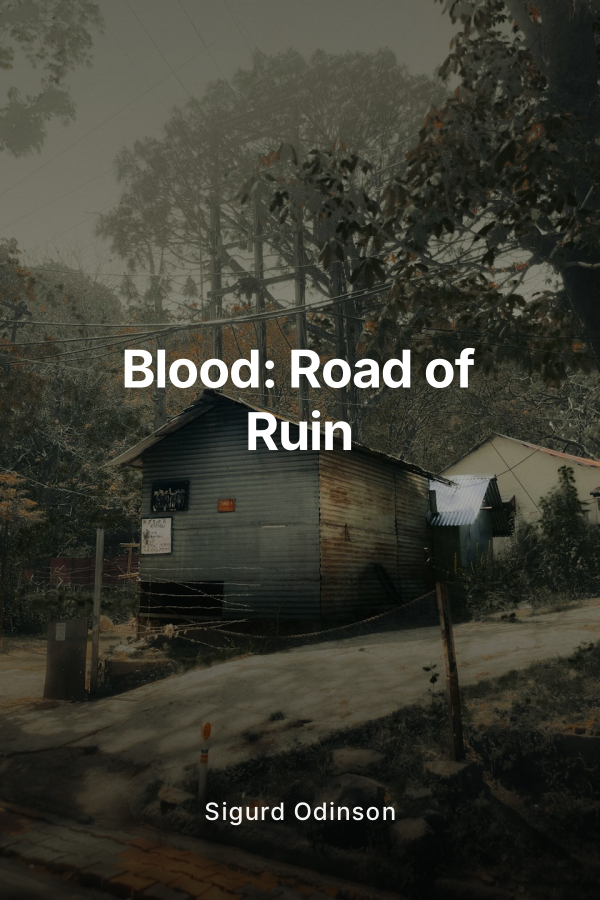
Daniel Sato leaves behind the wreckage of a vanished life and walks into the dust of a broken nation, carrying grief like a second spine and a power as dangerous as it is intimate. In a post-apocalyptic America of ruined cities, desert highways, fortified settlements, and lawless zones, he is not a hero in the traditional sense. He is a survivor. He is a son of doctors who fled civil strife in Seattle for the promise of Montana, only to be erased by disease, leaving Daniel to outlive his family and bury even the last anchor of his childhood: the grandfather who died of old age. With nowhere left to belong, he heads east in search of a better life, and instead finds a world where the roads belong to the cruel, the strong, and the fast.
Traveling alone through empty highways, Daniel moves through a landscape stripped of comfort and certainty. The world around him is a warning in itself: abandoned cars rotting under sun-bleached signs, dead silence broken by distant engines, smoke hanging above the horizon, and towns that look more like wounds than places to live. His life becomes a fragile balance between movement and memory. In quieter moments, he remembers Montana, his family’s brief hope of safety, and the tragedy that took everything from him. But the road never lets him stay in memory for long. The farther he travels, the more the ruin of civilization presses in, until even the act of surviving begins to feel like a confrontation.
Daniel’s blood manipulation makes him both formidable and constrained. He can shape and weaponize only his own blood unless it comes into contact with another person’s, which gives his power a terrifying intimacy and a brutal edge in close combat. He cannot dominate from afar or rely on overwhelming spectacle. Instead, he fights up close, where every strike matters and every wound carries consequence. His blood can be used for minor healing, giving him just enough resilience to keep going after damage that would break lesser men. But this gift is never free. His power is tied to pain, injury, and endurance, and every use of it deepens the sense that survival itself is a cost he must keep paying.
The first great turn in his story comes at the outskirts of Kansas City, where he stumbles into a world already under siege. There he meets two of the most important pieces of his found family. One is a sarcastic fourteen-year-old blonde boy with the metahuman ability to instantly switch the positions of two objects, a street-smart leader of the Lost Boys, a group of young survivors trying to outwit the world that failed them. The other is a goth girl obsessed with pre-apocalypse fashion artifacts, a dreamer who becomes infatuated with Daniel and decides, with total conviction, that he is some kind of vampire or blood-born variation of one. Their presence gives Daniel something he has not had in a long time: people worth protecting, and people who begin, almost immediately, to protect him in return.
Kansas City also becomes the story’s first brutal demonstration of the world’s true power structure. The city is raided and occupied by the Nomads, a biker faction that has established itself through numbers, brutality, and control of the roads. They are not merely criminals. They are a mobile regime of violence, taking what they want and enforcing their rule through fear. Their leader, Snakeskin, is a colossal metahuman whose bulletproof, snakelike skin and immense strength make him a terrifying figure even before his cruelty is fully understood. He is ruthless, dominant, and built like a war machine. Under him, the Nomads become the shape of the new wilderness: organized predation, moving from settlement to settlement, claiming the open highway as their kingdom.
Daniel’s life collides with the Nomads not because he seeks revenge, but because survival and loyalty force him into conflict. He is drawn into their orbit through the need to protect his friends and the accidental, dangerous momentum of the road. What begins as a desperate struggle becomes a battle of identity. Daniel is pushed toward leadership not by ambition, but by necessity. He becomes the kind of man who stands when others would break, and in doing so he defeats the Nomads’ leader in a way that is as ugly and one-sided as the world itself. The fight against Snakeskin is not glorious. It is a beating, a test of endurance in which Daniel is battered, broken, and nearly overwhelmed. He suffers broken bones and serious injury, and his victory comes only through a grim, desperate act of blood and precision. When his blood gets into Snakeskin’s eye, it travels behind the eyeball and into the brain, killing him from the inside. It is a victory that feels more like survival than triumph.
With Snakeskin dead, Daniel inherits more than a biker gang. He inherits the consequences of power. The Nomads do not simply vanish when their leader falls. They become a force that can be reshaped, redirected, or destroyed. Daniel brings in the Lost Boys, folding them into the future he is trying to build, and the group sets its eyes on the badlands, where the remnants of natural gas fields and forgotten cities promise the possibility of raids, supplies, and movement into a larger world. Their new direction is less about conquest than momentum. They are not trying to save America. They are trying to survive long enough to matter inside it.
At the center of the story is a mixed ending that feels both like a reward and a warning. Daniel gains a found family, a fragile future, and the beginnings of leadership, but his body is broken and his victories have not made the road kinder. The world beyond them is still widening, still darkening, still full of new enemies waiting beyond the last fight. That is the final note of Blood: Road of Ruin. It is not the story of a man who conquers the apocalypse. It is the story of a man who survives it long enough to become responsible for others, only to discover that responsibility is its own kind of battle. In the wreckage of America, Daniel Sato does not find peace. He finds purpose, and with it, a road that stretches farther than he ever wanted, and farther than he can yet see.