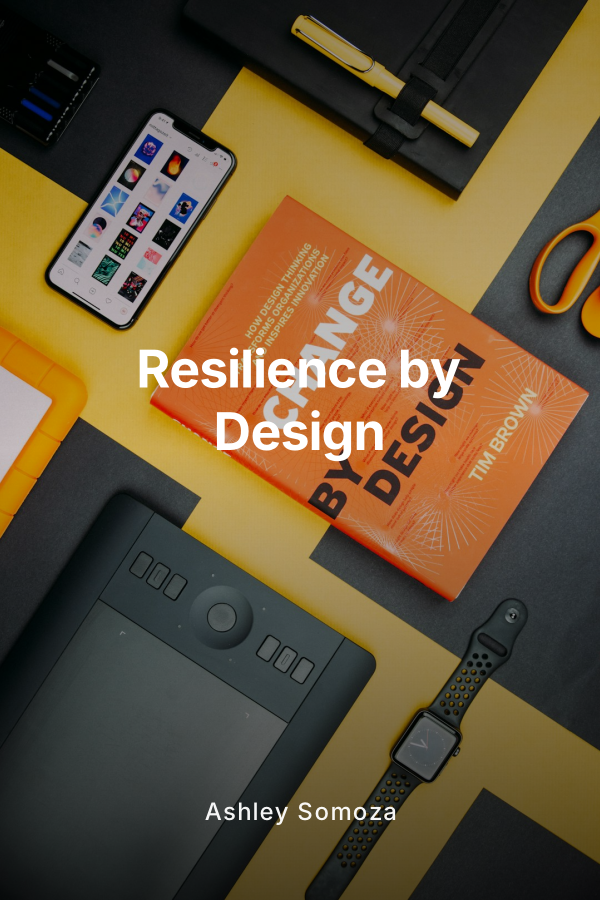
Resilience by Design positions resilience as a strategic leadership responsibility, not an individual character trait or a technical checklist. Drawing on more than two decades of experience advising global corporations, public agencies, and international institutions, Ashley Somoza reframes resilience as something leaders intentionally architect through their values, decisions, and systems long before a visible crisis appears .
The book speaks to senior leaders who feel the weight of responsibility, the drag of accumulated crises, and the subtle constraints of their own past success. It acknowledges how years of leading under pressure can leave difficult-to-name scars that influence how boldly they move, what they risk, and how they respond when stakes are high . Rather than celebrating heroic endurance, Somoza calls leaders back to stewardship, integrity, and clarity. She invites them to set down the quiet burdens they have carried alone and to examine how inherited structures, unexamined decisions, and normalized pressures have shaped their leadership and their organizations.
Across the book, resilience is treated as a design problem: a matter of how systems, teams, and choices are configured to anticipate, absorb, and adapt to disruption. Somoza blends research, real world case examples, and guided reflection to show that outcomes in crisis are rarely accidental. They emerge from patterns of decision making, incentives, culture, and infrastructure that leaders either allowed or intentionally built over time .
Resilience by Design gives leaders a language and a toolkit to move beyond reactive fixes and performative preparedness. It emphasizes three intertwined domains:
- The inner architecture of the leader, including moral courage, ethical clarity, and the ability to metabolize past failures and disappointments into sharper vision rather than hardened defensiveness.
- The design of organizational systems, from risk and operations to governance and culture, so that performance, safety, and human impact are held in deliberate tension rather than traded off unconsciously .
- The broader ecosystem of partners, regulators, and communities in which organizations operate, highlighting the mutual dependencies that determine whether disruption becomes catastrophe or catalyst.
Throughout the book, Somoza challenges common myths of resilience, particularly the idea that strength is defined by relentless endurance or lone heroism. She argues instead for resilience as shared stewardship: the disciplined practice of designing for transparency, accountability, and humane decision making even when it is inconvenient or costly. Leaders are guided to interrogate which pressures in their environment are unavoidable and which are artifacts of outdated assumptions, narrow metrics, or inherited expectations that no longer serve their mission.
Practical features are woven into each section. Leaders encounter probing questions that surface the invisible rules and habits governing their choices, along with structured prompts to trace how a single decision travels through systems and impacts people at the front line . Action steps translate reflection into tangible moves, from redesigning escalation pathways and decision rights to recalibrating incentives so that speaking up, pausing, or redesigning is rewarded rather than penalized.
Without being explicitly devotional in tone, the book remains grounded in a strong moral compass and ethical conviction. Somoza’s own orientation toward stewardship and responsibility shapes the way she frames every concept, asking leaders to consider not just what works, but what is right, sustainable, and aligned with the kind of legacy they intend to leave . Resilience is treated as both a strategic asset and a matter of conscience.
By the final pages, readers are invited to reclaim a sense of agency. Resilience by Design shows that peace, strength, and strategic clarity are not lost to the chaos of modern leadership. They can be rebuilt, piece by piece, as leaders redesign how they think, what they prioritize, and how their systems function under stress. Rather than accepting disruption as an endless cycle of firefighting, senior leaders emerge with a blueprint for building organizations that can face uncertainty with courage, adapt with humility, and keep people at the center of every critical decision.