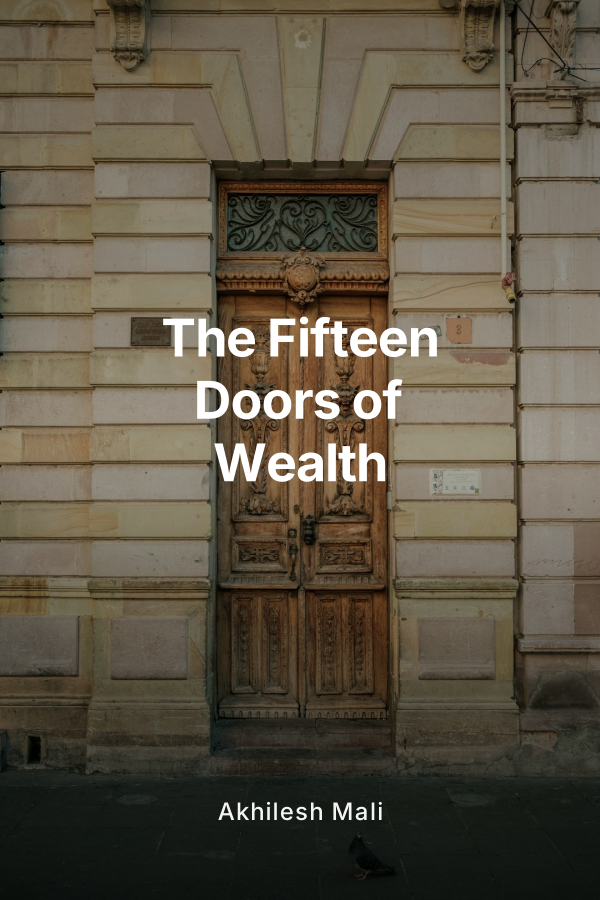
This book is a blunt invitation to cross an invisible line in your life. It starts with an uncomfortable truth: most people will work hard for decades and never touch the richest experiences this planet quietly reserves for the few who solve money early. The aim of this book is not to glorify the rich for their toys, but to expose what wealth really buys: time, safety, options, and the power to design several different lives inside a single lifetime.
Inspired by the provocative idea that “the gap is not money, the gap is options,” the book takes you behind fifteen doors of experience that poverty almost always keeps shut: retiring your parents with a single decision, waking up in a home that is fully paid for, saving a loved one’s life with one phone call and a check, stepping inside the private world of artists, experts, and leaders, and even choosing to reinvent who you are every decade because money is no longer the prison guard of your identity.
Rather than staying as a list of fantasies, the book turns these visions into a serious challenge. Each of the five chapters reframes wealth from a distant dream into a concrete, strategic project that can be solved in about a decade if you are bold, disciplined, and willing to think like an owner instead of an employee. The target reader is not the already wealthy. It is the hungry, the underpaid, the ambitious outsider who suspects there is a parallel world behind the velvet rope and is ready to do whatever it ethically takes to get in.
Chapter 1: The Hidden Cost of Staying Broke
The opening chapter confronts the reader with the idea that staying poor does not just mean fewer possessions. It means never buying your parents a home and watching them work until their bodies fail. It means mornings polluted by anxiety about rent and bills, instead of quiet, spacious starts in a home that is fully yours. It means that when a parent or child gets seriously ill, you rely only on whatever the public system can offer, rather than calling the best specialists on earth and giving them a blank check to save someone you love. The chapter paints these contrasting mornings, phone calls, and family scenes in vivid detail not to shame the reader but to create an emotional jolt strong enough to cut through apathy.
Here, the central thesis is introduced: money is not about status symbols, it is about control over the moments that actually matter. The book argues that true poverty is the inability to change outcomes that break your heart, even when solutions exist, simply because you do not have the resources. This chapter establishes the moral urgency of getting rich: it is not selfish to want money, it is selfish not to, if you could use it to reduce suffering for the people you love and the community around you.
Chapter 2: The Parallel World of the Rich
This chapter pulls back the curtain on the “parallel world” that wealth quietly unlocks. It describes how rich life is less about Bentleys and more about back rooms, green rooms, and quiet privileges that never show on social media. You are no longer the fan in the crowd, you are laughing with the artist backstage. You are not the guest hoping for a room upgrade, you are taking a private elevator to a presidential suite that is larger than the house you grew up in, watching your family run around in disbelief. You are not helpless in your struggles, because you can hire the very best coaches, advisors, and problem solvers alive to focus exclusively on your challenges.
Through stories and composite portraits, the chapter shows how money silently changes the answer from “no” to “maybe,” and often to “yes.” Sold out flights become flexible journeys. Closed doors become negotiations. Bureaucratic barriers become solvable inconveniences. The point is not that money makes you better than others, but that it places you inside a different game that most people do not even know exists. Once you see that this world is real and populated by individuals who were not born special, only disciplined and strategic, your sense of what is possible begins to shift.
Chapter 3: Buying Back Your Life
Here the tone turns practical and philosophical. The chapter asks a simple question: if you solved money, what would your days actually look like? It explores what it means to wake up in a home you own outright, with no bills in the back of your mind, no landlord, no threat of eviction. You exercise because you want to feel strong, not to escape stress. Food is prepared by others to nourish you, not rushed together in a panic between shifts. You are not begging an employer for vacation days. You never again fear getting fired because you no longer need anyone’s permission to exist. You own the business. You own your mornings, your calendar, and your energy.
From there, the chapter expands into the psychology of time. When you are broke, you are always in a rush, sprinting between emergencies you did not choose. When you are wealthy, urgency becomes rare. The most luxurious asset in your life is slowness. You can sit with your child over lunch in the middle of a Wednesday. You can say no to toxic people and walk away from deals, jobs, or relationships that insult your values, because you have options and reserves. The chapter presents this not as fantasy, but as the natural byproduct of building a significant financial buffer and structuring life around ownership rather than wages.
Chapter 4: From One Life to Many
This chapter introduces one of the book’s boldest ideas: solve money once, and you can live several distinct lives in one lifetime. Most people spend forty years accumulating just enough to survive, which means they lock into a single identity, a single career, and a single script. The text argues that if you engineer your finances with intention and aggressiveness, you can compress this process into roughly ten focused years. Once your baseline is secured, every decade becomes a new chapter where you can choose completely different expressions of who you want to be.
The narrative explores hypothetical “second lives”: the entrepreneur who becomes a painter, the programmer who turns sailor, the manager who spends a decade building schools, the investor who retreats to a quiet mountain town to write. Money does not buy character, purpose, or talent, but it removes the constant pressure to monetize every curiosity. The chapter challenges the reader to imagine themselves not as a fixed role forever, but as a series of evolving identities, each funded by the freedom that financial independence can create. This vision of “multiple lives” becomes one of the book’s central motivators for aggressively pursuing wealth: not for a bigger version of your current life, but for completely different ones.
Chapter 5: Crossing the Line
The final chapter turns the book into a call to action. It insists that choosing a side is no longer optional. Either you accept a life of permanent limitation, or you decide, here and now, that you are going to learn the language of resources and step into the resourced world. The reader is guided through the mindset shift from passive consumer to active architect of wealth: from “I hope I get a raise” to “I will own assets,” from “It is unfair” to “The game is rigged, so I will learn the rules and win anyway.”
Although this summary does not yet unpack specific tactics, it establishes the strategic direction the full book will follow. You will learn how to use a decade to move from surviving to abundance, how to transition from employee thinking to owner thinking, how to build cash reserves that turn crises into opportunities, and how to transform your desire to help your parents, your partner, your future children, and your community into a concrete wealth plan. The chapter closes by reminding you that the richest experiences on that list of fifteen are not reserved for the chosen few. They are reserved for those who take responsibility for becoming resourced enough to unlock them.
Taken together, “The Fifteen Doors of Wealth” is not a worship song to money. It is a manifesto for freedom. It shows you the real cost of staying broke, the invisible world that opens when you are not, and the profound responsibility that comes with entering it. If the goal is freedom, then this book is your blueprint for walking from the side that only dreams about it to the side that lives it, designs it, and shares it.