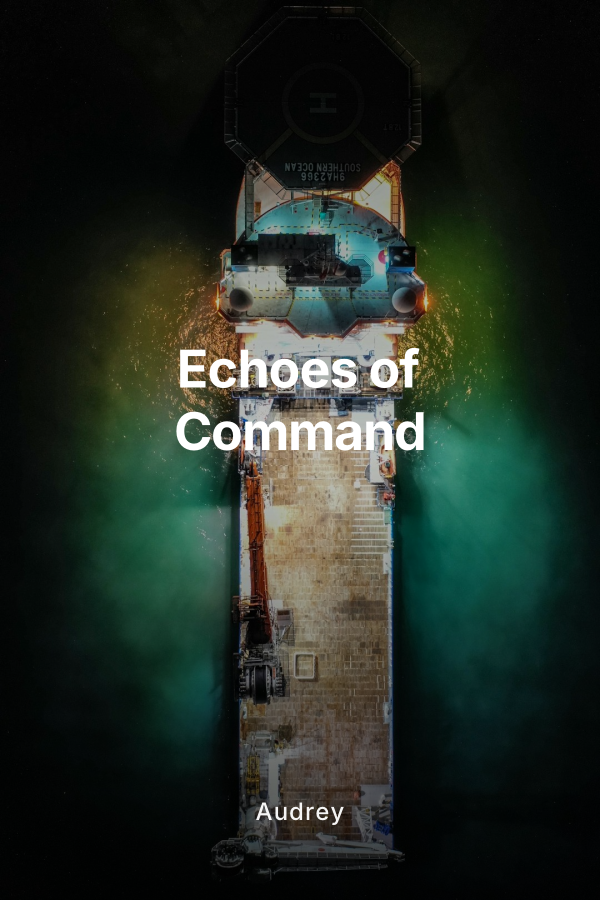
“Echoes of Command” continues the story of Audrey Yan after the destruction of the tablet and the fall of the admiral who tried to claim it, shifting the battlefield from alien ruins and impossible artifacts to courtrooms, councils, and the bruised interior of Starfleet itself. Where “Shards of Command” followed a teenage lieutenant commander racing alone to stop a weapon that could rewrite reality, the second volume asks what happens after you win a fight that should never have existed in the first place. The tablet is dust. The admiral’s crimes stand exposed. Yet the Federation Audrey fought to protect is now forced to confront the fact that a decorated flag officer nearly seized absolute power while an entire crew helped him hunt the one person who tried to stop him.
At the opening of this new book, Audrey has returned to the Enterprise with her rank intact and her body marked by the scars of channeling the tablet’s energy through herself. Picard and the senior staff have publicly acknowledged that they misjudged her, and the bridge has become a place where her voice is finally heard instead of tolerated. Yet the resolution that felt quietly hopeful at the end of the first volume proves to be only the beginning of a far more complicated reckoning. Starfleet cannot simply write a classified report that says a teenager saved the galaxy by destroying a weapon their own admiral tried to steal. Governments, allies, and enemies all want answers. So does Audrey, who now has to live in the space between vindication and lingering doubt, respected on paper but still watched in corridors where whispers have not yet caught up with the truth.
The central conflict of “Echoes of Command” unfolds on three entwined fronts. The first is political. An emergency Federation inquiry convenes to investigate how the admiral manipulated systems, falsified orders, and used the Enterprise as cover for his private quest for power. What begins as a narrow tribunal focused on one man widens into an examination of the culture that enabled him. Captains who never questioned his sealed directives, intelligence officers who accepted convenient gaps in the record, and counselors who labeled Audrey’s suspicions as trauma responses all find themselves under harsh scrutiny. The hearings expose the uncomfortable reality that the Federation’s faith in its own ideals became a blind spot large enough to hide a coup.
Audrey is summoned as both victim and alleged accomplice. She sabotaged Starfleet systems, stole a shuttle, violated orders, and disappeared with classified artifacts before anyone knew the full extent of the admiral’s plot. During the hunt, she became the face of “rogue officer” for the fleet. Now that narrative has cracked, but it has not vanished. Senators and captains demand to know whether Starfleet can afford to tolerate someone who will defy direct orders whenever she believes she is right. The tribunal scenes combine legal maneuvering with raw emotion as Audrey is forced to relive operations that nearly killed her in order to justify choices she made at sixteen in the dark with no support. Evidence uncovered by Data and others during the first book shifts from quiet background detail to the fulcrum of her defense, as telemetry and altered logs make clear that she was the one person in the mission who consistently chose protection of life over strategic advantage.
The second front is personal and psychological. Destroying the tablet did not erase Audrey’s history with the Borg or the Romulan lab that rebuilt her, it layered a new trauma on top of the old. The attempt to invert the artifact’s power left her with chronic pain, sensory glitches, and intermittent echoes of the tablet’s geometry humming behind her eyes, as if some fragment of its impossible mathematics refuses to let go. These symptoms threaten to be used against her in the tribunal as proof that she is unstable. At the same time, they force her to confront a frightening question: if the tablet is gone, why does its pattern still live in her nervous system?
Counseling sessions with Troi become a crucible rather than a quiet side note. For years, Audrey treated therapy as another obligation imposed from above, something she endured with jokes and minimal honesty. In this volume, she finally begins to unpack the overlapping layers of being assimilated, de-assimilated, weaponized, distrusted, and then hailed as a savior after almost dying. The book lingers in small but piercing moments: Audrey freezing at the sound of synchronized footsteps in a corridor that recalls the Borg; her flinch when a well meaning officer reaches for her without warning; the first time she allows herself to admit that she does not know who she is without a crisis to solve. Her healing is not a straight line. Some days she leans into the crew that finally believes in her. Others she snaps, pulls away, and seriously considers leaving Starfleet before it can break her again.
The third front is external and existential. Power never disappears without consequences. The shockwaves from the tablet’s destruction begin to ripple through the quadrant in ways no one anticipated. In deep space, long range probes start returning distorted readings from a region of subspace once believed inert. Temporal anomalies flicker like bruises where the tablet’s influence once would have anchored alternate outcomes. Quietly at first, then with growing urgency, ships and stations report dreams shared across crews: flashes of realities that almost were, timelines where the admiral succeeded, where Audrey claimed the tablet for herself, where the Borg learned to fold its equations into their collective will.
Into this instability steps Q, amused and annoyed in equal measure. In “Shards of Command,” his intervention took the form of a twisted trial that ultimately nudged Audrey toward destroying the artifact instead of claiming it. Now he appears again, needling her about the mess left behind. He insists that reality remembers every path it could have taken, and that ripping away a focal point as powerful as the assembled tablet has left the universe slightly off balance. Normally, he might let that imbalance play out as a cosmic joke. Here, however, Q claims that something old and opportunistic is stirring in the wake of the tablet’s erasure, a presence that once fed on imposed order and now prowls the fractures between timelines in search of a new anchor.
Audrey does not trust Q, but she cannot ignore the evidence of her own senses. The lingering geometric afterimages in her vision begin to line up with the anomalies Starfleet is mapping at the edge of known space. Wherever she goes, the unstable regions react, stabilizing or flaring depending on her choices. Scientists on Earth whisper that she may be carrying a kind of “after pattern” of the tablet in her mind and body, not power in the traditional sense but a key to how causality is fraying. The Federation Council wants to put her in a lab. Enemies who catch rumors of what she did with the tablet see an opportunity to capture a living weapon. Picard and the Enterprise crew find themselves fighting on two fronts: defending Audrey’s right to be a person rather than an object of study, and racing to contain phenomena that could shatter navigation, communication, and diplomacy across the quadrant.
As the story unfolds, Ensign Li steps into a more defined role as Audrey’s partner and counterweight. Where Audrey’s instincts drive her to sprint into the heart of danger alone, Li has begun to learn how to translate those instincts into plans that others can follow. Their bond, forged under accusations of betrayal and shared near capture in the first book, deepens into a wary but fierce loyalty that bends the usual gulf between ranks. Tension remains: Audrey still hates being protected, and Li refuses to stand aside while the officer who saved her life burns herself out cleaning up messes she did not create. Their arguments about risk and responsibility become one of the book’s emotional engines, exposing the difference between survival habits and genuine strategy.
The middle of “Echoes of Command” braids these threads together in a mission that feels at first like a straightforward survey and quickly devolves into a crisis of identity for the Federation itself. Sent to chart a widening subspace scar linked to the tablet’s destruction, the Enterprise encounters a flotilla of ships bearing Federation transponder codes from no recognizable registry. Their captains claim to serve the same ideals as Picard, but they remember a different history, one in which the admiral succeeded, the tablet was used as a deterrent against every major power, and Audrey Yan died as a failed experiment years earlier. The scar in space is not just a physical wound, it is a point where two incompatible versions of the Federation brush against each other.
Faced with living proof of the future she refused, Audrey must watch people who look like her colleagues argue that their authoritarian peace is worth a few crushed timelines. The diplomatic standoff that follows is part starship standoff, part ethical debate. Both sides carry the same emblem and quote the same founding principles. Both insist they are trying to prevent greater suffering. Only one is willing to erase entire realities to maintain control. The encounter forces the Enterprise crew to confront how thin the line is between their Federation and a version that quietly accepted the admiral’s logic. It also proves Q’s point: destroying the tablet did not erase the paths it opened, it only left them unanchored and dangerous.
The climax brings all three fronts to a head. Political pressure from the tribunal demands a neat resolution. The anomalies threaten to tear navigation routes and colonies out of phase. The alternate Federation moves to secure Audrey as a strategic asset, arguing that since her choices destabilized reality, she has a duty to help them “fix” it by whatever means necessary. In a sequence that echoes but pointedly diverges from the first volume’s finale, Audrey is given a brutal set of options. She can surrender to being studied and deployed as a living key, trusting institutions that have already failed her. She can run, risking the spread of anomalies and leaving others to deal with the fallout of her victory. Or she can once again choose a path that satisfies neither side, sacrificing the possibility of easy solutions in favor of preserving messy, ungoverned freedom.
With the Enterprise caught between fire from the alternate fleet and pressure from her own government, Audrey uses the residue of the tablet’s pattern inside her mind to sever the link between realities entirely. The maneuver is precise and personal rather than spectacular. She does not seize control of causality, she loosens her own connection to the paths where she ever touched the tablet at all. In doing so, she closes the scar but also surrenders the strange, involuntary influence she held over unstable regions of space. Physically, the act leaves her even more fragile than before, her nervous system forced to adapt to one last rewrite. Ethically, it cements her stance: she would rather live in a universe where no one can use her as a bridge to power than maintain any special status that might tempt others to treat her as a tool again.
The aftermath mirrors and expands on the quiet resolution of “Shards of Command.” The tribunal cannot neatly classify what Audrey has done. She disobeyed in order to save lives, destabilized reality in order to preserve free will, and then gave up the only leverage that might have protected her from future exploitation. Some call her reckless. Others call her the conscience Starfleet did not know it needed. In a final hearing, Picard refuses to let the council bury her actions under layers of classified language. He insists that if the Federation wants to remain itself, it must acknowledge not only its triumphs but its failures, including the way it treated a young officer who saw danger before anyone else did.
Audrey, for her part, begins to define a future that is not built entirely around crisis response. She remains on the Enterprise by choice, not inertia, beginning to mentor younger officers who remind her of who she was before the Borg, before the Romulans, before the admiral and the tablet. Her relationship with Ensign Li evolves into a partnership that models dissent as a form of loyalty rather than defiance. The TNG crew, once the instruments of a witch hunt against her, now invite her voice when policy decisions loom, understanding that the same instincts that made her hard to manage also make her invaluable when the stakes are highest.
“Echoes of Command” is written for readers who loved the tense, morally intricate journey of “Shards of Command” and want to see what comes after the apparent victory. It trades the thrill of chasing a single weapon for the slower burn of reckoning with the systems that made that weapon desirable in the first place. By weaving tribunal drama, cosmic anomalies, and intimate character work with a mostly canon TNG ensemble, the novel deepens the series’ central question: what does it mean to serve an ideal when the institution that carries that ideal keeps proving itself fallible?
At its core, the second volume is the story of a young woman who refuses to let survival turn into cynicism. Audrey Yan has every reason to walk away from Starfleet, every reason to distrust anyone in a uniform. Instead, she chooses the harder path of staying and insisting that the future live up to its promises. Even when the universe itself shudders with the memory of power she destroyed, she holds to the same line that guided her before. No one, not an admiral, not a council, not even she herself, has the right to rewrite other people’s lives for their own version of the greater good.