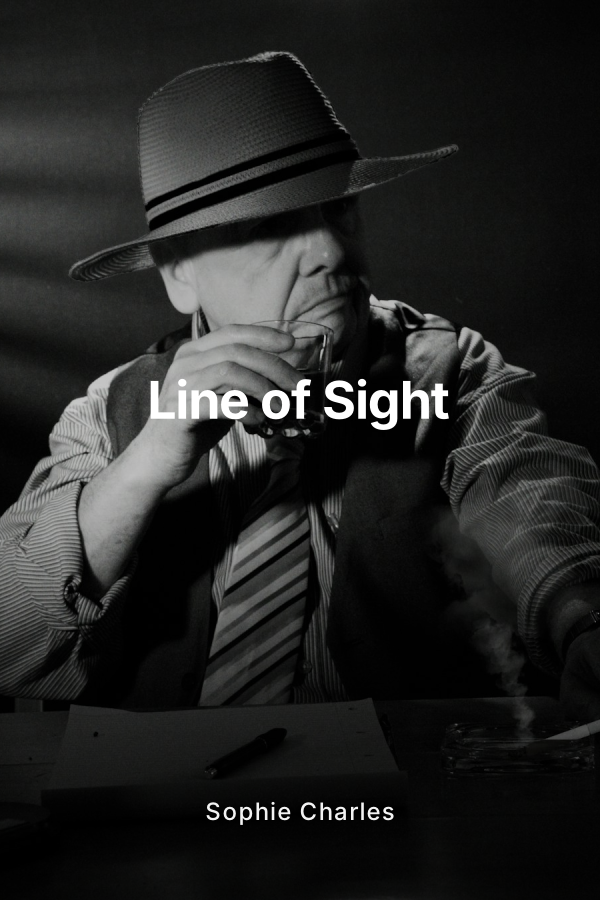
Tess Brennan works homicide in New York. Tough, witty, and allergic to emotional entanglements, she keeps people at arm’s length and buries herself in the job. When a series of precision sniper killings hits the city, it looks like a dream come true for headline writers and a nightmare for the NYPD. Drug dealers, murderers, and known harassers are dropping one by one, each hit executed from long range with military level skill. The city whispers about a ghost on the rooftops cleaning up the streets.
Tess sees something uglier. Someone has appointed himself executioner and is rewriting the rules in blood. There is nothing she despises more than people who think they stand above the law. She is assigned to lead the task force, but there is one problem. She knows absolutely nothing about snipers.
Enter Jake Trilling, a quiet, unnervingly calm young sniper brought in as the in house expert. He is fit, tanned, with ruffled blond hair and pale blue eyes that miss nothing. On paper he is the perfect asset. In person he is the exact kind of partner Tess hates. Reserved. Controlled. Refusing to fill silences with nervous chatter. Where she fires off sarcastic one liners to keep the world at bay, Jake answers with clipped words and the occasional dry remark that lands sharper than a bullet.
From the first crime scene, the tension between them is thick. Tess stomps around in tank top, cargo pants, and scuffed army boots, reading the victim’s dirty history from the file with open disgust. Jake stands at the window line in fitted shirt and slacks, reconstructing firing angles and wind drift like he is back on a range. They clash over everything from tactics to ethics. Tess wants to hunt a murderer. Jake refuses to ignore the fact that someone is targeting people the courts failed to cage.
The pattern escalates. A dealer with a history of walking on technicalities. A domestic abuser whose case collapsed. A predator who stalked women in subway stations. Each kill is surgical. No collateral damage. No witnesses. Every scene whispers the same message. This is punishment, not chaos. The shooter is working from some private moral code, cleansing the city one shot at a time.
As pressure mounts from the brass and the media, something about Jake starts to gnaw at Tess. He slips away at odd hours. Vanishes from the squad room with vague explanations, just before another body hits the pavement. His records are clean, his service immaculate, but he has no solid alibis for the times that matter most. Tess has spent her career trusting what she can prove and nothing else. Now her instincts turn on the one person she is supposed to rely on.
The investigation forces Tess into a world she does not understand. Ballistics charts, sniper nests, unfamiliar jargon. She hates depending on Jake’s expertise, hates how he can see things she cannot. Every time she starts to adapt to his closed off presence, another unexplained absence pulls the ground away again. She starts digging into his past, quietly cross checking his movements, interrogating his colleagues in the department’s sniper pool.
Her questions lead her to James, an experienced marksman on the force, who presents as cooperative, professional, even a little nervous under her hard stare. She grills him relentlessly, looking for cracks. She gets nothing that sticks. James’s partner, Dave, barely registers on her radar, a background note in someone else’s file. She does not bother to bring him in. The omission will haunt her later.
Meanwhile, the sniper continues. Each kill is bolder, closer to crowded streets, timed to provoke panic but still executed with chilling precision. The city grows more divided. Some citizens hail the unseen shooter as a necessary evil. Others call him a monster. Tess faces reporters who ask on camera if the NYPD is doing enough to stop a killer who is only hitting people “who deserve it.” The unspoken accusation is clear. Maybe the cops are dragging their feet because deep down they approve.
Inside the department, suspicion spreads in quieter tones. A shooter this good must have training. Maybe military. Maybe law enforcement. Rumors swirl around Jake. Tess hears them in break rooms and hallways. She watches him endure the whispers with grim, silent patience, never defending himself, never lashing out. His refusal to fight back only makes her more uneasy.
Their working relationship becomes a tightrope. In the field, they rely on each other with dangerous intimacy. Jake stands behind her at potential nests, guiding her line of sight with gentle, firm instructions. Tess leans on his knowledge to interpret every scrape on a ledge, every mark in a stairwell. Back at the station, she pulls away, closing doors to make secret calls, chasing leads that circle back toward him. Banter turns sharp. Her jokes sting. His rare one liners grow colder.
The case that was “just another job” mutates into something personal when she realizes the only way to move forward is to accuse Jake, at least in her own mind. Her distrust, a shield that once kept her safe, now threatens to sabotage the hunt for the real killer.
When another vigilante hit goes wrong and an innocent bystander is wounded, public opinion turns. The romanticized idea of a righteous ghost crumbles. The killer is not a controlled surgeon anymore. He is slipping. Or getting bolder. Either way, the fallibility makes him more dangerous. For Tess, it finally seals the case. This is a murderer, nothing else. Jake’s technical admiration for the shooter’s skill cuts her the wrong way. It feels too close to respect.
Under rising internal pressure, Tess pushes harder. She rechecks ballistic reports, combs through timestamps, forces analysts to re run footage. A crack appears in her theory at the worst possible moment. At the scene of the latest shooting, a camera captures a shadow in a distant reflection. The posture does not match Jake’s build. The stance is wrong. The rifle platform suggests a different dominant hand than his. It is the first solid sign that whoever is pulling the trigger, it is not Jake.
The realization hits her like recoil. She has spent crucial days chasing the wrong ghost while a real one roams free. Her distrust has not only endangered the case. It has put Jake under a cloud that could destroy his career. Confronted with the evidence, she has a choice. Double down on suspicion, or admit she was wrong and shift her focus.
Tess, who never apologizes, quietly starts to change tack. She brings Jake deeper into the core of the investigation, this time as a true partner instead of a suspect in disguise. The move is awkward, but the job leaves no room for pride. Jake, burned but too professional to walk away, responds by opening up in careful increments. He shares insights he had been holding back, not from malice, but from a lifetime of being taught to keep his mind compartmentalized.
Together they re evaluate every prior assumption. Jake helps Tess map the killer’s vantage points on a citywide grid. The pattern reveals an unsettling familiarity with NYPD response times and blind zones. The shooter is not some random zealot. He knows the system from the inside. That takes them back to the sniper pool, back to James and the man Tess barely noticed, Dave.
A new lead suggests James’s shifts align suspiciously well with several shootings. The brass wants a fast answer and James is the neat solution. Tess and Jake set up a trap, placing James under subtle surveillance while leaking a fake schedule for prisoner transfers involving high profile offenders. If the vigilante is inside the department, he might not be able to resist.
The night of the operation, Tess and Jake sit in an unmarked car, watching the precinct, nerves coiled tight. Rain smears the city lights across the windshield. James walks past their position, expression drained, oblivious to the silent stakeout. Then everything slams into chaos. A shot rips through the air. Glass explodes. James goes down in a spray of blood, the red blooming across his shirt under the harsh streetlamp.
The supposed suspect has just become the latest victim. Their entire working theory collapses on impact. As sirens screech and uniforms scatter in panicked response, Tess’s mind races. Someone anticipated their move. Someone knew James was being used as bait. The shooter has been inside their circle deeper than anyone guessed.
In the shell shocked aftermath, Tess and Jake return to the precinct to deliver the news to James’s wife. It is a brutal, quiet scene that strips away their usual armor. Tess’s no nonsense exterior falters in the face of raw grief. Jake stands just behind her, steady but visibly shaken. When James’s wife, devastated and rambling, begs them not to forget to tell his friend Dave about what happened, the name slices through Tess like a spotlight.
Dave. The man she did not bother to interview. The colleague who moved through the background of everyone else’s statements. As she turns to the window, she spots him in the distance, running toward the lot. He is clutching a guitar case. The detail snaps into place with horrible clarity. The size. The shape. The perfect disguise for a broken down rifle.
In that instant Tess sees the whole pattern. The insider knowledge. The access. The way James’s schedule had fit the killings because Dave had built his own operations around his partner’s movements. Her failure to look at the quiet one, the overlooked one, is the blind spot the killer has driven through again and again.
She bolts for the stairs with Jake on her heels. The chase that follows tears through the bowels of the precinct and into the city night. Dave, desperate and cornered, abandons the pretense of the guitar case and pulls the weapon from its velvet prison. The final confrontation does not play out as a romantic sniper duel at extreme distance. It is messy, fast, brutal. Close quarters.
Dave fires from alleys and loading docks, using every structural advantage he has spent years memorizing. Tess and Jake move as a unit for the first time, covering each other, exchanging clipped, urgent banter that cuts through fear. Tess’s growth crystallizes here. Instead of pushing Jake away, instead of charging ahead alone, she chooses to trust him. She takes positions based on his calls, relies on his judgment of angles and cover, lets him drag her out of the path of a shot she does not see.
In the end it is a combination of Tess’s tenacity and Jake’s technical genius that breaks Dave. Tess corners him, using her understanding of his psychology as a self appointed cleanser of the city. She needles him, holds up his victims, forces him to look at the collateral harm, the innocent blood on his hands. While his focus fractures, Jake exploits the hesitation and neutralizes him in a tight, high risk exchange of fire that nearly costs him his life.
The case closes with Dave in custody and the myth of the righteous ghost shattered. The city returns to its regular level of violence and sin, which suddenly feels almost comforting in its predictability. On paper, the task force has succeeded. Off the record, Tess carries the weight of every mistake that almost let a murderer walk.
In the quiet afterward, her arc comes full circle. She acknowledges to Jake, in her own awkward, clipped style, that she was wrong about him. That her refusal to trust had not made her stronger, only more blind. Jake, bruised but alive, accepts the apology with a minimal nod and one dry, perfectly timed line that makes her laugh for the first time in weeks.
Their relationship settles into something solid and unspoken. Deep trust. Mutual respect. They still argue over tactics. Tess still fills lulls in conversation with biting humor. Jake still observes more than he speaks. But now the tension between them is no longer suspicion. It is a sharp, electric understanding that they are better together than apart.
“Line of Sight” tells a tight, fast paced story of a city held hostage by a sniper who believes he is saving it, and the two detectives forced to track him while learning that the most dangerous blind spots are the ones inside their own defenses. Gritty crime scenes, relentless momentum, and constant verbal sparring between a guarded homicide detective and a quiet, lethal sniper drive the narrative toward a final, claustrophobic shoot out where every choice counts and trust is the only thing that keeps them alive.