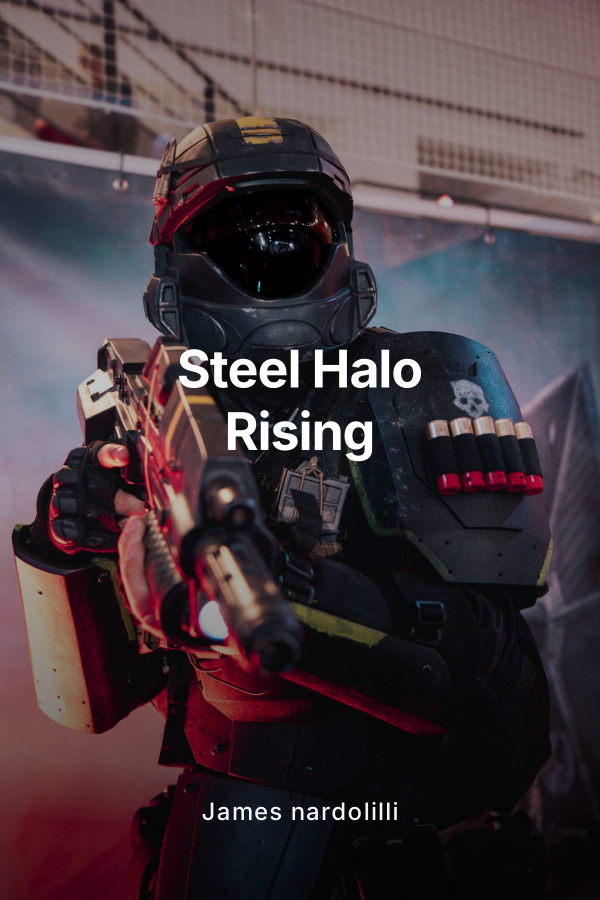
James Rouge dies as a lifetime real-time strategy veteran and British Navy SEAL, only to awaken in the world of Goddess of Victory: Nikke with something far more dangerous than luck, far more absurd than mercy, and far more useful than common sense: a Command and Conquer style system built on the full might of Halo UNSC technology. He is remade as a Spartan II in MJOLNIR MK VII, dropped onto the surface alone inside a Halo Wars style firebase, and left with one task that sounds simple only to people who have never had to rebuild civilization under fire: survive, secure the base, and turn an alien war zone into the foundation of a new world.
From the moment James boots up inside the firebase, the story locks into a sarcastic, battle-forward campaign of escalation. He is not underpowered, not scrambling for scraps, and not forced to improvise with medieval nonsense. Instead, the system gives him access to a terrifyingly advanced military machine, with Halo tech spanning from Combat Evolved to Infinite, and it is all stronger than the technology already present in his new world. That imbalance becomes the engine of the story. James does not merely endure the chaos. He dominates it. The firebase becomes a fortress, the battlefield becomes a testing ground, and the war against the Raptures becomes an exercise in how thoroughly one very dry, very British Spartan can embarrass an entire enemy species.
The early chapters focus on securing the base, locking down the perimeter, and turning survival into a logistical art form. James is alone, but never truly outmatched, because every step he takes reveals another layer of command capability. He establishes defenses, studies the surrounding terrain, and begins the brutal process of making the surface his own. His first great breakthrough is not a speech, a treaty, or a miracle. It is a vehicle. The Warthog becomes his symbol of momentum, and the first test drive is gloriously ridiculous. Rather than treating it with solemn reverence, James treats it like the ultimate expression of military disrespect, tearing across hostile ground with the sort of reckless confidence that only a Spartan in near-limitless hardware can afford. It is the beginning of his legend and also the first time the world realizes that this newcomer is not a survivor to be managed, but a force to be feared.
The Raptures, expecting either panic or retreat, instead encounter overwhelming force delivered with almost comic indifference. Their confusion only makes their downfall more efficient. James does not negotiate with them, does not hesitate, and does not give them the dignity of being considered a real contest. He crushes them, repeatedly and decisively, with weapons, armor, and battlefield awareness that leave the native powers of the world scrambling to understand what just arrived in their war. The tone stays sharp and witty throughout, with James’s dry sardonic humor cutting through every brutal engagement. His commentary turns slaughter into satire, and his confidence, while fully justified, is never presented without a knowing sense of absurdity.
As the firebase grows, so does the scale of the campaign. James’s goal is not mere conquest for its own sake. It is something more difficult and more ambitious: rebuilding civilization. The long war is framed not as a fantasy of domination alone, but as a systematic effort to replace collapse with order. Safe zones begin to form. Supply lines become possible. Infrastructure returns where there was only ruin. His advanced technology, once used only for war, becomes the backbone of a new civilization built under the protection of impossible firepower. In this new order, the Halo arsenal is not just a weapon set. It is a blueprint for the future.
The Nikkes enter the story as comic foils, wary at first, then increasingly impossible to ignore. They do not understand James, his technology, or his absurd calm in the middle of apocalypse-level events. Their reactions sharpen the humor, but they also become essential to the story’s emotional structure. Through them, James is forced to confront a world that has been surviving without anyone like him, and his relationship with them evolves from curious disruption into mutual reliance. He becomes a commander not because he demands obedience, but because his competence leaves no room for doubt. Around him, the story blends battlefield spectacle with the slow, stubborn work of building trust, territory, and hope.
Steel Halo Rising is a power fantasy with a purpose, a military adventure with a grin, and a world-rebuilding campaign led by a man who treats catastrophe like a strategic inconvenience. It follows James Rouge as he turns a lonely firebase into the seed of a civilization, a battlefield into a dominion, and an alien war into the opening chapter of a far larger human future.