Six years after the world collapsed beneath infection, gunfire, and the wet, choking sound of the dead rising in the streets, twenty-nine-year-old Elias Crowe survives alone in the rotting shell of Columbus, Ohio, carrying an M4 taken from the dead officer who once sacrificed himself to save a stranger during the first days of the outbreak. That stranger was Elias, and the memory of that act has become both his burden and the last proof he has that mercy once existed in the world. Hidden in his pack is a fading photograph of his sister Lena, last known to be alive in Atlanta before all communication vanished, and the desperate hope of finding her becomes the single fragile thread keeping him human
When Elias intercepts a rumor carried by frightened survivors moving through the ruins, he learns of a chain of fortified settlements stretching south, each one whispering the same impossible thing: a woman matching Lena’s description has been seen among the living. Forced out of the numb routine that has defined his existence, Elias begins a brutal journey across a country reduced to carrion silence, where every town has become a tomb and every mile tests the limits of hunger, grief, and trust. Along the way, he is drawn into the lives of other survivors who are just as broken as he is: a former paramedic who saves lives while losing faith in her own, a teenage brother and sister who have learned to kill before they learned to grieve, an ex-convict whose violence may be the only reason any of them stay alive, and a quiet child who has stopped speaking after witnessing something too terrible to name.
As Elias gathers these strangers around him, the road becomes more than a search. It becomes a reckoning. The dead are no longer the only threat. Militant enclaves prey on the weak under the language of order. Starving bands strip the bones from the world and call it survival. A fanatical settlement built around infection worship hides unspeakable rituals behind locked church doors. Worst of all, Elias begins to discover that some survivors are changing the rules of the horror itself, using the dead as shields, weapons, and warnings. Every new milestone on the road south costs blood. Every victory leaves someone buried, bitten, or morally ruined. The further Elias travels, the more he is forced to confront the possibility that surviving long enough to find Lena may mean becoming someone she would never recognize.
The emotional heart of the story deepens as Elias’s group hardens into a makeshift family. Bonds are formed in the dark over canned food, old stories, stitched wounds, and the terrible intimacy of depending on someone to keep watch while you sleep. Yet the closer they come to Atlanta, the more the past claws its way back. Elias is haunted by the officer’s sacrifice, by the people he could not save, and by the growing fear that his need to find Lena is no longer only love, but guilt sharpened into obsession. The novel’s most devastating power comes from this tension: in a world of torn flesh and collapsing cities, the deepest wound is not infection but attachment. Everyone Elias lets himself love becomes another way for the world to break him.
When Atlanta finally rises before them, it is not a destination but a nightmare made vast. The city has become a sprawling grave maze of quarantined zones, flooded highways, mass pyres, and high-rise strongholds where rival survivor factions war over medicine, ammunition, and rumors of a cure. Somewhere inside that hell Lena is alive, but reaching her means passing through the deadliest territory Elias has ever seen and uncovering the truth about what she has become in order to endure. She is not the lost girl frozen in the photograph. She is stronger, scarred, and bound to a community whose survival depends on secrets that could destroy everything Elias has fought to preserve. Their reunion is not simple relief. It is painful, overwhelming, and nearly unbearable, because love has survived, but innocence has not.
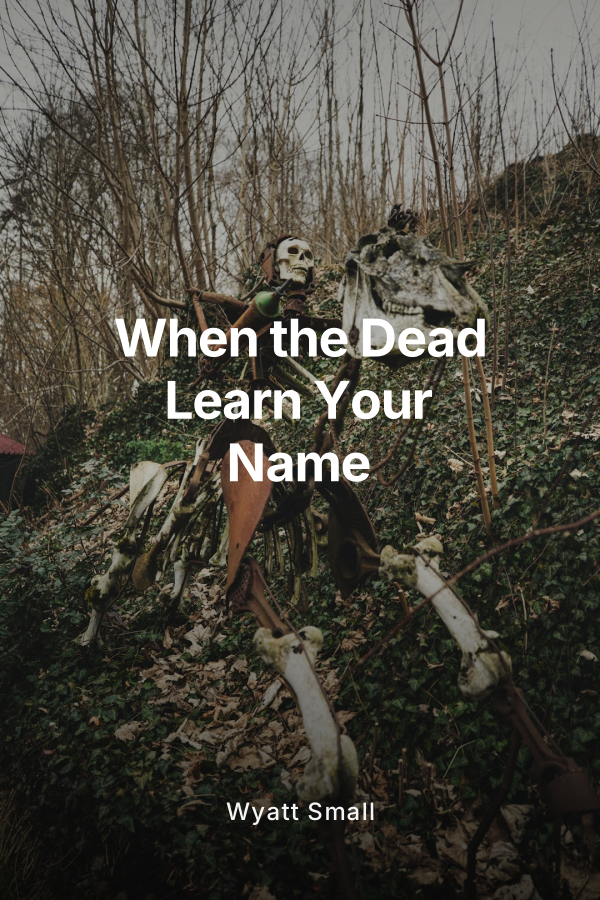
When the Dead Learn Your Name is a savage, deeply emotional horror epic about grief, loyalty, found family, and the cost of refusing to let hope die. Told through Elias’s intimate and relentless perspective, the book combines graphic survival, escalating threats, and heartbreaking human connection into a story designed to devastate as much as it terrifies. At its core, it is about one man crossing the ruins of America to save his sister, only to discover that the real battle is not just against the dead, but against the slow erosion of the soul. It promises a journey filled with unforgettable survivors, brutal milestones, impossible choices, and a final hard-won light that shines brightest because it rises from absolute darkness.