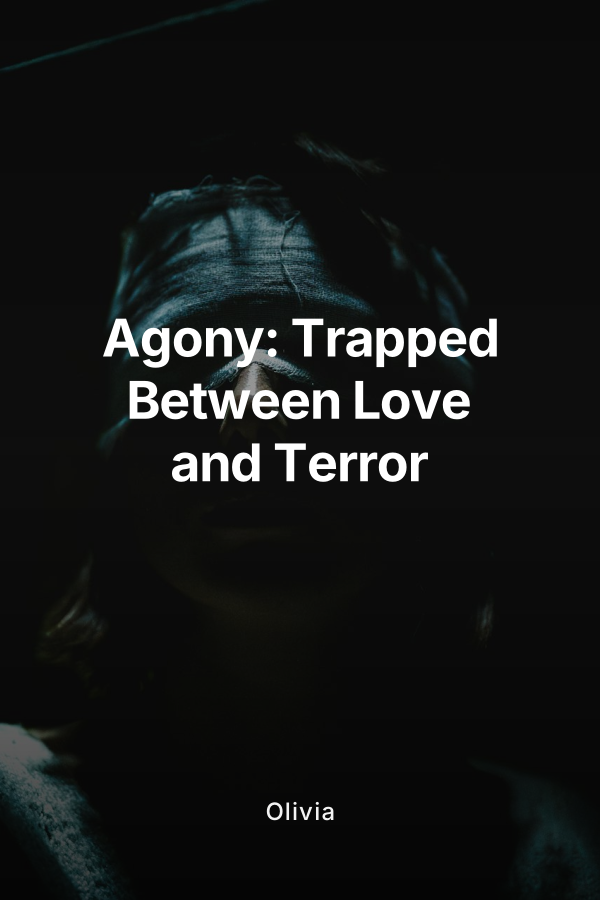
Ira wakes to the sound of her own scream.
Cold concrete at her back. A blank wall inches from her face. The taste of metal and fear in her mouth. She turns her head and realizes her left arm is gone. Blood seems to be everywhere. Then a laugh slides out of the dark. A girl’s voice. Sweet. Delighted. Wrong. Leah says Ira tried to run, tried to leave her, and this is what happens to people who abandon love. Leah promises she can make it all better. She can put Ira back together. She can make Ira love her. Forever.
But the blood is not blood. The wound is not what it seems. The horror is a game. A test. A trap.
Agony is a tight, two-chapter psychological thriller about captivity, obsession, and the thin line between a joke and cruelty. Every scene is a pressure cooker. Every page forces the reader to question what is real, who is lying, and how far a person can be pushed before something in them finally breaks.
At the center stand three girls tied together by a warped idea of love.
Ira wanted a quiet life. A part-time job, late-night calls with her best friend Emily, a vague sense that maybe the future could be something good. She never asked for a secret admirer. She never noticed when Leah started rearranging her life. Watching. Waiting. Learning what Ira feared and what she craved. The way Ira glowed when she talked about Emily. The way pain and affection sometimes blurred in Ira’s stories about her past.
Leah does not believe in ordinary romance. She believes in possession. To her, love is not a choice. It is an equation she can solve if she controls every variable. If she isolates Ira from friends. If she stages little accidents. If she becomes the only person who can hurt Ira enough to matter and comfort Ira enough to be needed.
Emily is the one person who sees the pattern. She notices the anonymous messages that sound too intimate. The gifts with no name. The way Ira starts to flinch at harmless noises. Emily has her own scars and her own capacity for violence, but she has drawn a single hard line. No one gets to break Ira again.
The story opens in Chapter One with the ordinary world starting to crack.
Ira and Emily live in a city that never really sleeps, a place of neon-lit corners and crowded trains. They joke to hide their anxiety. They move through days filled with small humiliations and little victories. At first, Leah is just a shadow at the edge of scenes. A quiet classmate. A coworker who knows too much. A username that appears whenever Ira is online.
Strange things start to happen. Ira comes home to find her belongings slightly rearranged. A photograph of Ira and Emily vanishes. Later, a new photo appears in Ira’s locker at work. Same shot. Same angle. Except Emily is missing from the frame, as if she had never stood beside Ira at all. A cheap prank, Ira tells herself. Nothing more.
Then the messages change. They move from awkward to invasive. Whoever is sending them mentions specific clothes Ira wore two days earlier. They describe the way Ira ran her fingers along the scar on her wrist during lunch. They talk about Emily as if Emily is a stain that needs to be scrubbed out of Ira’s life.
Ira tries to laugh it off. Emily does not laugh.
Emily starts tracing the digital fingerprints. She pushes Ira to report it, to take it seriously. They fight over it, because fear makes Ira defensive and shameful and angry. Their bond strains, even as danger tightens around them.
One night, after a brutal argument, Ira storms out alone.
She never makes it home.
Chapter One closes with a memory cut short. A hand over Ira’s mouth. A chemical sting in her lungs. A last glimpse of a face she thought she knew. The city keeps moving. Trains run on time. Emily dials Ira’s number again and again. No signal. No answer.
Chapter Two opens in the dark room.
Ira wakes with fragmented flashes of what came before. A party. A drink that tasted wrong. Leah’s face too close. Then blackness. Now she is strapped down, staring at a wall that reveals nothing. When she finally turns, she sees the empty space where her arm should be. The horror floods her. Her mind shatters into panic.
Leah steps out of the shadows like a lover stepping into a surprise date. She is all smiles. Soft, sing-song words. She tells Ira this could have been beautiful if Ira had not tried to run so many times. She calls Ira “my girl.” She speaks of devotion and fate and the way Ira will eventually understand. Her version of love is simple. If Ira will not come willingly, Leah will chain every part of her until submission looks like choice.
She plays with Ira’s perception. She adjusts straps, touches skin, brings a screen to Ira’s face. Images flicker across it - videos Leah has recorded, photographs of Ira sleeping, clips of Emily’s social media silently scrolling. Leah kisses the screen in front of Ira’s eyes, then leans in and kisses Ira’s forehead, testing for a reaction. Ira flushes from terror and humiliation, and Leah reads that as proof that her experiment is working.
When Ira demands to know where all the blood came from, Leah laughs and casually reveals the truth. It is not blood. It is cheap, sticky ketchup poured with theatrical flair. The missing arm was a trick of angles, restraints, and a drugged mind. Leah never needed to cut; she only needed Ira to believe she had. Because if Ira cannot trust her senses, Leah becomes the only reality left.
But Leah underestimates one thing.
Emily refuses to let Ira disappear.
While Leah toys with Ira, Emily is tearing the city open. She retraces the last hours before Ira vanished. She hacks, lies, and threatens her way into security footage. She recognizes Leah in the background of scenes she had ignored. A girl always just behind Ira. On the train platform. At the coffee shop. At the party. Always watching.
The trail leads to a forgotten building at the edge of the city. A place with boarded windows and a basement no one has legal access to. Emily goes in alone, armed with nothing but a cheap sword bought on impulse years ago and a promise she once made to Ira when they were both too young to understand what it meant to protect someone.
Inside, the timelines converge.
In the basement, Leah is spiraling. Ira keeps calling for Emily, even in the middle of her terror, and it cuts Leah like a knife. Leah insists Ira does not need Emily. Leah can be comforter, punisher, savior, everything. Leah tightens the restraints and threatens worse games. She offers bargains. If Ira obeys, Leah will make the pain stop. If Ira accepts her love, Leah will reattach what she has taken. If Ira resists, Leah will escalate.
The door bursts open.
Emily appears in the frame with the sword in her hand and rage in her eyes. For a flinch of a second, Leah is still convinced this is romantic. Two people fighting over Ira. Proof of how special Ira is. Proof of how special Leah’s love must be if someone would come armed to stop it. Leah begs them not to take things “too far.” She tries to spin it as a mistake. A misunderstanding. A dark joke.
But the room smells like fear and fake blood. Ira is strapped to a chair. Ketchup stains her skin in streaks that still feel like real wounds. The monitor shows a collage of stolen moments from Ira’s life. There is no misunderstanding.
What follows is not a clean fight. It is messy. Desperate. Every character has something to lose. Leah lunges between apology and attack. Emily wavers between killing and rescuing. Ira struggles to stay conscious and to decide what she is more afraid of: Leah’s obsessive devotion or the person Emily will have to become to end this.
By the end of the second chapter, the triangle has been shattered and rebuilt into something harder and sharper.
Someone bleeds for real this time. Someone walks out of the basement changed. Survival comes with a cost: broken trust, new secrets, and the knowledge that the worst wounds are the ones no one can see. Ira must decide whether safety with Emily is truly safe, or whether Emily’s capacity for violence in her defense is just another cage.
Agony leaves readers with questions that linger past the final page.
What is the difference between a joke and torture when the victim is not laughing? How far can devotion go before it becomes a weapon? When love, control, and rescue are tangled together, can anyone walk away clean?
The book is designed as a breathless two-part plunge into darkness. No filler. No escape. Just three young women trapped in a night where every choice is dangerous and every heartbeat could be the last.