Ava never believed in forever. Not when promises had always felt like silk ribbons that slipped through her fingers, beautiful and impossible to hold. She built her life on controlled distances and clean exits, collecting almosts and maybes instead of roots and rings. Love, to her, was something you survived, not something you trusted.
Then she met Luca.
Their story did not begin with fireworks. It started in a familiar city that suddenly felt foreign, on an evening that was supposed to be ordinary. Ava had returned for a temporary work project, intending to leave the past untouched: the streets where she had grown up, the cafe she used to hide in after school, the bridge where she used to count lights and daydream about escape. She had a plan, a return ticket, and a heart that had perfected the art of staying half asleep.
Luca was the complication she did not pencil into her schedule. He was warmth where she expected indifference, patience where she anticipated pressure, quiet certainty in the face of all her practiced doubt. He did not arrive as a savior or a storm, but as a presence that felt disarmingly safe, like a place she had never known she was missing.
From their first hesitant conversation, Ava sensed the danger. Not because he rushed her, but because he did not. He listened when she spoke and listened harder when she fell silent. He did not try to fix her jagged edges; he simply did not flinch from them. The more they spoke, the more she realized that he did not want a fantasy version of her. He wanted the truth, even when the truth came wrapped in fear.
The heart of their connection was not built on grand gestures, but on the quiet intimacy of small moments. A shared umbrella on a night when the rain felt relentless. A hand on the small of her back in a crowded street that made her feel protected instead of owned. The way he learned her coffee order, the way she learned his silences. They grew close with careful steps, turning everyday routines into rituals that tasted like belonging.
Yet love did not rewrite Ava’s history overnight. Old wounds do not disappear just because someone is willing to kiss them. Her past relationships had taught her that affection often came with conditions, and she had learned to leave before she was left. When Luca began to matter, really matter, her first instinct was to run.
The conflict at the center of their story is not an outside enemy, but the invisible war inside Ava’s chest. She is torn between the safety of solitude and the terrifying beauty of being fully seen. Luca is patient, but he is not perfect. He struggles with his own fears: the fear that he is asking for too much, that he is loving someone who might not choose to stay, that his quiet longing is not enough to hold her.
What makes their love story powerful is not how effortless it is, but how honest. They argue over real things. Over what it means to choose a shared future when you have lived your life expecting abandonment. Over the difference between compromise and self-betrayal. Over how to say I need you without feeling weak, and how to say I am scared without shutting the door.
Their intimacy unfolds slowly, intricately. It is not defined only by passion, though there is plenty of that, but by the tender, vulnerable spaces before and after. The way Ava’s hands tremble the first time she allows him to trace the scars she never talks about. The way Luca’s voice goes quiet when he admits the loneliness he had trained himself not to feel. The way their bodies learn each other’s languages, not as an escape from their pain, but as a deeper form of truth telling.
At the midpoint of their story, a choice looms that neither of them can ignore. Ava is offered a major promotion in another city, the very kind of opportunity she spent years chasing. It is everything she once swore she wanted: distance, independence, a chance to reinvent herself far away from expectations. Accepting it would mean leaving Luca behind, or asking him to change his entire life for her.
The tension is brutal and deeply human. Ava is terrified of making the wrong choice for the wrong reasons. Is staying just fear disguised as love? Is leaving courage, or just another escape? Luca, who has vowed never to stand in the way of someone’s dreams, must decide whether to fight for her or let her go with quiet grace.
In the most vulnerable stretch of their journey, their love is tested not by betrayal, but by silence. Missed calls. Unsent messages. Conversations postponed because the words feel too heavy. For a moment it seems that this will become another almost in Ava’s history. Another story of what might have been if only she had been braver.
What turns the tide is not a dramatic airport chase or a sweeping declaration shouted under the rain, but something smaller and far more intimate. It is the realization, on both sides, that love is not proved by suffering alone. It must also be proved in the willingness to stay in the room when things get difficult, to listen even when annoyed, to reach out even when pride insists on staying still.
Ava’s growth forms the emotional core of the book. She moves from someone who waits for love to hurt, to someone who begins to believe that love can be a home instead of a battlefield. Her transformation does not erase her fears, but teaches her to speak them aloud. To tell Luca when she is triggered instead of disappearing. To ask for reassurance instead of pretending she needs nothing. To understand that being chosen means nothing if she refuses to choose back.
Luca’s arc is quieter but equally profound. He learns that loving deeply does not mean accepting emotional scraps or waiting indefinitely in uncertainty. He finds the courage to set boundaries without withdrawing his tenderness. He discovers that his desire for a shared life is not a burden he is imposing, but a legitimate need that deserves respect. He does not demand perfection from Ava, but he stops apologizing for wanting to be loved fully.
Their relationship, in the end, becomes a portrait of two flawed people learning the difficult art of staying. Staying present when past traumas rise up. Staying generous when misunderstandings bruise the heart. Staying open to touch after sharp words. Staying curious about each other’s inner worlds even when routine threatens to dull the edges of romance.
When they finally choose each other, it is not a surrender to fate, but a conscious, deliberate act. They agree to build a life shaped not by fear, but by shared rituals and gentle persistence. Morning coffees and late night walks. Honest conversations even when they sting. Apologies offered without defensiveness. Forgiveness given without keeping score.
The climax of the story does not paint love as a cure for all wounds, but as a partnership in healing. There is no smooth happy ending tied in a neat bow. Instead there is a promise: that they will keep learning together, keep failing and trying again, keep choosing each other when old patterns try to pull them apart. They understand that the real miracle is not that they found each other, but that they both dared to stay.
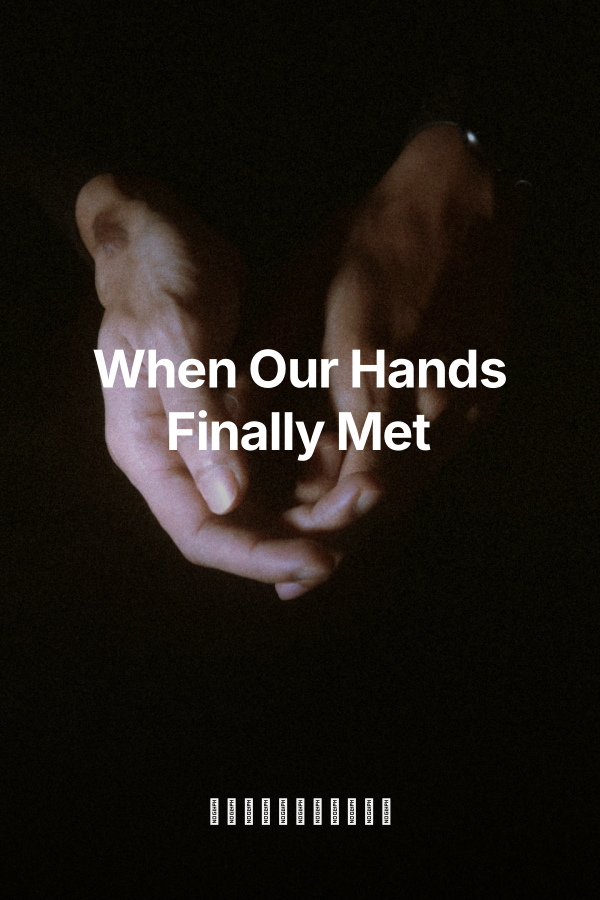
"When Our Hands Finally Met" is an intimate, emotionally charged romance about two people who are done with illusions and ready for truth. It captures the dizzy thrill of first attraction, the aching vulnerability of deepening trust, and the quiet, luminous joy of building a love durable enough to hold both passion and fear.
At its heart, the book is about this: the way two entwined hands can feel like the bravest act in the world. The way a simple touch can say I am here, I am not running, I am choosing you, again and again.
This is not a story about perfect love. It is a story about real love, with all its late night arguments, soft apologies, trembling first steps, and the fierce tenderness of two people who decide that, this time, they will not let go.