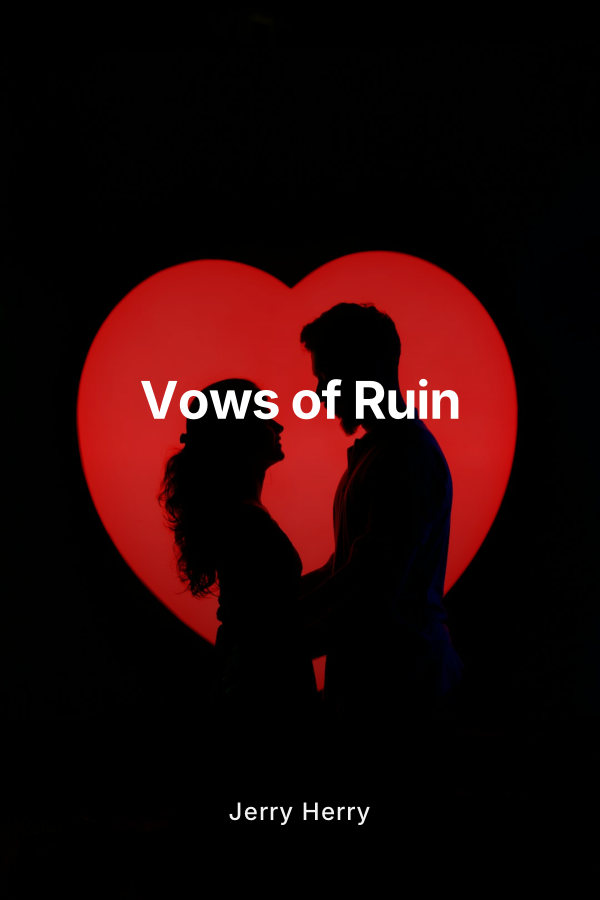
Vows of Ruin is a dark, intensely character driven contemporary romance about a woman who marries one brother to destroy the other, only to find herself trapped in a house where every wall remembers the man who broke her and the girl she used to be. It is a story of weaponized vows, forbidden obsession, and the slow, corrosive price of building a life on revenge.
At its core is Yn, a heroine who walks down the aisle already haunted, her wedding less a promise of forever than a strategic strike. She chooses Taehyung, the gentle younger brother, not because her past with Jungkook means nothing, but because it means too much. She wants safety after humiliation, medicine after poison, a man who looks at her like she hung a second sun in his sky instead of a storm that keeps demanding worship. Yet even as she kisses her new husband for the cameras, Yn is aware of Jungkook in the third row, his jaw locked, his stare a bruise across the distance. Her marriage certificate is inked over older scars.
The novel unspools in a single house that functions like a pressure cooker. After the wedding, Yn and Taehyung move into what used to be Jungkook’s space, a home saturated with memories of an old relationship that detonated the night she found another girl in their living room. That original betrayal reframes everything: the couch where she and Jungkook once planned a future becomes the crime scene where she left her key and her tears. The house she later shares with Taehyung is Jungkook’s old territory, given up “like a good brother” so that he can stay inside their lives as a resident ghost. Thin walls and shared hallways force everyone into constant proximity, turning daily rituals into psychological warfare.
Structured in tight, alternating points of view, Vows of Ruin lets the reader live simultaneously inside Yn’s granite refusal and Jungkook’s feral, unrepentant obsession. Yn frames her marriage as an act of survival and retribution. Taehyung is the good man she chose when she finally decided she was done loving storm fronts. He is safety, steadiness, a lover who listens and treats her body like something to cherish rather than conquer. In his arms she finds quiet, slow burning desire instead of Jungkook’s frantic edge. She intends to build something clean with him on the ruins of what Jungkook shattered.
Jungkook, in contrast, refuses the narrative of a “one time mistake” neatly repented. He is the golden son turned disgrace, a man who understands exactly how despicable he looks yet clings to his obsession with a stubbornness that borders on self destruction. The text never sanitizes him: he stages scenes, drags other women through the house so Yn will hear them, pushes boundaries in dark hallways because hatred from her is preferable to indifference. He accepts every label his family hurls at him but rejects the one outcome he finds intolerable: a future where she passes him in the kitchen like a stranger.
The central conflict is not simply a love triangle; it is a sustained, private war about ownership, memory, and identity. Jungkook is convinced that no one else has ever gotten the same version of Yn that he did, the girl who once told him to keep going even when it hurt, trusting him with both her body and her fear. He treats that history as a claim. Yn refuses this idea with a vengeance. For her, that girl died in the rain outside his building. He can keep her ruin; the rest, she vows, belongs to herself.
Every chapter sharpens this clash. Domestic scenes constantly double as battlefields. Jungkook listens through the bathroom wall as Yn chokes out Taehyung’s name, understanding that she is not just having sex with her husband but performing a message for him. She weaponizes intimacy, turning the sounds of her pleasure into knives. In response, he escalates: late night confrontations in unlit corridors, dangerous proximity that banks on muscle memory, low voiced taunts about the way she still gasps, the way her body remembers even when her mind spits that she hates him.
Yet the book refuses to give either of them an easy out. Yn’s hatred is not clean. It is threaded with desire, with the knowledge that Jungkook is not wrong about the specific burn of their chemistry. A drunken night on the couch ends with a kiss that both of them understand as a crack in the wall, not a reconciliation. She insists it was a mercy killing, a way to shut him up. He files it away as proof that nothing between them has truly died. The narrative lingers in that contradiction, forcing the reader to sit with the discomfort of a heroine who can mean every word of “I hate you” while her pulse hammers for the man she is determined never to forgive.
Around them, the family watches the mask of normalcy fray. Vows of Ruin devotes significant weight to the older generation, not as comic relief but as a Greek chorus of complicity and belated outrage. A climactic dinner scene finally detonates the polite silence: Jungkook’s open admission that he still wants his brother’s wife shatters his father’s patience and his mother’s denial. The study fills with the sound of Mr. Jeon’s fury as he calls his eldest son selfish, pathetic, sick, spelling out the truth everyone has been stepping around. “She is not some prize for you to snatch back,” he says. “She is a person. With a ring on her finger that you put there by losing her.”
Outside that room, the rest of the family sits at the dining table like trapped spectators. Grandma, sharp and unflinching, refuses the instinct to look away. She insists that Yn deserves to see every ugly piece, that the younger woman needs a clear picture of the family she married into. This intergenerational gaze complicates the moral landscape. They condemn Jungkook but also quietly hope Yn will help them tamp down the bomb he has become: forgive, move out, de escalate. Yn’s answer is chillingly simple. She is moving on with Taehyung, that is all. She will not offer her own forgiveness as everyone’s convenient exit ramp.
Taehyung himself is portrayed with nuance that makes the triangle cut deeper. He is not a fool. He knows his brother broke Yn before he ever placed a ring on her finger. He recognizes that this house was once Jungkook’s, that some of the tension they live inside is structural. When he finds out just how far Jungkook has gone cornering his wife, his easy warmth flares into steel. He promises to choose her every time, even if that means going to war with the brother he grew up idolizing. His loyalty is real, his love steady, which is precisely what makes Yn’s internal conflict so biting. She is not torn between a safe man she does not truly love and an obsessive ex who still owns her heart; she loves Taehyung, too, and that fact does not magically erase the gravitational pull of Jungkook.
The book’s emotional engine lies in Yn’s realization that revenge has not set her free. Marrying Taehyung hurts Jungkook. Living in his old room, letting his brother learn every pitch of her pleasure through thin walls, hurts him even more. She knows this, uses it, tells herself it is justice every time she hears a muffled thud in the hallway or catches a flash of Jungkook’s face when she calls her husband’s name. But the longer she maintains this performance, the more she sees what it costs her: chronic hyper vigilance, a body that hums with adrenaline whenever she senses Jungkook nearby, a version of herself who exists entirely in opposition to a man she swears she will never go back to.
Jungkook’s trajectory is equally unforgiving. He begins as a man convinced that one catastrophic mistake should not erase years of love. As the story unfolds, that conviction decays into something darker. Each boundary Yn asserts becomes a challenge. When she tells him he does not own her sounds or her image, he focuses on the one thing she cannot take back from him: their history. In private, he admits that other people’s disgust, even his father cutting him off, will not scare him straight. He has already burned his reputation and her trust. If ruin is all that is left to him, he will learn how to live inside it.
Throughout, the house itself functions as a living metaphor. Old beams groan under the weight of secrets. Bathrooms, stairwells, and doorways become recurring stages where memory and present crash into each other. This constant spatial repetition gives the story a claustrophobic intensity. Every scene feels like a variation on the same question: who owns this space, this memory, this version of Yn? When Jungkook corners her in a dark hallway, hand braced beside her head, the novel makes the reader feel every layer at once, from the thrill she once felt in that same spot to her current resolve to never give him the satisfaction of seeing her beg.
By the time the narrative reaches the point implied in the premise where Yn crosses the line she swore she never would, the groundwork has been meticulously laid. The affair with Jungkook is not framed as a random slip, nor as a purely romantic inevitability. It is the catastrophic result of a prolonged siege, of two people circling each other in a house built out of shared history and sharpened pain. Yn’s guilt is not performative; she understands exactly what she is doing to Taehyung, to herself, to whatever remained of her claim to moral high ground. At the same time, the text honors the brutal honesty of what she feels in Jungkook’s arms: that he knows a version of her no one else has touched, that part of her still believes she belongs to the boy who first taught her how to burn.
Thematically, Vows of Ruin interrogates the stories people tell themselves about love and punishment. It asks whether revenge can ever deliver the clean closure it promises, or whether it simply binds you tighter to the person you are trying to escape. It explores the difference between being someone’s miracle and being their mirror, the way Jungkook once used Yn to reflect back the version of himself he most wanted to see, and how she now uses Taehyung as proof that she can be loved in softer, healthier ways. It also refuses to let the reader tidy any of this up with platitudes about forgiveness. There is no guarantee of redemption here, for anyone.
For readers who crave morally messy, high tension romance, Vows of Ruin offers an unflinching look at what happens when you try to heal betrayal with performance instead of truth. It is intentionally uncomfortable, steeped in obsession, shame, and the aching tenderness of a good man caught in a war he never asked for. The book does not excuse cheating or cruelty, but it also does not pretend desire and history can be shut off like a tap just because a ring changes hands.
In the end, Vows of Ruin is not just about which brother Yn chooses. It is about whether she can ever fully choose herself while she is still living inside the echo chamber of Jungkook’s house and Jungkook’s gaze. It is about the cost of clinging to ruin as proof that you were once loved deeply, and the terrifying possibility that the only way to survive is to let that ruin go, even if it means becoming someone you no longer recognize.
The book closes not with neat reconciliation, but with the hard, luminous question it has been circling from the first line: when love has been twisted into war, is there any path forward that does not require you to betray someone, including the version of yourself you swore you would never abandon?