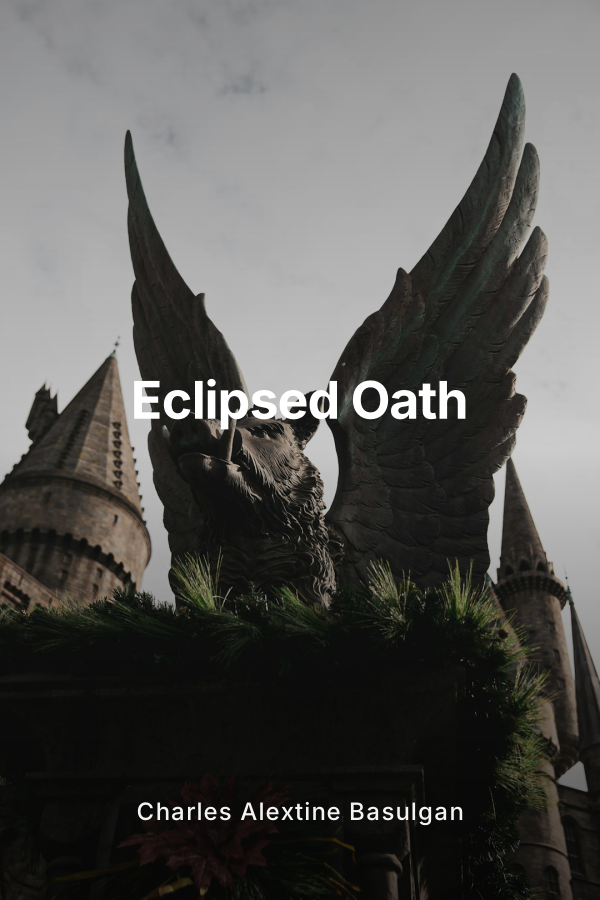
In a world that has already celebrated its victory and buried its heroes, an immortal archmage walks beneath quiet skies that should not hold storms anymore.
Decades ago Lucien Ardent ended the age of terror by defeating the Demon Sovereign, an entity whose power warped desire, eroded meaning, and pulled whole civilizations toward emptiness and decay. The bards sing of that final battle as a clean conclusion. The world teaches that the Sovereign died. Lucien knows the cost in lives, in promises, in the silent absence of the companions who should have stood at his side for centuries more. What he does not know is that the story of that victory is a lie built on a choice he can no longer remember.
Eclipsed Oath is an epic fantasy about memory sharpened into magic, grief stretched across immortality, and a cosmic force that resurfaces through storms and fractures in the sky. Its heart is not romance but companionship, legacy, and the quiet bonds that form between an ageless legend and the mortals determined to stand beside him.
At the center stands Lucien Ardent: eternally youthful, silent, and feared. To most of the living, his name is a story inherited from grandparents and textbooks. His face is not. Innkeepers look past him, guards question his papers, apprentices give him the cheap rooms. Yet the moment someone hears his name and realizes that this unassuming stranger is the Lucien Ardent, awe reshapes their features. Veterans straighten as if under command. Old mages raise trembling hands in wordless salutes. Once-forgotten memories crash back in, and with them the knowledge that the world should not have survived.
Lucien carries that weight like a second spine. His magic is Echo Magic, a discipline that carves power from memory. Every spell is a recollection turned outward, the past cast like a blade. He can kindle shields from nights spent around a campfire with the dead, summon storms from the terror of a city under siege, or forge spears of light from the moment he first swore to protect his companions. The more vivid the memory, the more devastating the spell, but every casting pulls at the recollection, threatening to dull the faces and voices that define who he is.
Alongside Echo stand two other pillars of magic. Sigilcraft etches power into air, stone, and skin for brutal, immediate effect. Sovereign Fragments are demonic cores that offer overwhelming strength while quietly corroding what makes a person human. The Demon Sovereign did not fall. It shattered itself, embedding its essence into scattered cores and into the hearts of the very heroes who sealed it. Each fragment is a seed of entropy, a knot of alien will that incites endless wanting, numbs satisfaction, and dissolves the structures that give life meaning.
The Sovereign itself is not a villain with a face but an impersonal, almost unknowable principle. It rarely speaks, and when it does, it is through tempests, distortions in the sky, or hollow whispers trapped inside fragments. It can be faintly understood as the embodied hunger of the universe: the pressure toward consumption, decay, and the erasure of attachment. It pushes against memory and connection, making lasting bonds feel fragile and costly. Where its fragments take root, people lose the capacity to feel joy, love, or purpose unless they chase more power, more control, more of anything to fill the growing void.
When the story opens, Lucien is attending the last funeral he ever meant to outlive. The final member of his legendary party has died, leaving him alone as the only survivor of that age. The world marks the passing with ceremony and songs. Lucien marks it with silence and a single unfinished spell left behind by his best friend, a man he never found the courage to tell, plainly, how much he mattered. That unresolved confession is a wound that never healed, a thread of regret tied to an incantation no one but Lucien can decipher.
On his journey home, the sky breaks.
A magical storm descends on a village the heroes once saved. Lightning does not just burn; it recites fragments of ancient battle-orders. Rain falls in patterns that mirror the sigils Lucien carved into the air decades ago. The catastrophe feels like the past replaying itself, more memory than weather. Lucien intervenes and reveals the terrifying extent of his power, tearing reality open with Echo Magic and Sigilcraft that reshape the battlefield in one breath. To the villagers, he looks like a god. To himself, he feels like a man stepping into footprints he never meant to repeat.
This is the first fragment outbreak. As Lucien studies the residual magic, he finds something impossible. The storm’s core carries the exact signature of his dead best friend, the same cadence of spellwork, the same emotional contours. Someone or something is reconstructing battles from his past and using the fallen as blueprints.
Magical disasters begin appearing across the continent, each one precisely mapped onto a location where Lucien’s party once fought the Sovereign. Towns that were once sites of triumph become epicenters of twisted storms. In one, citizens keep building an unfinished tower without knowing why, driven by compulsion rather than purpose. In another, a coastal city forgets its festivals, its stories, even the names of streets and districts; people go through motions of daily life stripped of meaning, like echoes with nothing to return to. The pattern is clear: someone is collecting Sovereign Fragments, and the world is slowly sliding into a state where nothing truly matters.
Lucien cannot face this alone. Reluctantly, he accepts new companions.
Kael is a young combat mage who grew up on half-true legends of Lucien Ardent. He idolizes the archmage yet fears he will never rise above mediocrity. His magic burns hot and bright but lacks refined control. To travel beside his childhood hero is at once a dream and a crushing expectation. He watches Lucien’s measured, devastating command of Echo Magic and sees only distance between them. Still, he is determined to learn and to prove himself worthy of the stories that shaped his childhood.
Seraphine is a former knight whose village was destroyed in an earlier, misdiagnosed fragment outbreak. Official records called it a wild surge of uncontrolled magic. She knows better. She carries a blade marked with sigils that never entirely cool and an unwavering moral compass honed by survivor’s guilt. Seraphine does not revere Lucien as a saint; she respects the man who made impossible choices and now bears their aftermath in silence, and she refuses to let him shoulder it alone.
Dain is a rogue scholar and practitioner of forbidden arts, moving along the seams between legitimate academia and outlawed occult circles. He has studied the Sovereign’s remnants for years and knows more about fragments than anyone alive, including Lucien. Dain approaches their mission with dry wit, sharp insight, and a gaze that always seems to be measuring costs the others have not yet realized they will pay. He is the one who first hints that the Sovereign’s fall was never as simple as the world believes.
Together they become a new party, though Lucien refuses to name them as such. His near-sacred loyalty to his dead companions turns into a quiet, distorted lens through which he views the newcomers. He projects old roles onto them unconsciously. Kael reminds him of the best friend he lost. Seraphine echoes the fallen knight whose courage once steadied him. Dain’s dry humor and ruthless logic resonate with another comrade long buried. At first, this projection keeps Lucien distant, always a step removed, preserving his vow that no one will ever again bear the cost he and his friends paid.
Yet the journey wears down his walls. Through shared camps under broken skies, late-night watch rotations, and small conversations that edge around grief rather than entering it directly, Lucien begins to see his new companions as themselves. The change is not immediate. It is built from countless small realizations: Kael’s different laugh, Seraphine’s distinct sense of justice, Dain’s own style of calculated risk. Eventually, these quiet shifts culminate in a breaking point when one of them confronts him about the way he keeps speaking to ghosts instead of to the living, forcing him to admit that his loyalty to the dead has been hurting the people still at his side.
The emotional spine of the story is not a romance but the bonds that form between these four, with particular focus on Lucien’s reluctant, evolving mentorship of Kael and his unyielding, complicated dedication to the memory of his lost party. The three younger members admire him more, not less, as they witness his scars and his restraint. Their admiration manifests as fierce, protective loyalty. They disobey his attempts at self-sacrifice, step between him and harm, and quietly scheme to keep him alive even when he treats himself as expendable. Over time, Lucien finds himself surrounded by people willing to defy him precisely because they refuse to lose him.
As the outbreaks intensify, the nature of the Sovereign’s fragments becomes clearer. Each fragment does more than twist magic. It erodes inner life.
People touched by fragments experience a creeping numbness. Joy becomes effortful. Love feels distant, like a story remembered rather than a feeling lived. Purpose leaches away, replaced by a restless, unsatisfied urge that can only be pushed aside by acquiring more power, more wealth, more anything. Yet every acquisition feels hollow almost instantly. This subtle emptiness terrifies Lucien more than overt madness. It is oblivion by degrees.
Eventually, Lucien discovers the truth hiding beneath his own missing memories. The Demon Sovereign did not fall screaming into the void at their hands. It chose to fracture itself, to seed its essence into the hearts of its greatest enemies. The original party used themselves as living vaults, anchors of human memory and attachment that could contain a force devoted to devouring both. Lucien volunteered to bear the largest fragment. To make that possible, he allowed his best friend to weave an unfinished spell around his very identity, erasing his recollections of the act and sealing away the full nature of the burden he carried.
The incomplete incantation his friend left behind was meant to free him one day, if the world no longer needed the fragment. But if that spell is finished and the seal is broken prematurely, the Sovereign’s power may flood the world unbound. Lucien’s forgotten choice returns as a dilemma. By retrieving the missing pieces of his memory, he risks unmaking the prison that has kept the cosmos from collapsing into unending hunger.
Meanwhile, each time Lucien overuses the fragment within him to quell another disaster, he feels his own ability to care falter. Moments that once would have torn him open leave him eerily calm. He notices that some memories no longer stir emotion when he calls upon them for Echo Magic. The most terrifying episodes reveal him operating with perfect logic and overwhelming power, but no visible humanity, as if the Sovereign’s principle were using his body as a clear channel. Kael is the first to notice the empty smile that does not reach Lucien’s eyes. Seraphine tests him with small rituals they have shared on the road. Dain quietly records the correlation between Lucien’s emotional numbness and the surging potency of his spells.
The story builds through four major arcs. In the opening, Ashes That Still Glow, the funeral of the last hero and the first fragment outbreak reawaken a world that believed itself healed. Lucien’s overwhelming display of magic and the revelation that the storm echoed his best friend’s spellwork set the tone for a narrative where every victory casts a longer shadow.
Stormfields shifts the narrative into an action-heavy core. Fragment monsters arise, landscapes warp, and Lucien’s new party faces war-scale threats at city walls and within collapsing fortresses. A pivotal battle sees Seraphine nearly die, forcing Lucien to draw recklessly on the Sovereign fragment inside himself to save her and the city. He briefly loses control, the sky reflecting his inner fracture in a convergence of unnatural constellations and black rain. For the first time in decades, he cries, and Kael witnesses the collapse of the legend into a human being who is terrified of what he is becoming.
In The Forgotten Seal, mystery overtakes spectacle. Through forbidden archives, rituals that let them walk through memories as physical spaces, and confrontations with other fragment-bearers whose personalities have nearly dissolved, the party unravels the history the world never knew. They learn of the Sovereign’s voluntary shattering, the heroes’ choice to serve as living seals, and the role Lucien’s erased consent played in anchoring the greatest fragment. The unfinished spell left by his best friend is finally understood for what it is: a key without a lock, an attempt to give Lucien back his life that came too late to be completed safely.
Eclipsed Oath, the final arc, brings the full scale of war back into focus. Outbreaks converge, storms overlap until whole regions exist within zones of distorted time and memory. The Sovereign’s fragmented will, though still impersonal, is felt in every hollowed face and every town that forgets why it exists. Lucien reaches the point where he must decide between two catastrophic options. He can erase his memories entirely, using the last and most dangerous variant of Echo Magic to strip himself down to a vessel of raw magical structure. Without memories, there would be nothing for the Sovereign’s principle to devour. The fragment inside him would implode, taking his identity and perhaps the entity’s largest anchor with it. The cost would be the erasure of every bond he has ever valued.
Or he can choose to keep his memories, hold tight to the love, regret, and loyalty that define him, and risk becoming the next manifestation of the Demon Sovereign. His very attachment, the strength of his Echo Magic and his enduring grief, make him the perfect host for a force that wants to break all bonds. The choice is not between life and death but between a world saved by forgetting and a world endangered by remembrance.
Lucien chooses memory.
He does so not out of naivety or selfishness but out of a hard-earned conviction that a victory purchased by the erasure of who they were would be the truest form of defeat. Throughout the story, the Sovereign’s power is associated with emptiness, with the dissolution of meaning and the corrosion of attachment. To answer that with self-inflicted absence would be to echo its nature, not oppose it. Lucien decides that if the world is to move forward, it must do so with its scars intact.
The final battle is as much metaphysical as physical. The sky becomes a memory-built battlefield where Echo Magic, Sigilcraft, and fragment power collide. Lucien and his companions face storms that replay the worst nights of the last war, landscapes that dissolve into half-remembered cities, and enemies driven not by malice but by the void gnawing at their capacity to care. The Sovereign never manifests as a single figure; instead, it appears as patterns in lightning, questions whispered through the mouths of those who have lost themselves, and the tug toward surrender that stirs whenever Lucien hesitates.
Kael, Seraphine, and Dain become more than mere supports in this climax. Their protective loyalty translates into concrete defiance. Kael physically blocks a spell that would have consumed Lucien’s mind to annihilate the fragment. Seraphine drags him back from a battlefield he hoped would be his last, refusing to let him define redemption as solitary martyrdom. Dain activates hidden safeguards woven into their strategies, ensuring that if the fragment erupts, it will be contained, not unleashed. Together, they embody the counterargument to the Sovereign’s principle: that meaning endures where people choose one another, even when the cost is fear and grief.
In the aftermath, the world is not restored to a pristine state. Some towns remain hollowed, their cultures needing generations to regrow. Some fragment-touched survivors will never feel fully whole. Lucien himself carries the lingering risk of relapse every time he reaches for Echo Magic that has been sharpened by the Sovereign’s shadow. But the core threat has been broken. The largest fragment is no longer a silent star lodged in his chest but a scar in the fabric of magic, monitored and contained by those who understand its nature.
The book closes not with a coronation or a monument but with a quiet scene by a campfire reminiscent of those that began Lucien’s journey. He sits with Kael beneath a repaired, if imperfect, sky. Firelight glints off sigils etched into stone. Lucien teaches Kael a spell once taught to him long ago, guiding the younger mage’s hands through the motions of Echo Magic that draws on memory without being devoured by it. In the warmth of that small circle of light, the world feels less like a place saved and more like a place choosing, night after night, to remember.
Eclipsed Oath promises a five-part epic of around ten thousand words in this telling, structured to balance reflective, time-soaked atmosphere with battles that crack the sky. Each chapter will deepen the world’s history and the logic of its magic, while preserving the intimate focus on an immortal archmage learning, slowly and painfully, how to live rather than merely endure. The storms are vast, the power overwhelming, but the story’s truest violence and grace occur in moments when a hand is placed on a shoulder, when a name is spoken correctly after years of silence, when someone refuses to let another walk alone into the dark.